
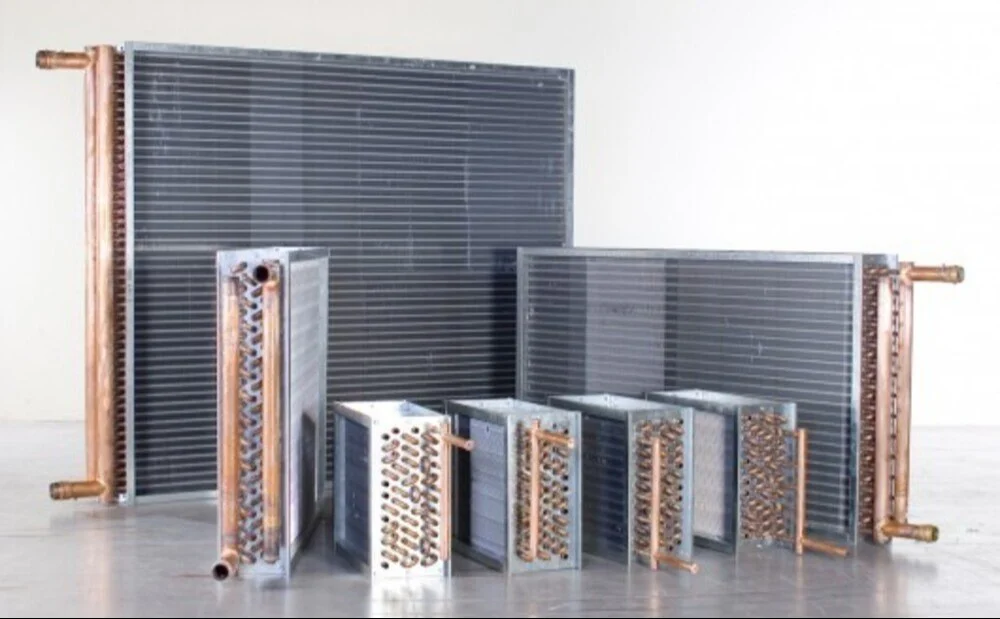
In an HVAC system, cooling is not just about lowering temperatures; it’s about controlling and rejecting unwanted heat. In air-cooled chillers, that vital task is handled by the condenser coil — a core component that quietly ensures the entire system performs efficiently.
While the compressor circulates refrigerant and the evaporator absorbs heat from the process, it is the condenser coil that completes the cycle, expelling the absorbed heat into the atmosphere. A poorly performing condenser coil doesn’t just lower system efficiency — it increases energy costs, shortens equipment life, and can even cause system failures during peak summer months. Whether you’re designing for an office building in Mumbai, a data center in Dubai, or a pharmaceutical plant in Pune, the quality, design, and maintenance of the condenser coil determine the system’s long-term reliability.
How the Condenser Coil Works
- The hot, high-pressure refrigerant gas enters the condenser coil from the compressor.
- Ambient air is forced over the coil using axial fans.
- The refrigerant releases its heat to the air, condensing into a high-pressure liquid.
- This liquid then flows to the expansion valve and evaporator to continue the cycle.
In-Depth: Unique and Advanced Insights
Microchannel Technology: Smaller, Smarter, Stronger
- Microchannel condenser coils use flat aluminum tubes with multiple small channels, greatly enhancing heat exchange efficiency.
- Benefits include:
- 30–50% smaller footprint
- Reduced refrigerant charge
- Improved durability against vibration
- Used widely in modular chillers, rooftop units, and compact industrial systems.
Corrosion-Resistant Coatings for Coastal and Industrial Zones
- In coastal cities like Chennai or Vizag, salt-laden air can corrode coils rapidly.
- Special coatings used:
- E-coat (ElectroFin): Provides uniform coverage, even in hard-to-reach areas.
- Blygold and Heresite coatings: Ideal for chemical and petrochemical industries.
- These coatings protect coils from:
- Galvanic corrosion
- Acidic gases
- Particulate pollutants
EC Fans with Smart Airflow Control
- Advanced air-cooled chillers pair condenser coils with EC (electronically commutated) fans.
- These fans dynamically adjust speed based on:
- Outdoor ambient temperature
- Refrigerant pressure
- Load demand
- Result: Lower noise, extended coil life, and 25–60% power savings.
Fin Density Optimization Based on Climate
- In dry, dust-prone environments like Rajasthan, wider fin spacing (e.g., 8–10 FPI) is preferred to avoid clogging.
- In clean, controlled climates (labs or tech parks), higher fin density (14–20 FPI) is acceptable for compact, high-capacity units.
- Some chillers feature hybrid coils with multi-zone fin densities for balanced performance.
Anti-Fouling & Self-Cleaning Coil Designs
- Coils can accumulate debris, reducing airflow and raising energy use.
- Hydrophobic coatings and nano-ceramic layers reduce dirt adhesion.
- Some systems now integrate:
- Reverse fan rotation cycles for dust blow-off
- Self-rinsing sprays that activate during coil cleaning schedules
Design Considerations in Coil Selection
- Altitude: At higher elevations, thinner air reduces cooling capacity. Coil size must be increased.
- Noise Constraints: Larger coils can reduce the need for fan power, leading to quieter systems.
- Footprint Restrictions: Microchannel coils help reduce horizontal space usage.
- Energy Efficiency Goals: Lower condensing temperatures = better efficiency. Larger or enhanced coils support this.
Advanced Testing and Engineering Validation
Modern condenser coils undergo:
- Finite Element Analysis (FEA) to ensure mechanical strength under pressure cycling.
- Salt Spray Testing (ASTM B117) for corrosion resistance.
- Heat transfer simulations (CFD) to validate airflow and turbulence across coil faces.
Future Trends in Condenser Coil Design
- Smart Coils with embedded temperature and pressure sensors
- Additive-manufactured coil geometries for precise thermal performance
- Recyclable materials for sustainable product life cycles
- Passive phase-change coatings that absorb heat spikes without power