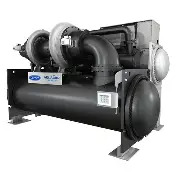
Centrifugal chillers are the heavy lifters of the HVAC world, typically found in large-scale commercial buildings and industrial facilities. To help you rank for this topic, I’ve structured this content to hit the primary keywords while providing genuine value to engineers and facility managers.
What is a Centrifugal Chiller?
A centrifugal chiller is a vapor-compression refrigeration system that uses a centrifugal compressor to move refrigerant through the cooling cycle. Unlike reciprocating or scroll compressors that use positive displacement, centrifugal chillers use dynamic compression.
By converting kinetic energy into static pressure, these units are incredibly efficient at handling high-volume cooling loads, making them the gold standard for skyscrapers, hospitals, and university campuses.
Shutterstock
Explore
How It Works: The Cooling Cycle
- The Compressor: The heart of the system. An impeller spins at high speeds, drawing in refrigerant vapor and throwing it outward using centrifugal force.
- The Condenser: The high-pressure vapor travels to the condenser, where heat is rejected (usually to a cooling tower water loop), turning the gas back into a liquid.
- The Expansion Valve: The liquid refrigerant passes through a metering device, dropping its pressure and temperature.
- The Evaporator: The cold refrigerant absorbs heat from the building’s “chilled water” loop. This chilled water is then pumped throughout the facility to provide air conditioning.
Key Benefits of Centrifugal Technology
- High Energy Efficiency: Especially at full load, centrifugal units often boast the lowest operating costs per ton of cooling.
- Reliability: With fewer moving parts than reciprocating compressors, these systems often have a lifespan of 20 to 30 years with proper maintenance.
- Compact Footprint: They provide a massive amount of cooling capacity (often 200 to 3,000+ tons) relative to their physical size.
- Sustainability: Modern units are designed for low-GWP (Global Warming Potential) refrigerants, helping buildings meet LEED certification standards.
Maintenance and Efficiency Tips
To keep a centrifugal chiller running at peak performance, consider these SEO-critical “best practices”:
| Task | Frequency | Benefit |
| Oil Analysis | Annually | Detects internal wear before a breakdown occurs. |
| Tube Cleaning | Seasonal | Removes scale buildup to maintain heat transfer efficiency. |
| Refrigerant Leak Check | Quarterly | Ensures the system stays charged and prevents environmental impact. |
| VFD Implementation | Once | Adding a Variable Frequency Drive can save up to 30% on energy costs. |
Choosing the Right Centrifugal Chiller
When selecting a unit, it isn’t just about the “tonnage.” You must consider:
- Turndown Capability: How well the chiller performs at “part-load” (e.g., a cool day when you don’t need 100% power).
- Water-Cooled vs. Air-Cooled: Most centrifugal units are water-cooled due to the massive heat rejection required.
- Oil-Free Options: Magnetic bearing (mag-bearing) chillers eliminate oil management entirely, reducing friction and maintenance costs.