
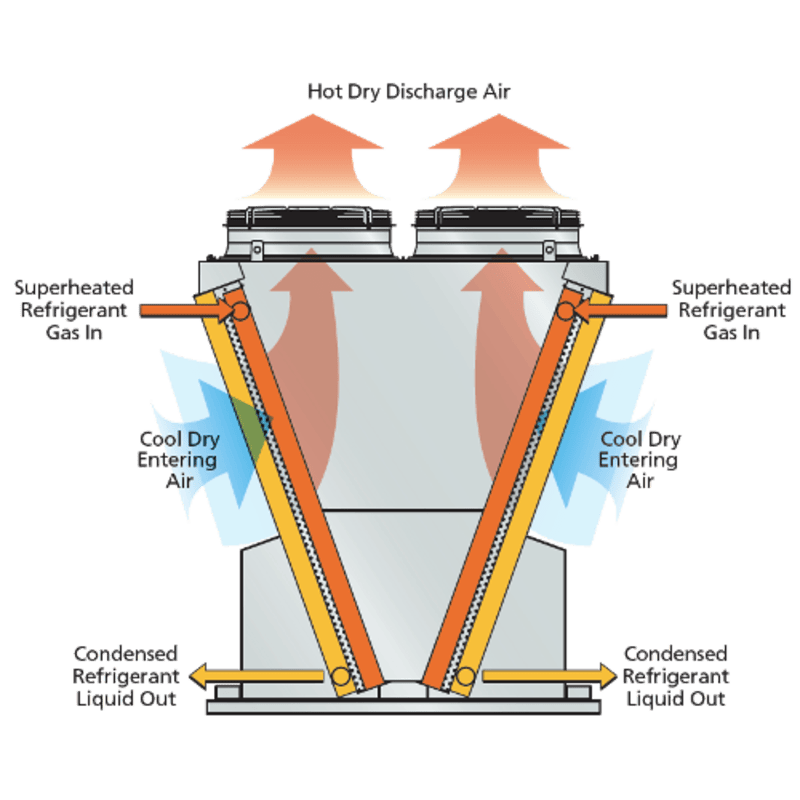
Dry cooling towers are essential in industrial applications where water conservation is crucial, such as in power plants, chemical processing units, and refineries. Unlike wet cooling towers, they do not rely on water evaporation to dissipate heat. Instead, dry cooling towers use air-cooled finned tubes to transfer heat from hot process fluid to the ambient air.
But what makes a dry cooling tower work effectively? It’s the combination of carefully engineered components, each playing a vital role in the thermal performance, structural integrity, and operational efficiency of the tower.
In this blog, we’ll break down the core components of a dry cooling tower, explaining their functions, importance, and the role they play in overall system performance.
Major Components of Dry Cooling Towers
Heat Exchanger (Air-Cooled Finned Tubes)
This is the heart of a dry cooling tower. The heat exchanger is usually made of finned tube bundles, typically of copper, aluminum, or stainless steel, designed to provide a large surface area for air-to-fluid heat transfer.
Function:
- Transfers heat from the process fluid (e.g., water, oil, or other industrial liquids) to the air without direct contact or evaporation.
Key Features:
- Available in different fin geometries (circular, rectangular)
- Can handle high temperatures and pressures
- Critical for thermal efficiency
Benefits:
- No water consumption
- Low scaling and corrosion
- Highly durable and energy-efficient
Fans (Axial or Centrifugal)
Fans play a crucial role in moving ambient air over the finned tubes, enhancing heat rejection by increasing airflow. Depending on the tower size and design, fans may be forced-draft (pushing air) or induced-draft (pulling air).
Function:
- Ensures proper airflow across the heat exchanger
- Maintains the temperature differential needed for heat transfer
Types:
- Axial fans (common in large dry towers)
- Centrifugal fans (used in smaller or enclosed systems)
Benefits:
- Improved airflow control
- Adjustable fan speed for energy savings (with VFD)
- Designed for low-noise and high-efficiency operation
Fan Drive System (Motors & Gearboxes)
The fan drive system consists of electric motors, gearboxes, and sometimes belt drives or direct drives, depending on tower design.
Function:
- Powers the fan to maintain desired airflow
- Often equipped with Variable Frequency Drives (VFD) for energy efficiency
Key Considerations:
- Energy consumption
- Maintenance access
- Vibration control and alignment
Benefits:
- Precise airflow modulation
- Reduced wear and tear on fan components
- Helps in reducing operational cost
Air Inlet Louvers (Optional in Some Designs)
These are protective barriers placed at the air entry points to prevent the ingress of debris, insects, or snow, and to streamline the airflow.
Function:
- Controls the amount and direction of air entering the tower
- Acts as a filter and structural support
Benefits:
- Clean internal airflow path
- Enhances fan efficiency
- Prevents clogging of finned tubes
Plenum Chamber
The plenum is the air distribution chamber located between the fan and the heat exchanger. It helps evenly distribute airflow across the entire heat exchanger surface.
Function:
- Ensures consistent air delivery over all finned tubes
- Reduces hotspots and enhances heat rejection
Benefits:
- Uniform cooling performance
- Stable pressure and airflow balance
- Reduces thermal stress
Casing / Structural Frame
The casing is the external skeleton of the dry cooling tower. Made of galvanized steel, stainless steel, FRP, or aluminum, it supports all major components and protects them from the environment.
Function:
- Provides mechanical support and housing for internal components
- Protects system from weather, impact, and external contaminants
Benefits:
- Durable and corrosion-resistant materials ensure longevity
- Modular design makes installation easier
- Can be designed to withstand high wind and seismic loads
Advanced Dry Cooling Systems
- Sound Attenuators: Reduce noise levels in urban or sensitive areas.
- Anti-Vibration Mounts: Provide additional vibration protection for rooftop units.
- Fog Prevention Systems: Prevent condensation on heat exchanger surfaces in colder climates.
Understanding the components of a dry cooling tower is essential for proper selection, design, operation, and maintenance. Each part—be it the finned tube heat exchanger, the high-efficiency fan system, or the robust casing—plays a specific role in optimizing performance, extending service life, and reducing operational costs.
Whether you’re planning a new installation or maintaining an existing one, knowledge of these components can help you make smarter decisions and ensure the long-term reliability and sustainability of your cooling system.