
In modern industrial operations, where precision, reliability, and productivity are crucial, maintaining the right hydraulic oil temperature is not just a best practice—it’s a necessity. Whether in CNC machinery, injection molding, presses, or power packs, the performance of hydraulic systems is heavily influenced by how effectively the hydraulic oil is cooled.
This is where Hydraulic Oil Chillers step in. These specialized refrigeration units are engineered to remove excess heat from hydraulic oil, thereby maintaining its viscosity, chemical stability, and lubrication properties. An overheated hydraulic system can lead to oil degradation, seal damage, component warping, and system shutdowns. Thus, a hydraulic oil chiller not only improves operational efficiency but also extends the life of both the oil and the equipment.
Compressor – The Heart of Refrigeration Cycle
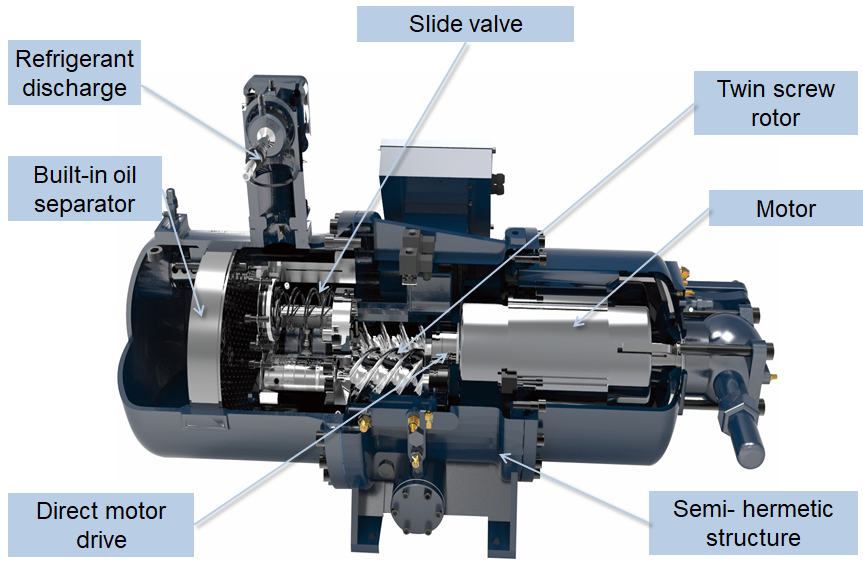
The compressor compresses the low-pressure refrigerant gas from the evaporator into a high-pressure, high-temperature gas. It essentially kickstarts the refrigeration cycle by increasing the refrigerant’s energy state.
- In hydraulic oil chillers, scroll or rotary compressors are commonly used because they provide silent and vibration-free operation, which is important in high-precision environments.
- Some systems use semi-hermetic compressors for ease of maintenance and long service life.
- Modern compressors may be equipped with VFDs (Variable Frequency Drives) for energy-efficient speed modulation based on oil temperature demand.
Condenser – Heat Discharge Unit
The condenser cools the hot refrigerant gas and converts it into a high-pressure liquid by releasing heat to the ambient air (air-cooled) or to water (water-cooled).
- Air-cooled condensers are fitted with aluminum fins and copper tubes for better heat conduction and corrosion resistance.
- Water-cooled condensers are used in closed-loop systems to ensure stable performance in dusty or hot environments.
- Anti-fouling coatings and wide fin spacing are design innovations used to prevent clogging in industrial zones with high particulate matter.
Expansion Valve – Flow Regulation Element
The expansion valve controls the amount of refrigerant entering the evaporator by reducing its pressure, which allows it to absorb heat effectively.
- Traditional systems use thermal expansion valves (TXVs), but modern hydraulic chillers use electronic expansion valves (EEVs) for better flow control and faster response.
- EEVs can adjust refrigerant flow in real-time, helping to maintain precise oil temperature even during load variation, reducing cycle stress.
Evaporator / Oil Cooler – The Core Heat Exchanger
This is the point where the refrigerant absorbs heat from the hydraulic oil, cooling it down. The refrigerant evaporates here and returns to the compressor.
- Shell-and-tube or brazed plate evaporators are preferred for hydraulic oil due to their high-pressure tolerance and easy maintenance.
- The internal surfaces are often engineered with turbulent flow paths or baffles to prevent hot spots in the oil and ensure uniform cooling.
- Some designs include oil-side temperature balancing, ensuring critical equipment does not suffer from thermal shock.
Oil Circulation Pump – The Flow Engine
It circulates hydraulic oil from the system to the chiller and back, ensuring continuous temperature regulation.
- Pumps are selected based on viscosity-specific performance curves because hydraulic oil thickens or thins depending on the temperature.
- A good oil chiller uses high-static head pumps to manage resistance from long piping or complex hydraulic systems.
- Some chillers integrate dual-pump systems: one for normal operation, and one as a backup to ensure redundancy in critical machinery.
Oil Reservoir or Storage Tank
This tank holds extra hydraulic oil and helps in settling impurities or providing buffer volume during peak load.
- Some chillers have integrated filters or magnetic strainers inside the reservoir to trap metallic particles or debris, thereby protecting downstream components like valves and actuators.
- Modern tanks include level sensors, heaters, and thermal insulation to maintain oil properties under varying ambient conditions.
Understanding the internal components of a hydraulic oil chiller is more than just technical curiosity—it’s a strategic advantage for engineers, plant managers, and procurement professionals. Each part, whether it’s the compressor, evaporator, or control system, contributes to the chiller’s efficiency, reliability, and longevity. Knowing how these elements interact enables better:
- Chiller selection based on specific industrial needs,
- Preventive maintenance planning to reduce downtime,
- Energy optimization by identifying where upgrades like VFDs or EEVs could help.
In today’s competitive industrial environment, where even small temperature deviations can lead to significant production losses, investing in a well-designed and properly maintained hydraulic oil chiller pays off in operational consistency and cost savings.