In industries where heat control is crucial—such as HVAC, power generation, plastics, food processing, and steel—cooling towers serve as the backbone of thermal regulation. Among the various types of cooling towers, crossflow cooling towers stand out for their simple yet highly effective cooling mechanism.
These towers use an intuitive design that brings air and water together at right angles, allowing efficient evaporation, natural flow dynamics, and energy-saving heat rejection.
This blog breaks down the cooling mechanism of crossflow towers in detail:
- How air and water interact
- Why the design enhances thermal efficiency
- The role of drift eliminators, fill media, and fans
- Key operational features that influence cooling performance
- Plus, how to optimize this mechanism for maximum results
How Crossflow Cooling Towers Work
The Core Principle: Evaporative Cooling
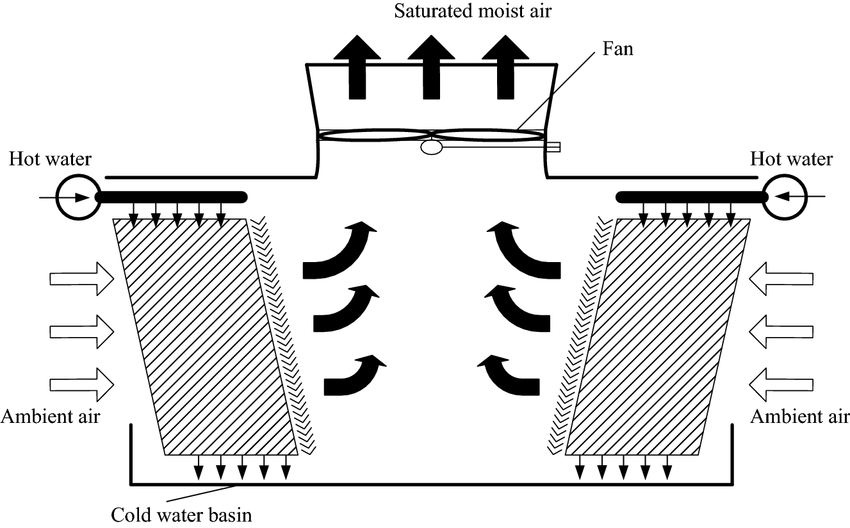
At the heart of the crossflow tower is the evaporative cooling process. Hot water from the process or HVAC system enters the tower and is distributed over fill media. Simultaneously, air is drawn horizontally through the fill. As the water meets the cooler air, a small portion of the water evaporates, removing heat in the process.
This phase change from liquid to vapor requires energy, which is absorbed from the hot water — resulting in lower water temperature. The cooled water is then recirculated back into the system.
Detailed Breakdown of the Cooling Mechanism
Water Distribution Over Fill Media
Water from the chiller or industrial process enters the top of the tower and is distributed into gravity-fed basins.
- The basins have orifices or nozzles that release water evenly over the fill
- Water trickles downward due to gravity
- There’s no need for high-pressure pumps — saving energy
This slow, controlled water flow creates a thin film over the fill surface, which increases contact area for air interaction.
Keywords: water distribution basin, gravity flow water cooling, open basin crossflow tower
Airflow Perpendicular to Water Flow
Fans draw air into the tower horizontally from both sides. As this air passes through the fill, it comes in contact with the descending water.
- This cross-path (perpendicular) movement enhances heat exchange
- Cooler, ambient air absorbs heat from the warm water
- Some water evaporates, drawing latent heat away from the liquid stream
Unlike counterflow systems, where air is forced against falling water, the crossflow arrangement allows for less airflow resistance, enabling higher air volumes with lower fan power.
Keywords: horizontal air entry, crossflow air pattern, evaporative cooling process
Role of Fill Media
The fill packs are crucial components in maximizing the cooling efficiency.
- They provide increased surface area for water-air interaction
- Help break water into fine droplets or thin films
- Promote evaporation and heat dissipation
The fill is typically made from PVC or polypropylene, chosen for their durability, corrosion resistance, and thermal performance.
Keywords: crossflow fill design, energy-efficient fill pack, thermal transfer surface
Evaporation and Heat Removal
As water passes over the fill and meets air:
- A small percentage (1–2%) of water evaporates
- This evaporation removes a significant amount of heat from the remaining water
- The air absorbs this heat and humidity and is expelled out of the tower
This latent heat removal is far more efficient than just sensible cooling (temperature reduction) and allows for substantial heat rejection with relatively small amounts of water loss.
Keywords: evaporative heat rejection, latent heat cooling, air-water heat exchange
Fan System Function
Crossflow towers use axial or centrifugal fans mounted at the top or side of the unit.
- Fans create the negative pressure needed to pull air through the system
- Fan speed can be regulated using Variable Frequency Drives (VFDs)
- Lower fan power reduces energy consumption while maintaining airflow rates
Keywords: axial fan cooling tower, VFD cooling fan, energy-saving fan drive
Factors Affecting Cooling Efficiency
- Ambient Wet-Bulb Temperature
- Lower wet-bulb temperatures improve evaporation
- Crossflow towers operate most efficiently when the air is dry
- Fill Condition and Type
- Clean, high-quality fill ensures better heat transfer
- Scaled or blocked fill reduces efficiency
- Water Flow Rate
- Uniform flow distribution is critical
- Too much or too little water disrupts evaporation dynamics
- Airflow Volume and Velocity
- Fans must pull enough air for effective cooling
- VFDs help maintain optimum air volume with minimal energy
- Maintenance Practices
- Periodic cleaning of fill, basin, and drift eliminators ensures uninterrupted performance
Energy and Water Efficiency Advantages
Crossflow cooling towers offer lower operational costs and sustainable cooling through:
- Lower fan and pump energy
- Reduced drift and water wastage
- Efficient thermal exchange at partial loads
- VFD and BMS integration options
How to Optimize Cooling Mechanism in Crossflow Towers
- Install auto-clean systems or side-stream filtration to reduce fouling
- Use chemically treated makeup water to avoid scaling
- Inspect and clean drift eliminators monthly
- Calibrate fans with smart controllers based on real-time load
- Upgrade to energy-efficient fill packs where applicable
- Conduct thermal imaging checks to detect coil or fill blockages
The cooling mechanism in crossflow cooling towers is an elegant fusion of physics, engineering, and environmental design. By combining gravity-based water flow, horizontal air draft, and evaporative cooling, these systems offer:
- High thermal efficiency with minimal energy input
- Reduced water consumption and drift
- Lower operational and maintenance costs
- Smooth integration with smart, modern energy systems