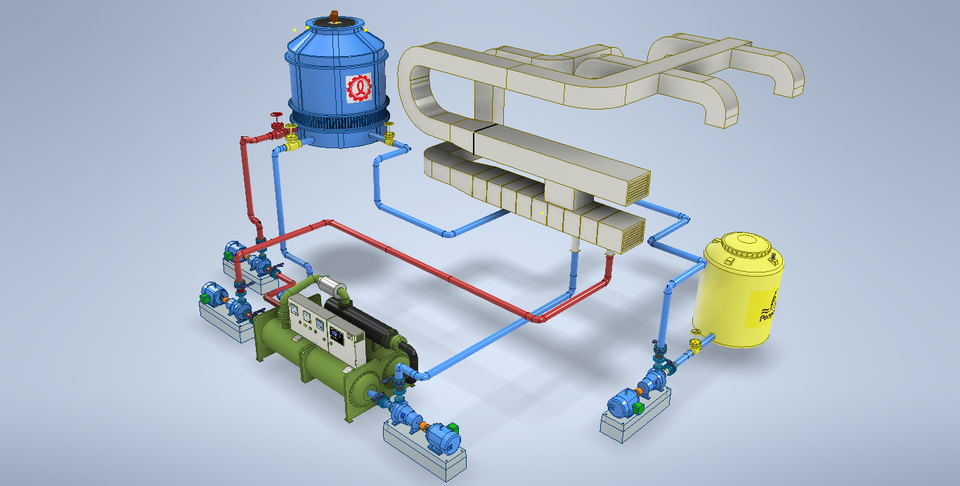
Cooling mechanism of water-cooled chiller systems plays a vital role in industrial and commercial refrigeration by efficiently extracting unwanted heat from processes or environments and rejecting it using water-based heat transfer. Unlike air-cooled systems, water-cooled chillers utilize a closed-loop system in which heat is absorbed from the building’s cooling load and then transferred to condenser water, which is ultimately cooled in a cooling tower.
Water-cooled chillers are renowned for their superior energy efficiency, long-term performance, and adaptability to large-scale applications. Their cooling mechanism depends on advanced thermodynamic processes, including vapor compression, heat exchange, and phase change of refrigerants — all precisely controlled by sophisticated electronics for optimum performance.
Step-by-Step Working: Cooling Mechanism in Detail
Evaporator – Primary Cooling Begins
The cooling cycle initiates in the evaporator, where the return chilled water from the building or process arrives at a higher temperature, usually between 12°C to 15°C (depending on the application).
- The evaporator is a shell-and-tube or plate-type heat exchanger.
- Inside, a low-pressure, low-temperature refrigerant comes into contact with the tube or plate walls.
- As the refrigerant flows over these surfaces, it absorbs heat from the returning water.
- This causes the refrigerant to evaporate into a low-pressure gas, while the water gets cooled down to the supply temperature (typically around 6–7°C) and is sent back into the building.
Note: Efficient heat transfer here is critical — designs like falling film evaporators enhance performance by maximizing surface contact between refrigerant and water.
Compressor – Pressure and Temperature Rise
After evaporation, the now gaseous refrigerant enters the compressor — the most energy-consuming part of the system.
- The compressor increases the refrigerant’s pressure, which simultaneously raises its temperature.
- This prepares the refrigerant for efficient heat transfer in the next step (condenser).
- Most modern water-cooled chillers use screw, scroll, centrifugal, or magnetic bearing compressors.
- Variable Speed Drives (VSDs) are commonly used to adjust the compressor speed to match cooling load dynamically — dramatically improving energy efficiency.
Note: The compressor determines the chiller’s capacity range, noise level, and energy consumption. Magnetic bearing compressors also reduce maintenance by eliminating friction and oil.
Condenser – Heat Rejection to Cooling Water
The superheated, high-pressure refrigerant vapor enters the condenser, where it undergoes condensation by releasing heat to condenser water.
- The condenser is another heat exchanger, but instead of chilled water, it uses water from the cooling tower loop.
- As the refrigerant gives off its heat to the condenser water, it changes phase from vapor to liquid.
- The heat-laden water exits the condenser and is sent to the cooling tower for rejection to the atmosphere.
Note: Efficient heat transfer here ensures proper condensation of the refrigerant, and designs like microchannel condensers are used in premium systems to improve thermal contact and reduce refrigerant charge.
Cooling Tower – Rejecting Heat to Atmosphere
The heated condenser water moves to the cooling tower, typically located on a rooftop or an outdoor section of the facility.
- Inside the cooling tower, air is forced over fill media, causing a portion of the water to evaporate.
- The evaporation removes heat from the remaining water, effectively reducing its temperature.
- This cooled water is then pumped back to the condenser to repeat the cycle.
Note: The effectiveness of the cooling tower directly affects the chiller’s performance. Wet cooling towers provide higher efficiency than dry ones due to evaporative cooling.
Expansion Valve – Dropping Pressure for Cooling Effect
After condensation, the refrigerant is now in high-pressure liquid form. Before re-entering the evaporator, it must be cooled further.
- It passes through an expansion valve (TXV or EEV) which drastically reduces its pressure.
- This pressure drop cools the refrigerant to a low temperature and prepares it for maximum heat absorption in the evaporator.
- The refrigerant now becomes a low-pressure, cold liquid–vapor mix, ideal for starting the cycle again.
Note: The expansion valve precisely controls refrigerant flow and maintains system balance — some advanced systems use electronic valves with real-time adjustments based on load.
Supporting Systems That Enhance the Cooling Mechanism
Pumps
- Chilled water pumps circulate chilled water throughout the building.
- Condenser water pumps circulate water between the chiller condenser and cooling tower.
Control Systems
- Most modern chillers are operated through PLC-based automation systems or Building Management Systems (BMS).
- Real-time sensors monitor pressure, temperature, flow rate, refrigerant level, etc.
Sensors and Feedback Loops
- Enable adaptive control to improve energy performance during fluctuating demand or ambient conditions.
Advantages of Water-Cooled Chiller Cooling Mechanism
Higher Energy Efficiency
- Uses water for heat rejection, which has better thermal conductivity than air.
- Especially efficient at higher ambient temperatures.
Longer System Lifespan
- Indoor installation protects major components from environmental wear and tear.
Quiet Operation
- Less fan noise compared to air-cooled systems due to indirect heat rejection via water.
Scalability
- Suitable for small plants to district cooling systems — chillers can be added in parallel.
Sustainable Operation
- Uses low-GWP refrigerants, free cooling (in colder climates), and heat recovery options.
Cooling mechanism of water-cooled chiller systems showcases the intelligent use of phase change thermodynamics and efficient heat rejection to provide dependable, scalable, and energy-conscious cooling. Through a cycle of evaporation, compression, condensation, and expansion, the system effectively absorbs heat from the building and safely transfers it outside via water and ambient air — all while minimizing energy consumption and maximizing system lifespan.
Thanks to modern innovations like variable speed compressors, advanced heat exchangers, and AI-based control algorithms, water-cooled chillers are not only more powerful but also more intelligent and environmentally responsible. Whether it’s a commercial skyscraper, a data center, or an industrial process plant, these systems form the backbone of modern, sustainable thermal management.