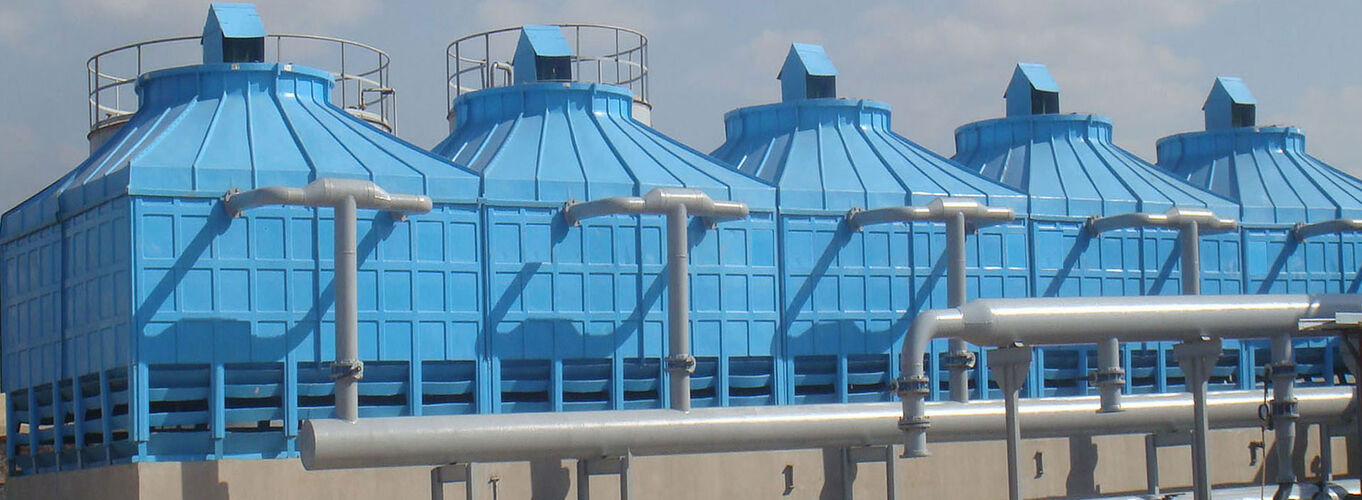
The Power of Evaporation: How Cooling Towers Work in HVAC Systems
cooling towers
For large commercial buildings, hospitals, data centers, and industrial facilities, a conventional air conditioner simply isn’t powerful or efficient enough. The hidden hero of large-scale climate control is the Cooling Tower. These essential devices are the final step in a commercial Heating, Ventilation, and Air Conditioning (HVAC) system, responsible for rejecting waste heat into the atmosphere and ensuring the central chiller operates at peak efficiency.
Understanding the Evaporative Cooling Process
A cooling tower functions by exploiting the natural process of evaporative cooling. This is the same principle that cools you down when sweat evaporates from your skin—it takes heat with it as it changes from a liquid to a gas.
In an HVAC system, the chiller cools water that circulates through the building to absorb heat (like cooling the air in offices). This heated water then flows to the cooling tower, where the waste heat must be removed before the water returns to the chiller.
The process is a simple, yet highly effective cycle:
- Hot Water Entry: Warm water (called condenser water) from the chiller’s condenser enters the top of the cooling tower.
- Water Distribution: The water is distributed over a material called fill, which breaks the water into small droplets and maximizes the surface area for air contact.
- Air-Water Interaction: Large fans (in mechanical draft towers) or natural convection (in natural draft towers) draw or force air up through the falling water.
- Heat Rejection: As the air and water mix, a small amount of the water evaporates. This evaporation requires a significant amount of energy, which is drawn directly from the remaining body of water, cooling it down substantially.
- Cooled Water Return: The now-cooled water collects in the tower basin and is pumped back to the chiller to start the cycle again. The heated, moist air is simply released into the atmosphere.
Key Benefits for Commercial HVAC
Integrating a cooling tower with a water-cooled chiller is significantly more energy-efficient than using air-cooled systems, which is the primary reason they are favored for large structures.
- Energy Savings: By coolinThe Power of Evaporation: How Cooling Towers Work in HVAC Systems
For large commercial buildings, hospitals, data centers, and industrial facilities, a conventional air conditioner simply isn’t powerful or efficient enough. The hidden hero of large-scale climate control is the Cooling Tower. These essential devices are the final step in a commercial Heating, Ventilation, and Air Conditioning (HVAC) system, responsible for rejecting waste heat into the atmosphere and ensuring the central chiller operates at peak efficiency.
Understanding the Evaporative Cooling Process
A cooling tower functions by exploiting the natural process of evaporative cooling. This is the same principle that cools you down when sweat evaporates from your skin—it takes heat with it as it changes from a liquid to a gas.
In an HVAC system, the chiller cools water that circulates through the building to absorb heat (like cooling the air in offices). This heated water then flows to the cooling tower, where the waste heat must be removed before the water returns to the chiller.
The process is a simple, yet highly effective cycle:
Hot Water Entry: Warm water (called condenser water) from the chiller’s condenser enters the top of the cooling tower.
Water Distribution: The water is distributed over a material called fill, which breaks the water into small droplets and maximizes the surface area for air contact.
Air-Water Interaction: Large fans (in mechanical draft towers) or natural convection (in natural draft towers) draw or force air up through the falling water.
Heat Rejection: As the air and water mix, a small amount of the water evaporates. This evaporation requires a significant amount of energy, which is drawn directly from the remaining body of water, cooling it down substantially.
Cooled Water Return: The now-cooled water collects in the tower basin and is pumped back to the chiller to start the cycle again. The heated, moist air is simply released into the atmosphere.
Key Benefits for Commercial HVAC
Integrating a cooling tower with a water-cooled chiller is significantly more energy-efficient than using air-cooled systems, which is the primary reason they are favored for large structures.
Energy Savings: By cooling the water closer to the ambient wet-bulb temperature (the lowest temperature air can reach by evaporation), cooling towers reduce the workload on the chiller’s compressor. This can lead to substantial reductions in HVAC energy consumption and lower utility bills.
Optimal Performance: They prevent overheating and thermal stress on the chiller, extending the lifespan of expensive equipment and ensuring consistent, reliable cooling throughout the building.
If you manage a large facility, understanding cooling tower operation is the first step toward optimizing your building’s energy usage and maintaining a comfortable environment.g the water closer to the ambient wet-bulb temperature (the lowest temperature air can reach by evaporation), cooling towers reduce the workload on the chiller’s compressor. This can lead to substantial reductions in HVAC energy consumption and lower utility bills. - Optimal Performance: They prevent overheating and thermal stress on the chiller, extending the lifespan of expensive equipment and ensuring consistent, reliable cooling throughout the building.
If you manage a large facility, understanding cooling tower operation is the first step toward optimizing your building’s energy usage and maintaining a comfortable environment.