When designing an industrial or commercial HVAC system, the debate often comes down to Cooling Towers vs. Chillers. While both are heat rejection systems, they operate on different physical principles and serve distinct temperature requirements.
Understanding these differences is key to optimizing energy efficiency and reducing operational costs.
1. How They Work: The Core Mechanics
The fundamental difference lies in how they remove heat from your process or building.
- Cooling Towers: These utilize evaporative cooling. Hot water is sprayed over a fill media where it meets a stream of air. A small portion of the water evaporates, which significantly cools the remaining water. It is an “open” or “semi-closed” process that relies on the ambient “wet-bulb” temperature.
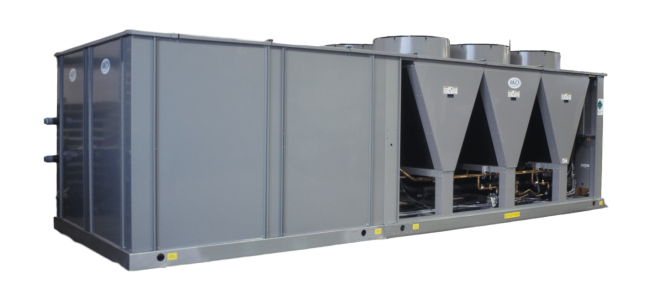
- Chillers: These use a refrigeration cycle (compressor, evaporator, condenser, and expansion valve). A refrigerant absorbs heat from the process fluid and moves it elsewhere. Chillers can be air-cooled (rejecting heat directly to the air) or water-cooled (using a cooling tower to reject the heat).
2. Comparison at a Glance
| Feature | Cooling Tower | Industrial Chiller |
| Cooling Method | Evaporation (Air + Water) | Refrigeration Cycle (Compressors) |
| Temperature Limit | Limited by ambient humidity | Can reach sub-zero temperatures |
| Energy Consumption | Very Low (Fans & Pumps only) | High (Power-hungry Compressors) |
| Upfront Cost | Lower | Higher |
| Primary Use | Bulk heat rejection | Precision & low-temp cooling |
3. When to Choose a Cooling Tower
Cooling towers are the “workhorses” of heavy industry. They are ideal if:
- Massive Heat Loads: You need to cool large volumes of water for power plants, refineries, or steel mills.
- Budget Sensitivity: You want a system with lower capital and electrical costs.
- Moderate Temperatures: Your process can run effectively with water that is 3–5°C above the outdoor wet-bulb temperature (typically 25–30°C in summer).
4. When to Choose a Chiller
Chillers are essential for high-precision environments. They are the better choice if:
- Precision Cooling: You need to maintain a strict temperature (e.g., ±0.1°C) for medical imaging (MRI), semiconductors, or laboratory equipment.
- Cold Requirements: Your process requires water temperatures below 15°C, which a cooling tower cannot achieve in summer.
- Indoor Constraints: You need a modular system that can be installed in a basement or mechanical room (air-cooled chillers can be placed on roofs; water-cooled chillers stay indoors).
5. Better Together: The Hybrid Approach
In many large facilities, they aren’t competitors—they are partners. A water-cooled chiller uses a refrigeration cycle to get water very cold, but it sends its own waste heat to a cooling tower to be exhausted. This combination is often the most energy-efficient way to cool a large skyscraper or a massive factory.