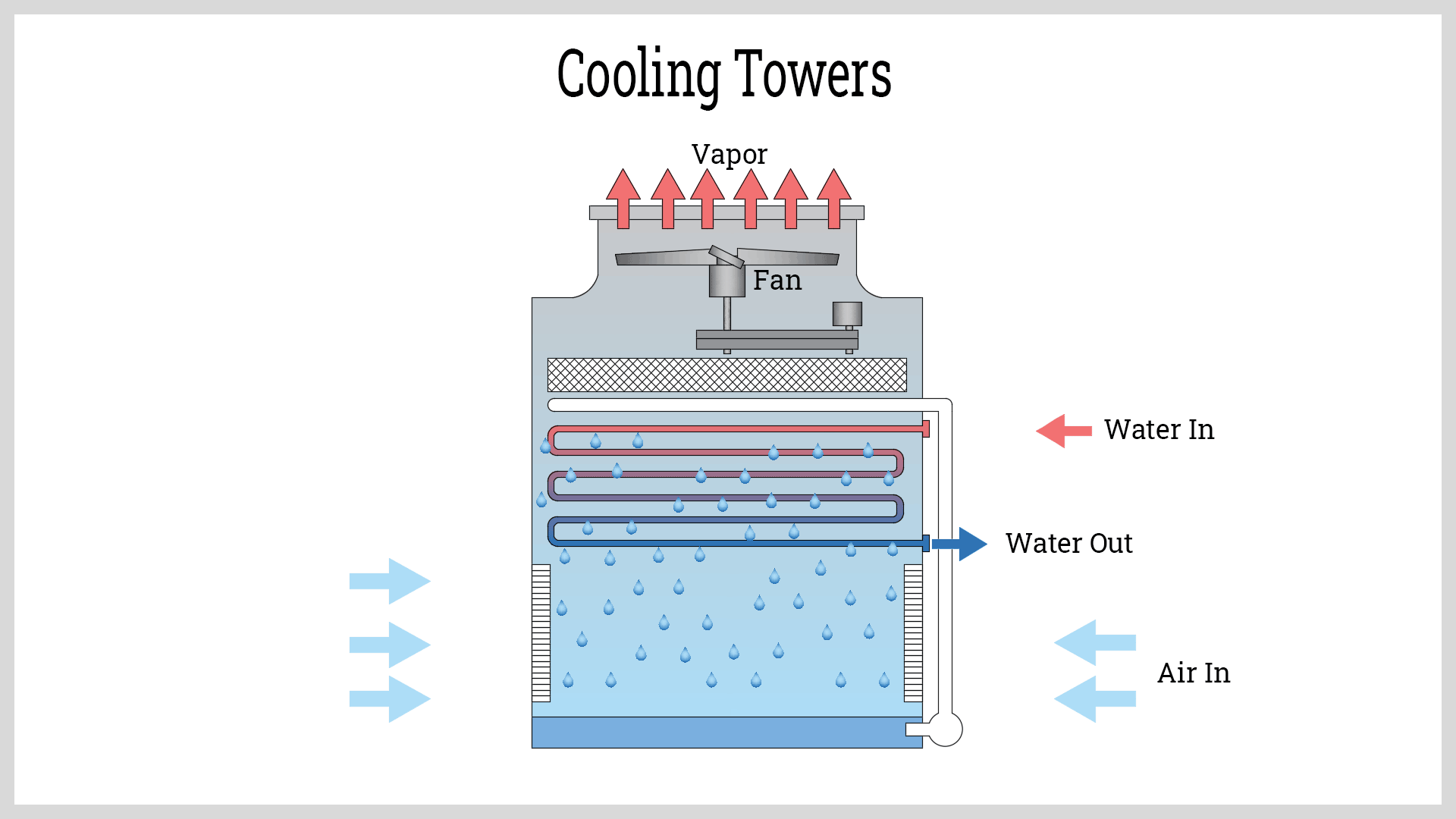
Understanding the cooling tower working principle is essential for anyone managing industrial processes or large-scale HVAC systems. At its core, a cooling tower is a specialized heat exchanger that uses a combination of water and air to transfer process heat into the atmosphere.
The primary physical phenomenon behind this is evaporative cooling. Here is a step-by-step breakdown of how this process works.
1. The Physics: How Evaporation Creates Cooling
The working principle relies on the fact that when water evaporates, it requires energy (latent heat). This energy is taken from the remaining water, which results in a temperature drop.
Think of it like the human body: when you sweat, the evaporation of moisture from your skin cools you down. A cooling tower does this on an industrial scale
Shutterstock
2. Step-by-Step Operation
A standard cooling tower follows a specific cycle to reject heat:
- Hot Water Entry: Hot water from an industrial process (like a power plant or air conditioning condenser) is pumped to the top of the tower.
- Water Distribution: The water is distributed through nozzles across the “fill media.” The fill is designed to break the water into tiny droplets or spread it into a thin film, maximizing the surface area exposed to the air.
- Air Interaction: Large fans (in induced draft towers) or natural atmospheric pressure (in natural draft towers) pull air through the fill.
- Heat Exchange: As the air passes the water, a small portion of the water evaporates. This process removes a significant amount of heat from the remaining liquid.
- Collection: The now-cooled water falls into a cold-water basin at the bottom, where it is pumped back to the industrial equipment to begin the cycle again.
3. Factors Affecting Efficiency
The performance of the cooling tower working principle depends on several environmental factors:
- Wet-Bulb Temperature: This is the lowest temperature that can be reached by evaporative cooling. A cooling tower can never cool water below the ambient wet-bulb temperature.
- Range: The difference between the hot water inlet temperature and the cold water outlet temperature.
- Approach: The difference between the cold water outlet temperature and the ambient wet-bulb temperature.
4. Why It Matters for Industry
By utilizing the cooling tower working principle, facilities can recycle over 95% of their process water. This makes it an incredibly cost-effective and environmentally friendly alternative to “once-through” cooling systems that dump heated water into local rivers or sewers.
Conclusion
Whether it’s a small FRP unit for a mall or a massive concrete tower for a refinery, the principle remains the same: using air and evaporation to keep machinery running at safe temperatures.