
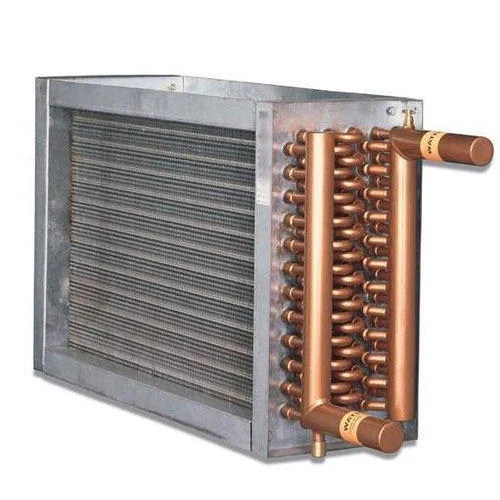
Cooling coils are at the heart of any HVAC system. They’re responsible for removing heat from indoor air, making spaces comfortable and suitable for people, processes, or products. Among the two most commonly used coil types are Direct Expansion (DX) coils and Chilled Water (CW) coils. While both achieve cooling, they do so in fundamentally different ways, which impacts everything from energy use and space requirements to cost and maintenance. Let’s explore how these two systems work and which is better suited for your application.
What Are Direct Expansion (DX) Coils?
▸ How DX Coils Work
Direct Expansion coils use refrigerant directly to cool air. When warm air passes over the coil, the liquid refrigerant inside it evaporates, absorbing heat from the air in the process. This cooled air is then delivered back into the space. The refrigerant cycle is completed as the vapor moves to a compressor and condenser, where it’s converted back to liquid and recirculated.
▸ Where DX Coils Are Used
DX coils are common in small to medium-scale HVAC systems, such as rooftop units, packaged air conditioners, split ACs, and some air handling units (AHUs). They’re preferred for their compact size, quick response, and lower initial cost, making them ideal for offices, retail stores, schools, hotels, and smaller industrial setups.
What Are Chilled Water Coils?
▸ How Chilled Water Coils Work
Chilled water coils, on the other hand, work with cold water that’s been cooled by a central chiller system. The water is pumped through the coil, and as warm air passes over it, heat is transferred to the water, cooling the air. The warmed water then returns to the chiller to be cooled again.
▸ Typical Applications for CW Systems
Chilled water coils are widely used in large commercial or industrial buildings, such as malls, hospitals, data centers, factories, and campuses. Though the setup is more complex—requiring chillers, pumps, and piping—it is scalable, flexible, and energy-efficient for high-capacity cooling.
Key Differences Between DX and Chilled Water Coils
▸ Cooling Medium: Refrigerant vs Water
DX coils use refrigerant that evaporates inside the coil to absorb heat. CW coils use chilled water from an external chiller. This fundamental difference defines their system complexity and applications.
▸ System Architecture and Complexity
DX systems are self-contained with all components—evaporator, compressor, and condenser—within a unit. CW systems are centralized, requiring extensive piping and auxiliary equipment.
▸ Installation Cost and Space Requirements
DX coil systems are more affordable upfront and space-saving. CW coil systems demand mechanical rooms, piping networks, and higher capital investment but are better for large infrastructure.
▸ Maintenance and Operating Costs
DX coils are easy to maintain, but refrigerant leaks and pressure balance issues can occur. CW systems need maintenance for chillers, pumps, and water treatment, but offer better long-term operational control.
▸ Energy Efficiency and Load Handling
DX coils are efficient in small to mid-size loads. CW coils are better for large, constant loads and can integrate energy recovery and load modulation systems for enhanced performance.
▸ Zoning and Control Capabilities
DX systems provide independent control per unit, which is ideal for zoning in split systems. CW systems can be zoned with control valves, VAV boxes, and smart BMS integration for precise regulation.
Choosing between DX and chilled water coils depends on your building size, budget, cooling load, and design goals. For smaller spaces or retrofits where budget and speed are priorities, DX systems are an efficient and compact solution. For larger installations with long-term operation and high cooling demands, chilled water systems provide better efficiency, zoning, and lifecycle value.
Understanding these key differences allows building owners, facility managers, and HVAC consultants to design climate systems that align with energy performance goals, space constraints, and comfort requirements.