
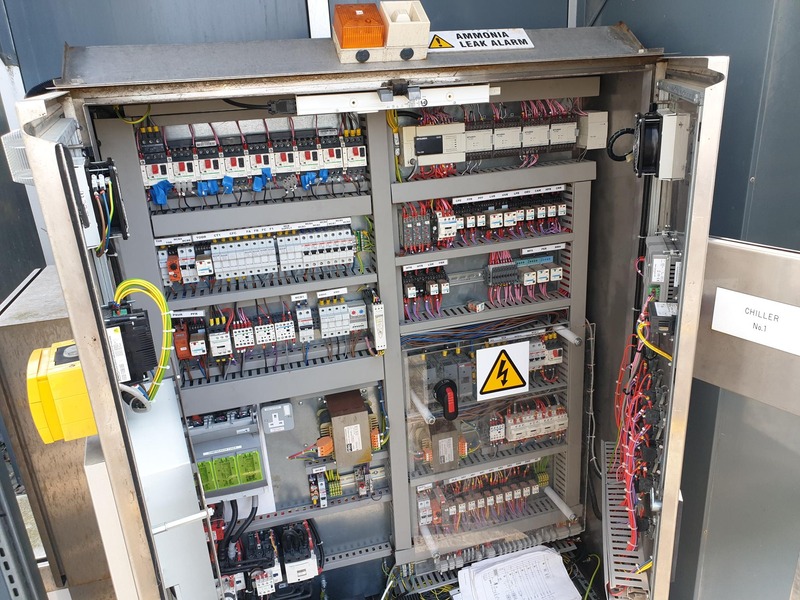
Electrical Components in Spindle Chiller are the unseen yet essential elements that drive precision, reliability, and intelligence in modern cooling systems. While most spindle chillers are recognized for their ability to control temperature and manage coolant flow, it is the internal electrical framework that ensures these tasks are carried out safely and efficiently.
In high-speed CNC and industrial machining environments, even minor fluctuations in spindle temperature can lead to tool wear, thermal distortion, or dimensional inaccuracy. That’s where the electrical infrastructure comes into play. From the power supply unit that stabilizes incoming voltage to the PLC or microcontroller that orchestrates real-time responses, and VFDs (Variable Frequency Drives) that adjust motor speeds on demand, every electrical component serves a specific function.
Main Power Supply Unit (PSU)
The Power Supply Unit (PSU) is the entry point of all electrical energy in a spindle chiller.
Functions:
- Converts incoming AC mains voltage into usable voltage levels for internal components.
- Distributes isolated power to various modules like the controller, pumps, compressors, and fan motors.
- Equipped with fuses, surge protectors, and EMI filters to ensure stable and clean electrical input.
Unique Insight:
In regions with unstable grid power, high-end spindle chillers include automatic voltage regulators (AVRs) and dual power input circuits for seamless switchover between mains and generator supply.
PLC / Microcontroller Unit
The Programmable Logic Controller (PLC) or microcontroller is the brain of the spindle chiller.
Functions:
- Executes control logic for cooling cycles, alarms, flow rate adjustment, and compressor on/off timing.
- Interfaces with sensors and field devices using digital and analog I/Os.
- Provides automatic safety shutdown in case of any critical fault.
Unique Insight:
Advanced spindle chillers feature field-upgradable PLC firmware, allowing manufacturers to upload improved control logic without hardware changes — making the system future-proof.
Temperature Sensors & Thermistors
These components measure the real-time temperature of various zones in the chiller.
Types:
- NTC Thermistors (Negative Temperature Coefficient): Widely used for quick temperature feedback.
- RTDs (Resistance Temperature Detectors): High precision, linear output, used for critical applications.
Placement:
- Coolant inlet and outlet
- Compressor discharge line
- Heat exchanger surface
- Ambient air (for fan speed control)
Unique Feature:
Some systems use dual-sensor cross-verification — the controller compares readings from two sensors for the same point to detect drift or failure, which enhances reliability in high-stakes operations.
Inverter Drives (VFDs)
Variable Frequency Drives (VFDs) control the speed of motors used in:
- Coolant pumps
- Scroll or rotary compressors
- Condenser fans (in air-cooled units)
Benefits:
- Reduce inrush current during startup
- Dynamically adjust pump or compressor speed based on load
- Save energy and extend motor life
Unique Application:
Top-tier spindle chillers employ dual VFDs — one for coolant flow, another for compressor — and synchronize their performance using sensor feedback to create a fully adaptive cooling loop.
Control Display Panel (HMI)
The Human-Machine Interface (HMI) is where users interact with the chiller.
Features:
- Digital touchscreen or membrane keypad
- Real-time readout of temperature, flow rate, and alarm status
- Password-protected service menus
- Language and unit customization
Unique Advantage:
Many modern chillers now offer Wi-Fi or Ethernet-enabled HMIs, which allow technicians to:
- Monitor chiller status remotely
- Adjust settings from mobile devices
- Access historical data logs via the cloud
Capacitors & Soft Starters
Used for motor and compressor start-up support.
Purpose:
- Reduce starting torque and inrush current
- Improve power factor correction
- Enable smooth, gradual motor acceleration
Unique Tech:
Thermally adaptive soft starters can detect ambient and component temperature. If the chiller has just been powered off, it delays restart until the internal temperature has normalized — preventing thermal stress.
Electrical Components in Spindle Chiller define the performance, safety, and intelligence of the entire cooling system. These components don’t just supply power—they regulate temperature with microsecond-level precision, protect the spindle and coolant loop from electrical or thermal damage, and enable real-time decision-making through automation.
From high-accuracy thermistors and digital control panels (HMIs) to energy-saving soft starters and inverter-driven pumps, each component is designed to handle complex operating conditions with minimal manual intervention. Furthermore, features like remote connectivity, cloud-based diagnostics, and adaptive response logic give operators full visibility into chiller health and efficiency — often without needing to physically access the machine.
The result is a smarter, safer, and more energy-efficient spindle cooling solution that enhances machining performance and ensures long-term equipment reliability. As manufacturers seek tighter tolerances, faster cycle times, and reduced downtime, investing in spindle chillers with a robust electrical architecture becomes a strategic advantage.