As industries around the world prioritize sustainability, cost-effectiveness, and low-carbon operations, energy efficiency in industrial systems has become a top priority. One such system playing a significant role in reducing energy usage is the closed loop cooling system.
Unlike open cooling towers, closed loop systems provide indirect heat rejection while ensuring that the process fluid remains sealed from contaminants. Their unique design not only prevents fouling and scaling but also contributes directly to higher energy savings, reduced water usage, and longer equipment lifespan.
This blog explores the core energy-saving mechanisms, design features, optimization strategies, and industrial advantages of closed loop cooling systems—showing how they can significantly reduce electricity and water bills while ensuring top-tier cooling performance.
What Are Closed Loop Cooling Systems?
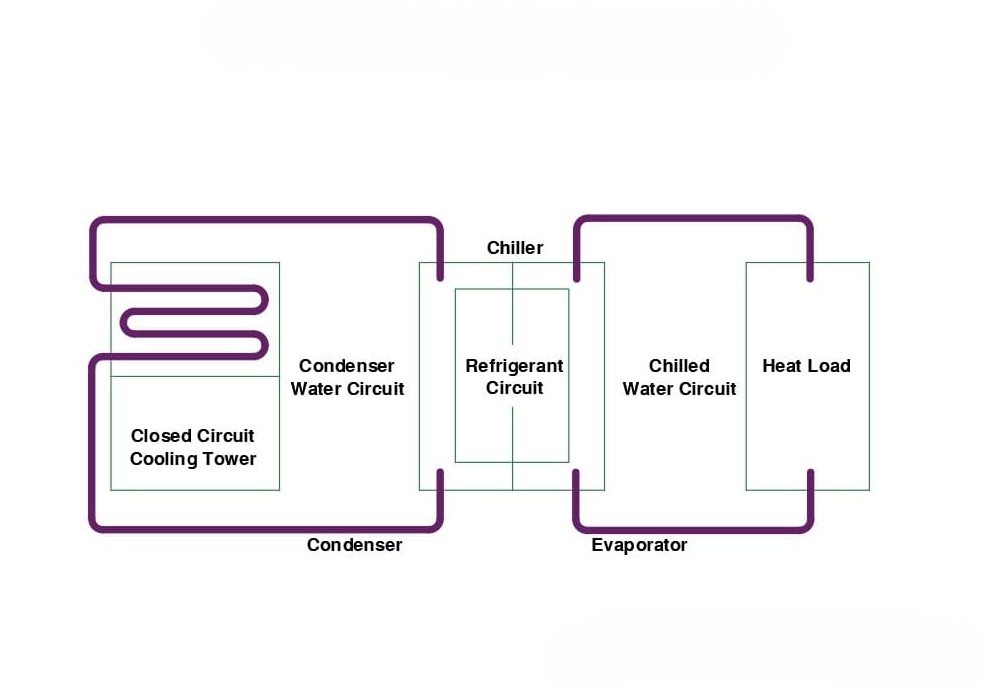
A closed loop cooling system consists of a sealed heat exchanger (usually a coil) through which the process fluid circulates. The heat is removed from this coil either through:
- Dry air cooling (sensible heat removal), or
- Spray water with air (evaporative cooling), depending on environmental conditions.
The key point is: the cooling fluid never mixes with air, maintaining purity and stable thermal transfer.
🔁 These systems are commonly used in HVAC, chemical processing, power plants, data centers, laser cooling, plastics, and pharmaceuticals—industries where both temperature precision and system cleanliness are non-negotiable.
How Closed Loop Cooling Systems Improve Energy Efficiency
Reduced Pumping Power
In open systems, pumps must work harder to overcome friction and elevation loss due to long pipelines and return headers. Closed loop systems, being pressurized and self-contained, require:
- Less power for fluid circulation
- Smaller, low-head pumps
- No energy lost to open discharge or splash out
🧮 Savings of up to 20–30% in pumping energy are common.
Lower Fan Power Usage
Modern closed loop systems come with:
- High-efficiency axial or centrifugal fans
- Variable frequency drives (VFDs) to reduce RPM based on real-time load
- Auto-adjustable airflow controls
These technologies allow fans to operate only at required speeds, reducing unnecessary power draw—especially during cooler ambient conditions.
🌬️ VFD-enabled fans can reduce energy use by up to 50% in part-load conditions.
Hybrid Operation Modes
One of the biggest energy-saving strengths is the dual operation mode:
| Mode | Use Case | Energy Savings |
|---|---|---|
| Dry Cooling Mode | In cold climates or nighttime | No water pump, minimal fan use |
| Evaporative Mode | During peak heat loads | Max cooling, still efficient |
This hybrid flexibility allows the system to respond to load variation and ambient conditions, saving both electricity and water.
Minimized Water Treatment and Loss
Closed loop systems:
- Don’t allow air or debris into the system
- Require less frequent water top-up
- Need fewer chemical treatments (no open evaporation circuit)
- Reduce drift loss (common in open towers)
This directly cuts down on chemical dosing pump electricity use, water pumping, and the operational load of treatment equipment.
Optimization Strategies for Maximum Energy Efficiency
To ensure your closed loop cooling system reaches peak energy performance:
Install VFDs on Fans and Pumps
- Adjust motor speeds based on system demand
- Lower RPM = Lower energy consumption
- Integrate with control systems for automation
Use EC (Electronically Commutated) Fans
- Efficient at variable speeds
- Quiet operation
- Long lifespan, low maintenance
Insulate Pipelines and Coil Inlets
- Prevent unwanted heat gain or loss
- Ensure outlet temperatures remain consistent
- Lessens load on fans/pumps
Implement Smart Controls
- Use temperature and pressure sensors for real-time data
- Automate switching between dry and evaporative modes
- Set night-time economizer
Environmental Benefits Alongside Energy Savings
Closed loop systems don’t just save electricity; they also help reduce water and chemical usage, which contributes to environmental responsibility:
- Up to 70% less water loss compared to open systems
- Minimal blowdown due to low contamination
- Fewer chemicals needed for corrosion and bacteria control
- Zero exposure of process fluids to the atmosphere
Industries Benefiting Most from Energy-Efficient Closed Loop Cooling
- Data Centers – Lower cooling cost per kWh of computing
- Pharmaceuticals – Clean cooling with minimal microbial risk
- Food & Beverage – Protects hygiene and reduces process heat cost
- HVAC in Malls/Airports/Hospitals – Scalable and reliable
- Chemical Processing Plants – Stable process temperature with low OPEX
- Steel and Metal Plants – Recovers heat efficiently with glycol systems
- Power Plants – Supports closed turbine loop or generator cooling
A closed loop cooling system is more than just a cleaner, sealed design—it’s a strategic investment into the energy and operational efficiency of your plant. With lower power consumption, fewer chemical requirements, and smarter control capabilities, it provides an excellent return on investment and helps industries meet energy conservation goals.
⚡ Energy-efficient cooling today = competitive advantage tomorrow.
Whether you run a high-heat process, a mission-critical server room, or a precision manufacturing unit—closed loop cooling systems deliver smart, sustainable cooling that reduces power bills, water bills, and unplanned maintenance.