Navigating Thermal Dynamics: The Inherent Flexibility of GPHEs
Gasketed Plate Heat Exchangers (GPHEs) operate under dynamic thermal conditions, where process fluids can range dramatically in temperature, causing significant thermal expansion and contraction within the unit’s components. Unlike rigid shell-and-tube designs, GPHEs are uniquely engineered to manage these thermal stresses through the inherent flexibility of their stacked plate pack. Each thin metal plate, separated by an elastomeric gasket, allows for a degree of individual movement. This flexibility, coupled with the compressible nature of the gaskets, enables the entire assembly to “breathe” and adapt to temperature gradients between the hot and cold sides, as well as during transient operations like start-up and shutdown. Effectively managing thermal expansion GPHE is paramount to preventing plate deformation, internal stress accumulation, and ultimately, ensuring the long-term integrity and leak-free operation of the heat exchanger system. Gasket materials respond differently to repeated expansion: some elastomers (EPDM, HNBR, FKM) resist Compression Set and creep better at elevated temperatures, while PTFE‑encapsulated seals handle chemical attack but can migrate if not properly retained. Attachment style—clip‑on, glued, or snap‑in—affects both serviceability and migration risk; glued gaskets reduce migration during expansion but complicate replacement, whereas clip‑on systems simplify maintenance but require precise groove tolerances to avoid walking. Discussing Gasket Migration Prevention, Compression Set Data and Gasket Retention Methods gives maintenance teams concrete reasons to stock the right spare kits and follow documented tightening sequences.
The Critical Role of Gaskets in Dynamic Sealing
The gaskets in a GPHE serve a dual purpose: to create a leak-proof seal between adjacent plates and to accommodate the unavoidable thermal expansion and contraction. Each gasket is precisely molded with a specific profile that fits into a groove on the plate, ensuring correct positioning. The profile typically includes a sealing bead that creates a primary barrier against fluid leakage, along with a secondary groove or “safety ring” that acts as a backup should the primary seal fail. Furthermore, the inherent elasticity of the chosen gasket material (e.g., EPDM, NBR, Viton) allows it to compress and decompress with the movement of the plates, maintaining continuous contact and sealing integrity. The method of gasket attachment—whether glued-in for maximum robustness or clip-on for ease of maintenance—also plays a role in how effectively the gasket resists dislodgment and maintains its sealing function under varying thermal and pressure conditions, ensuring reliable GPHE sealing. Thermal expansion in gasketed plate heat exchangers (GPHEs) is a continuous design and operating challenge: alternating hot and cold streams cause plate packs and frames to grow, contract, and shift differentially, so the mechanical layout (tie‑bars, bolts, and spacer bars) must accommodate movement without compromising Seal Integrity. Designers balance a snug gasket compression to prevent bypass leaks against enough clearance and controlled preload so plates can expand axially and laterally during thermal cycling. Calling out Differential Expansion, Expansion Gap Design and Tie‑Bar Stiffness in your post will help readers understand why a rigidly over‑torqued pack often leads to gasket extrusion, premature Compression Set, and leaks after a few heat cycles.
Frame Compression: Orchestrating a Tight and Flexible Assembly
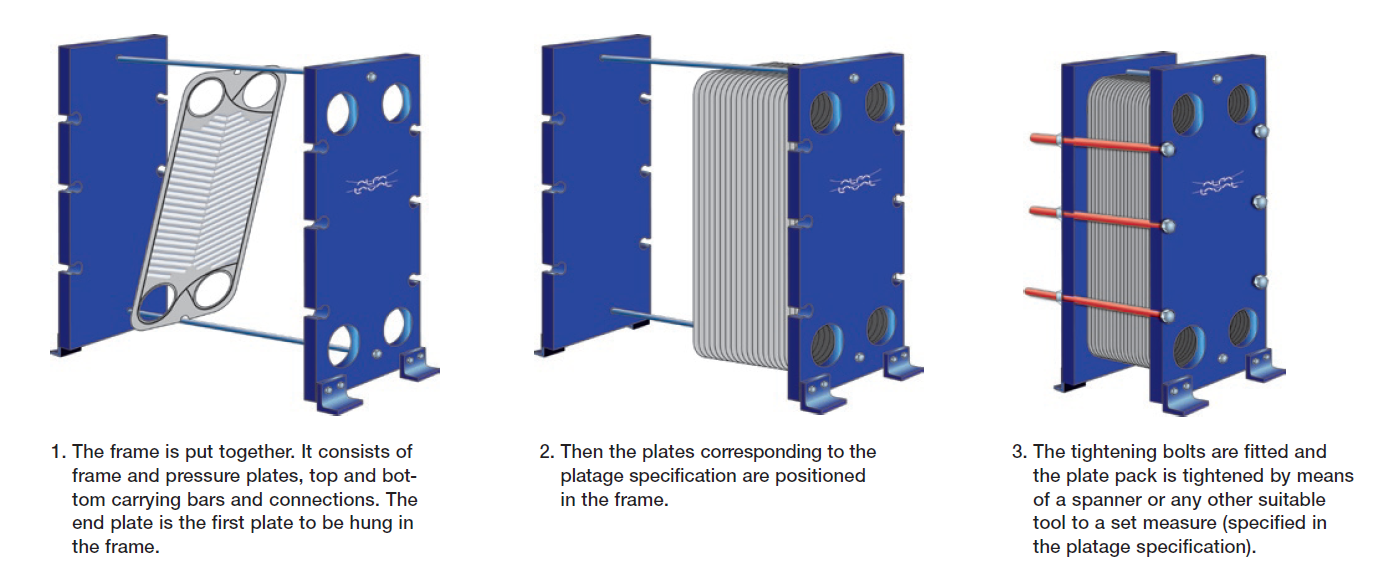
The robust frame of a GPHE, comprising the fixed frame plate, movable pressure plate, and tightening bolts, plays a crucial role in orchestrating both effective sealing and controlled expansion management. The tightening bolts apply a precise and uniform compression force across the entire plate pack, deforming the gaskets to create the initial leak-proof seal. This engineered compression allows the gaskets to act like springs, absorbing the relative movements caused by plate thermal expansion. Without this controlled compression, the plates would expand independently, leading to gasket dislodgment and critical leakage. Proper tightening bolt procedures and monitoring of the compression depth (or “A” dimension) are vital to ensure that the gaskets are neither over-compressed (which can prematurely age the material) nor under-compressed (leading to leaks). This delicate balance of applied force and material elasticity is key to achieving a durable and leak-free plate heat exchanger that can withstand the stresses of continuous operation. A controlled tightening procedure and documented torque sequence are the practical heart of long‑term sealing: progressive, evenly distributed preload avoids local overcompression and ensures uniform contact pressure across the gasket surface as the plate pack expands. Frames and tie‑bar designs that include built‑in expansion gaps or sliding end‑frames reduce induced stresses during start‑up and transient duty, while expansion joints or bellows can be specified for extreme temperature swing or steam services. Emphasize Operational Tightening Sequence, Plate Pack Expansion Control and Leakage Prevention to show readers how small checks—torque log, first‑cycle inspection, and gasket orientation—prevent most in‑service leaks.