
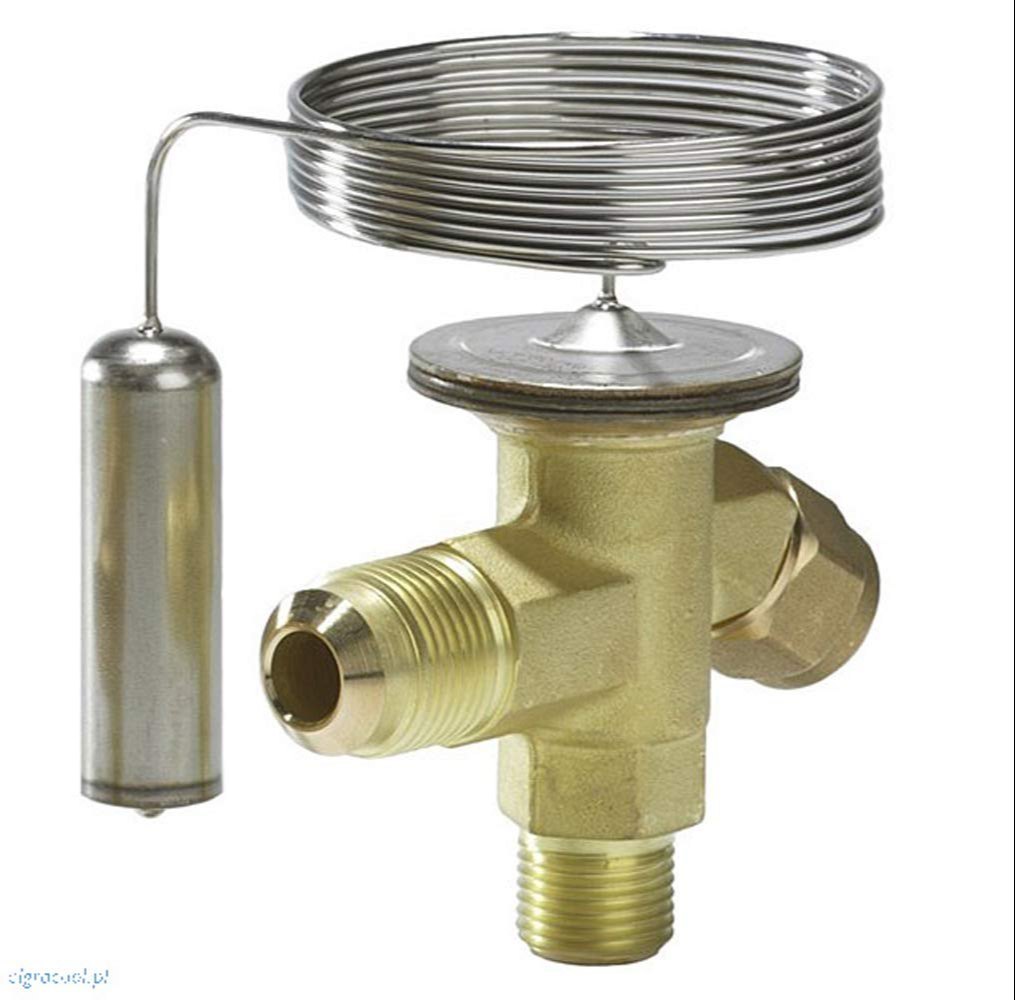
In an online chiller, where 24/7 performance, high process reliability, and tight temperature control are essential, the expansion valve plays a pivotal role. While components like the compressor or evaporator often get the spotlight, it’s the expansion valve that precisely meters how much refrigerant enters the evaporator coil—impacting cooling effectiveness, system balance, energy efficiency, and equipment longevity.
It regulates the refrigerant flow rate, maintains proper superheat, and ensures the evaporator always has the right refrigerant load based on real-time heat exchange demands.
In the case of online chillers, which handle non-stop operation for industrial processes like laser cooling, injection molding, medical imaging, or data centers, a robust and responsive expansion valve system becomes critical.
What Is an Expansion Valve and What Does It Do?
An expansion valve is a metering device in a chiller’s refrigeration cycle. It reduces the pressure and temperature of the high-pressure liquid refrigerant coming from the condenser before entering the evaporator.
Core Functions:
- Pressure Reduction: Transforms high-pressure liquid refrigerant into a low-pressure mist, enabling it to absorb heat rapidly in the evaporator.
- Flow Regulation: Controls the exact amount of refrigerant based on the evaporator’s load.
- Superheat Maintenance: Prevents liquid refrigerant from returning to the compressor, avoiding damage (liquid slugging).
Types of Expansion Valves Used in Online Chillers
In online chillers, the expansion valve selection depends on desired response time, load variability, system size, and control sophistication.
Thermostatic Expansion Valve (TXV / TEV)
- Operation: Mechanical – uses a sensing bulb and diaphragm to regulate refrigerant flow based on superheat.
- Best for: Constant or semi-variable loads.
- Limitations: Slow response, limited precision, less ideal for modern IoT-connected chillers.
Electronic Expansion Valve (EEV)
- Operation: Motor-driven needle valve controlled via PLC or microcontroller.
- Advantages:
- High precision flow modulation.
- Real-time superheat control.
- Seamless integration with IoT, SCADA, and BMS systems.
- Ideal for: Online chillers with varying process loads, multiple compressors, or energy efficiency goals.
Capillary Tube (Rare in online chillers)
- Operation: Fixed diameter tube that throttles refrigerant passively.
- Drawback: Cannot adapt to load changes. No control features.
- Use case: Compact, low-cost systems—not suitable for online chillers.
Integration of EEV with Online Chiller Control Systems
Sensor-Based Automation
- Temperature Sensors at evaporator outlet
- Pressure Transducers in the suction line
- PLC or Microcontroller reads real-time data, calculates superheat, and modulates valve opening
Feedback Loop Control
- PID (Proportional-Integral-Derivative) control logic ensures:
- No overshooting of superheat
- Stable operation even under fast-changing loads
- Minimal oscillation of valve needle
Adaptive Learning
- Some advanced EEVs use machine learning algorithms to “learn” daily cooling patterns and adapt proactively.
Protective Functions in Expansion Valves
TXV/EEV Safety Logic Includes:
- Low Superheat Lockout: Prevents refrigerant flooding
- Anti-flood Logic: Temporarily closes valve under rapid load drops
- Sensor Error Detection: Triggers fail-safe valve closure
- Step Count Limits: Protects motorized valves from over-driving
The expansion valve in an online chiller may be compact in size, but it governs the very heartbeat of the cooling process. Whether it’s an advanced EEV integrated with an IoT-ready PLC or a reliable TXV tailored for predictable load conditions, the expansion valve determines:
- Cooling consistency
- Compressor protection
- Energy performance
- Process reliability
For industrial or mission-critical cooling, especially in online chiller systems, investing in the right expansion valve with the correct control logic is non-negotiable. It’s not just about cooling—it’s about cooling with precision, intelligence, and confidence.