
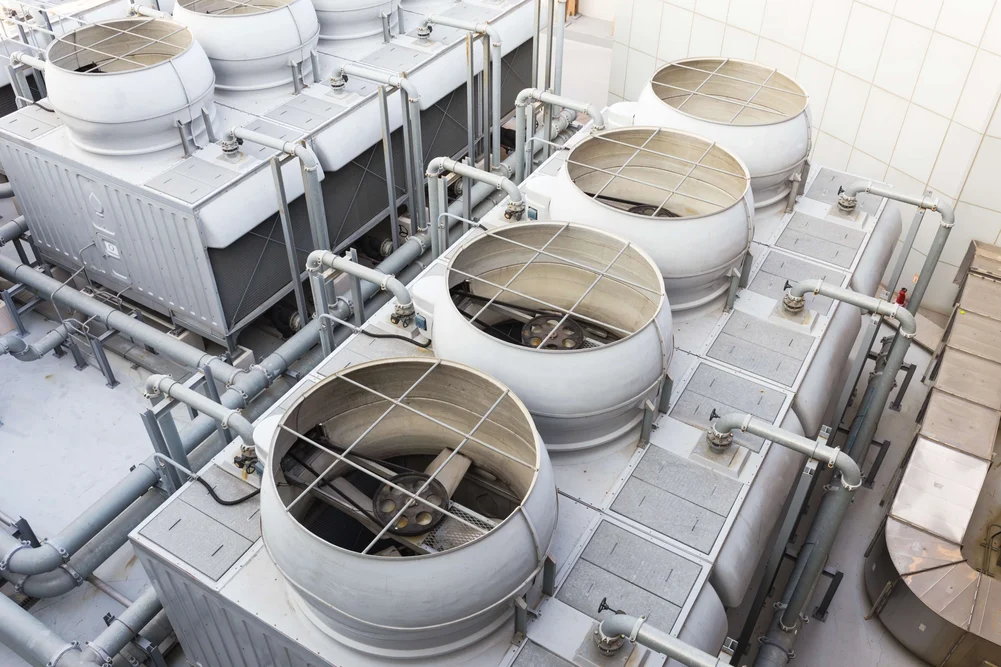
Fan systems are one of the most critical components in the performance and efficiency of a dry cooling tower. These fans drive the airflow needed to remove heat from the system, ensuring that industrial processes remain efficient, safe, and environmentally friendly. The right fan system can drastically improve energy efficiency, reduce operational costs, and extend the lifespan of your equipment. In this blog, we’ll explore the types of fan systems, how they work, their importance, and technological innovations in the field.
What Is the Role of Fans in Dry Cooling Towers?
Fans in dry cooling towers are responsible for drawing or pushing air across heat exchanger surfaces to enhance convective heat transfer. Since dry cooling towers do not use water for evaporation, air movement becomes the primary cooling method. The efficiency of heat rejection depends heavily on how well the fan system is designed and maintained.
Types of Fans Used in Dry Cooling Towers:
Axial Flow Fans:
- Most commonly used in air-cooled and dry cooling towers.
- Blades rotate around a central axis.
- Provide high volume airflow at relatively low static pressure.
- Energy-efficient and cost-effective for large-scale industrial use.
Centrifugal Fans:
- Used in compact and custom applications.
- Suitable where high static pressure is required.
- Often used in enclosed systems or where airflow needs redirection.
- More mechanically complex and costlier than axial fans.
Key Design Considerations:
Fan Diameter and Blade Profile:
- Larger diameter fans can move more air with less RPM.
- Blade design (e.g., aerofoil, hollow aluminum, or FRP) affects efficiency and noise.
Speed Control and Variable Frequency Drives (VFDs):
- Integration of VFDs allows for dynamic control of fan speed based on cooling demand.
- Saves energy during low load periods.
Fan Location:
- Forced draft: Fan is placed at the air inlet, pushing air through the system.
- Induced draft: Fan is placed at the outlet, pulling air through—better efficiency and noise control.
Importance of Fan System Efficiency:
- 40–60% of a dry cooling tower’s electrical power is consumed by fans.
- Efficient fan operation directly reduces operating costs and carbon footprint.
- Reduced wear and tear improves system longevity and reliability.
Innovations in Fan Technology:
Noise-Optimized Blade Designs:
- Use of low-noise airfoil blades.
- Essential for urban or noise-restricted industrial areas.
Smart Monitoring Systems:
- Fans are now integrated with IoT-based sensors to track vibration, temperature, and airflow.
- Enables predictive maintenance and reduces downtime.
Composite Blade Materials:
- Use of FRP (Fiber-Reinforced Plastic) or carbon fiber makes blades lightweight and corrosion-resistant.
Maintenance Tips for Fan Systems:
- Regular inspection of blades and hub for cracks or imbalance.
- Lubrication of bearings and gearboxes to ensure smooth rotation.
- Check for vibration or misalignment, which can cause mechanical failure.
- Monitor motor efficiency and replace worn-out belts or couplings.
Fan systems are the heartbeat of dry cooling towers, ensuring optimal airflow and effective thermal exchange. Whether you’re in the power, petrochemical, or HVAC industry, choosing the right fan configuration and maintaining it diligently can significantly improve your operational efficiency and reduce energy bills. As technology evolves, fan systems are becoming smarter, quieter, and more energy-efficient—helping industries meet both performance and sustainability goals.