
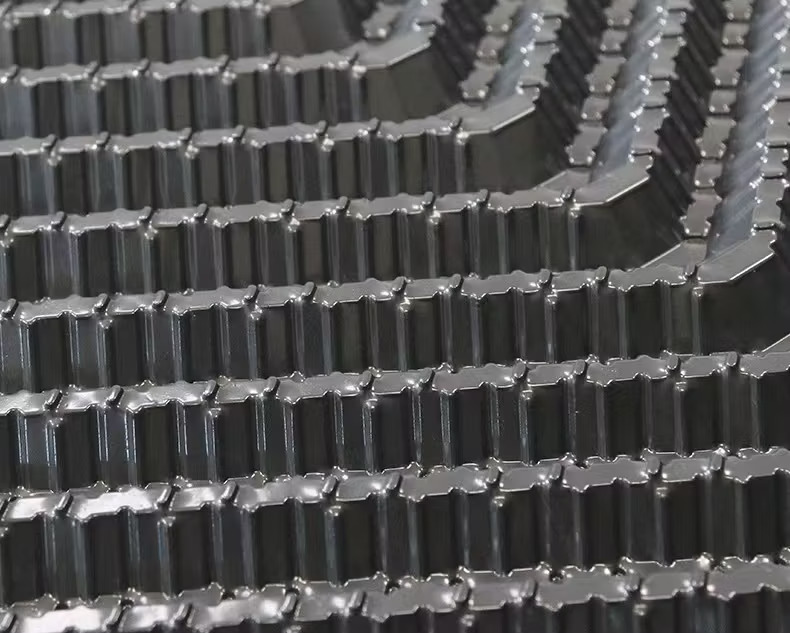
When it comes to Natural Draft Cooling Towers (NDCTs) — those iconic hyperbolic giants of the industrial landscape — the fill media quietly plays a starring role. Despite relying on passive airflow, these towers must ensure efficient heat rejection, and fill media is where the thermal magic happens.
In this blog, we explore the types, functions, materials, installation, and maintenance of fill media used in NDCTs and why it is critical for optimal tower performance.
What Is Fill Media in Cooling Towers?
Fill media is a structured or splash-type packing installed inside the cooling tower to increase the contact surface area between water and air. It promotes evaporation and heat dissipation, improving cooling efficiency without increasing tower size.
In natural draft systems, where airflow is created via the chimney effect, high-performance fill becomes even more essential since no mechanical fans are present to accelerate evaporation.
Types of Fill Media Used in NDCTs
Fill media is selected based on the industry application, water quality, and cooling requirements.
Film Fill
- Made from closely spaced, thin PVC sheets or channels
- Water spreads into a thin film, maximizing surface area
- Best for clean water applications
Splash Fill
- Composed of slats, bars, or grids that cause water to break into droplets
- More tolerant to dirty, high-solid water
- Used where fouling or scaling is expected
Hybrid Fill
- Combines features of splash and film fills
- Ideal for power plants, fertilizer plants, or refineries
Common Configurations:
- Vertical/horizontal film fill packs
- Offset or staggered splash grids
- High-performance vertical corrugated sheets
Material Selection for Fill Media
| Material Type | Key Features | Suitability |
|---|---|---|
| PVC (Polyvinyl Chloride) | High thermal performance, lightweight, UV resistant | Most common |
| PP (Polypropylene) | Higher temp resistance, durable | For slightly hot or aggressive water |
| ABS Plastic | Chemical resistant, rigid | Specialty applications |
| Wooden Slats (rare) | Used in older or traditional splash fills | High TDS industrial water |
Note: Fill material must be non-corrosive, water-resistant, and structurally stable over time.
Working Principle of Fill Media in NDCTs
- Hot water from the condenser or process system is distributed over the fill media.
- As water trickles down through the fill, it forms thin films or droplets.
- Simultaneously, air rises upward (due to buoyancy) through the fill zone.
- Heat and mass transfer occurs — water loses heat and some evaporates.
- The cooled water collects in the basin while the warm, moist air rises through the hyperbolic shell.
Installation and Structural Considerations
- Fill packs are installed in segments or blocks supported by grid beams or trays.
- In NDCTs, the fill zone is located above the cold-water basin and below the drift eliminators.
- Engineers must ensure:
- Uniform water distribution over fill
- Adequate airflow clearance
- Material compatibility with water chemistry
Performance Parameters of Fill Media
| Parameter | Typical Value or Range |
|---|---|
| Heat Transfer Coefficient | 400 – 700 kcal/m²/hr/°C |
| Void Fraction | > 90% |
| Maximum Water Loading | 4 – 6 m³/m²/hr |
| Temperature Range | 5°C to 60°C |
| Pressure Drop | Minimal (optimized for NDCTs) |
Engineered fill media can improve cooling performance by up to 30% compared to unfilled towers.
Maintenance and Cleaning Best Practices
Since NDCTs often deal with large volumes of process water, fouling and scaling can occur.
Inspection Checklist:
- Quarterly visual check for scaling or algae
- Annual cleaning with low-pressure water jets
- Replace broken or deformed fill sections
- Use anti-fouling chemicals for long-term protection
Never allow debris or silt buildup — it chokes airflow and reduces thermal performance.
Environmental and Efficiency Advantages
- Water Savings: Optimized evaporation leads to less blowdown
- Energy-Free Cooling: Enhances passive airflow without fans
- Reduced Plume Formation: Efficient heat transfer helps minimize visible vapor
- Extended Lifespan: Better fill = less stress on other components
In the world of natural draft cooling towers, fill media acts as the heart of thermal exchange. It allows passive air movement to do more with less, leveraging smart material design and optimal geometry to maximize cooling with minimal input.
Whether you’re operating a thermal power station, petrochemical refinery, or fertilizer unit — investing in the right fill media and maintaining it properly can deliver huge benefits in efficiency, compliance, and cost savings. As silent as they are, the fill media quietly ensures that your tower doesn’t just stand tall — but performs at its peak.