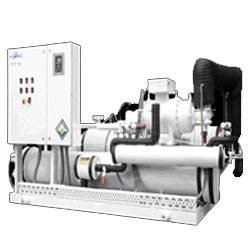
When your cooling needs drop below the freezing point of water, standard HVAC systems won’t cut it. Glycol and Brine chillers are the specialized workhorses designed for sub-zero applications, ranging from craft breweries to industrial food processing.
This content is structured to target high-intent keywords while establishing technical authority.
What is a Glycol/Brine Chiller?
A glycol or brine chiller is a specialized refrigeration system designed to cool a secondary fluid—typically a mixture of water and an antifreeze agent—to temperatures well below 0°C (32°F).
While a standard chiller uses water, these systems use Propylene Glycol, Ethylene Glycol, or Calcium Chloride Brine to prevent the liquid from freezing inside the heat exchanger, ensuring continuous flow and heat transfer in extreme conditions.
Key Applications: Where Temperature Matters
These chillers are essential for industries that require precise, low-temperature thermal management:
- Food & Beverage: Essential for “cold crashing” in breweries, winery fermentation control, and dairy cooling.
- Cold Storage: Maintaining sub-zero temperatures in industrial walk-in freezers and warehouses.
- Ice Rinks: Circulating chilled brine beneath the surface to maintain a consistent ice sheet.
- Pharmaceuticals: Precise temperature control for chemical reactions and vaccine storage.
- Data Centers: Low-temperature fluid cooling for high-density server racks.
Glycol vs. Brine: Which Secondary Coolant is Best?
Choosing the right medium is critical for system longevity and efficiency.
| Feature | Propylene Glycol | Ethylene Glycol | Brine (Salt Solutions) |
| Toxicity | Food Grade / Non-Toxic | Toxic (Industrial Only) | Non-Toxic |
| Efficiency | Moderate | High | Excellent |
| Corrosion | Low (with inhibitors) | Low (with inhibitors) | High (requires special piping) |
| Best For | Brewing & Food Processing | HVAC & Industrial Process | Large-scale Ice Rinks |
Why Efficiency Depends on the Mix
In a glycol chiller, the concentration ratio is everything. If the glycol concentration is too low, the fluid may freeze and burst the evaporator; if it is too high, the fluid becomes too viscous, forcing the pump to work harder and reducing heat transfer efficiency.
Technical Note: Most industrial applications utilize a 30% to 50% glycol-to-water ratio. The freezing point of the solution is typically calculated using:
$$T_f = K_f \cdot m$$
Where $T_f$ is the freezing point depression, $K_f$ is the cryoscopic constant, and $m$ is the molality of the solute.
Top Benefits of Modern Glycol Systems
- Freeze Protection: Operates reliably at temperatures as low as -40°C.
- Corrosion Inhibition: Modern glycol blends include additives that protect your internal piping and heat exchangers.
- Modular Design: Many glycol chillers are built to be “expandable,” allowing businesses to add cooling capacity as production grows.
- Year-Round Operation: Integrated “low ambient kits” allow these chillers to operate even in freezing outdoor winter temperatures.
Ready to Optimize Your Low-Temp Process?
Maintaining a glycol system requires specialized knowledge of fluid chemistry and pressure dynamics.