
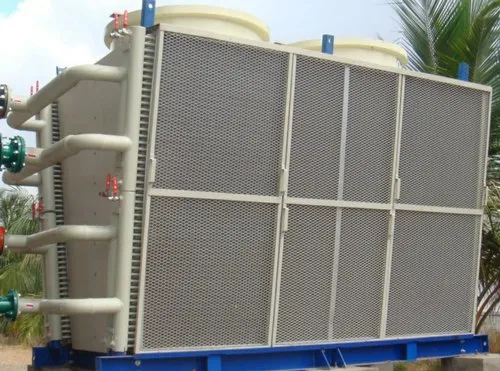
Dry cooling towers have become a critical component in modern industrial cooling systems, particularly where water conservation, environmental compliance, and low maintenance are essential. A key aspect of their effectiveness lies in the mechanism of heat transfer they use.
Unlike wet cooling towers that depend on evaporative cooling, dry cooling towers rely entirely on air as the cooling medium, utilizing finned-tube heat exchangers and high-efficiency fans to manage the heat load. Understanding how heat is transferred in these systems not only helps optimize their use but also reveals why they’re a top choice for sustainable and energy-efficient industrial cooling.
How Heat Transfer Works in Dry Cooling Towers
Air-Based Sensible Heat Transfer
Dry cooling towers operate by removing heat from process fluid using ambient air. This is known as sensible heat transfer, which means:
- The temperature of the fluid drops
- There’s no phase change, no evaporation
- Heat is transferred via direct contact between finned tubes and airflow
This eliminates latent heat losses seen in wet systems, improving thermal control and efficiency consistency.
Finned Tube Heat Exchangers – Maximizing Surface Area
The core of the dry cooling system is the finned tube heat exchanger. These tubes:
- Increase the surface area for heat transfer
- Are usually made of copper, aluminum, or stainless steel
- Facilitate rapid heat dissipation through forced convection
Result: Higher heat rejection rate in a smaller footprint.
Closed-Loop Circuit Prevents Thermal Contamination
The closed-loop fluid path ensures that the heat-carrying medium (usually water or glycol) remains:
- Isolated from the environment
- Free from contamination, scale, or fouling
- Thermally consistent for better energy transfer
Effect: More efficient, predictable heat transfer without chemical interruptions.
Axial Flow Fans – Enhancing Air Movement
Dry cooling towers use large axial fans to move ambient air across the finned tubes. Many systems today are upgraded with:
- VFD (Variable Frequency Drives)
- EC (Electronically Commutated) Motors
These fans adjust speed based on thermal load, enhancing airflow only when required.
This dynamic airflow control improves heat transfer rates while saving significant energy.
Parallel or Counterflow Design for Maximum Efficiency
Depending on the configuration, dry cooling towers may operate with:
- Parallel flow: Air and fluid flow in the same direction
- Counterflow: Air and fluid flow in opposite directions
Counterflow systems generally offer better thermal performance due to a greater temperature gradient, making them ideal for demanding industrial applications.
Ambient Temperature Impact on Heat Transfer
Since dry towers depend on the temperature difference between air and fluid, heat transfer efficiency is closely related to ambient conditions:
- In cool climates, dry towers are extremely efficient
- In hot climates, towers may need oversized exchangers or hybrid designs
Smart thermal sensors and climate-optimized configurations help maintain effective heat transfer year-round.
Thermal Conductivity of Materials
The material of the tubes affects how efficiently heat is transferred. Most dry cooling towers use:
- Aluminum or copper for excellent thermal conductivity
- Stainless steel for durability in aggressive environments
Proper material selection ensures long life and maximum thermal efficiency.
Applications Where Efficient Heat Transfer is Critical
- Power Plants – For condensing turbine exhaust
- Pharmaceutical Industry – For maintaining temperature-sensitive reactions
- Data Centers – For non-stop server room cooling
- Oil Refineries – For processing heat rejection without water
- HVAC in Green Buildings – To optimize energy and meet compliance
Understanding heat transfer in dry cooling towers helps engineers, plant managers, and energy consultants make smarter design decisions and implement more efficient cooling systems. By leveraging sensible heat transfer, closed-loop circulation, high-performance finned tubes, and smart airflow control, dry cooling towers deliver consistent, reliable, and eco-friendly performance across industries.
Their ability to operate without water, resist scaling or corrosion, and maintain energy efficiency makes them a preferred choice for companies focused on sustainability, operational savings, and low maintenance.
As global industries shift toward net-zero energy goals and green manufacturing, dry cooling towers—and the science of heat transfer behind them—are playing a central role in industrial innovation.