
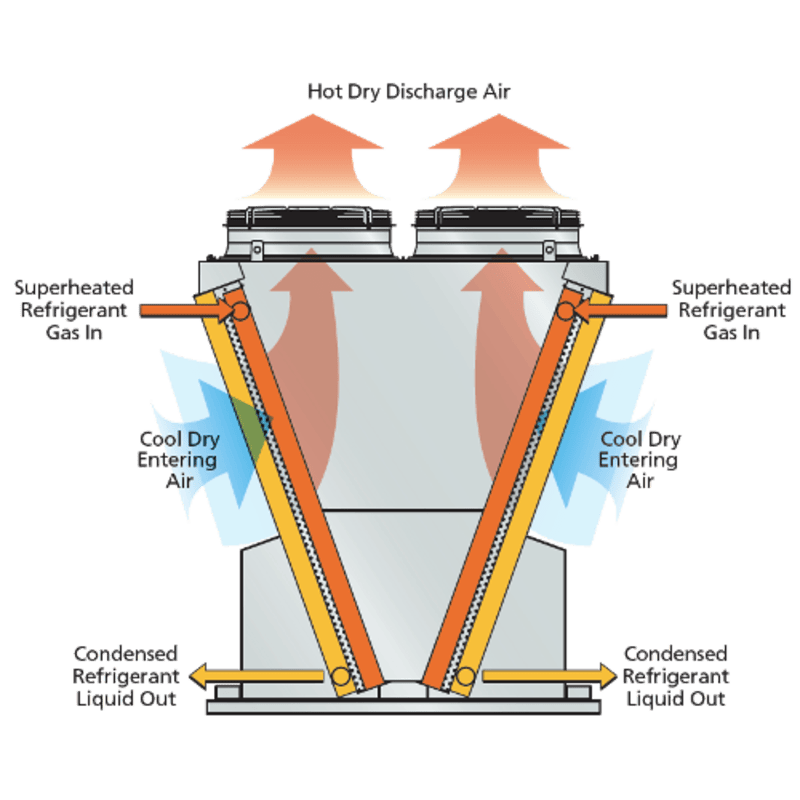
Dry cooling towers are valued for their water-saving design and low environmental impact, but maintaining their performance demands proactive care. Unlike wet cooling towers that suffer from water-related issues like scaling and microbial growth, dry cooling towers require precise mechanical and thermal maintenance. Industries relying on consistent cooling — such as power generation, petrochemicals, manufacturing, and data centers — cannot afford downtime caused by preventable mechanical failures or airflow inefficiencies.
In this guide, we explore all essential maintenance practices, tips for extending equipment life, and avoiding costly breakdowns in dry cooling systems.
Routine Maintenance Checklist for Dry Cooling Towers
Fan and Motor Inspection
- Check fan blades for cracks, dirt buildup, and misalignment.
- Verify motor current draw, vibration, and bearing noise.
- Ensure VFDs (Variable Frequency Drives) are functioning correctly.
Heat Exchanger Surface Cleaning
- Clean finned tubes to remove dust, leaves, insects, and airborne debris.
- Use low-pressure air or vacuum systems to avoid coil damage.
- In industrial zones, use foam coil cleaners that are non-corrosive.
Airflow Pathway Clearance
- Ensure no obstruction in air intake louvers and exhaust plenums.
- Check for debris accumulation or rodent nesting in ductwork or fan shrouds.
Structural Integrity and Frame Inspection
- Inspect panel joints, anchor bolts, and tower frame for corrosion or fatigue.
- Look for signs of UV degradation, paint peeling, or cracks in casing.
Electrical and Control System Testing
- Test fan motor controls, sensors, and relay terminals.
- Check thermal overload protection settings and emergency shutdown systems.
Temperature Monitoring
- Record inlet and outlet temperatures regularly to identify performance drop.
- A rising outlet air temperature often signals airflow restriction or coil fouling.
Preventive vs Reactive Maintenance
| Type | Description | Pros | Cons |
|---|---|---|---|
| Preventive Maintenance | Scheduled inspections, cleaning, lubrication | Avoids downtime, improves efficiency | Requires trained staff |
| Reactive Maintenance | Fixing only after breakdown occurs | Saves cost short-term | High risk of unexpected failure |
Recommendation: Always follow a preventive maintenance schedule for industrial dry cooling towers.
Common Maintenance Tools & Equipment
- Coil fin combs
- Electric vacuum blowers
- Ultrasonic vibration analyzers
- Thermal imaging cameras
- Torque wrench for fan blades
- Digital temperature and airflow sensors
- Condenser coil cleaning foam kits
Key Maintenance Indicators to Track
- Fan motor amperage draw
- Temperature delta (ΔT) across heat exchanger
- Vibration levels (mm/s or IPS)
- Pressure drop across air intake and exhaust
- Airflow velocity at fan outlet (m/s)
Tracking these ensures early detection of inefficiencies and avoids emergency repairs.
Dry cooling towers might be low-maintenance compared to their wet counterparts, but overlooking regular inspections and airflow management can compromise thermal performance and reliability. By implementing a structured preventive maintenance plan, industries can minimize operational costs, maximize lifespan, and avoid unplanned outages. With the increasing push for waterless cooling technologies, maintaining dry cooling towers has become an industrial priority — one that pays off in performance, compliance, and ROI.