The Secret Geometry: Understanding Plate Patterns in Brazed Plate Heat Exchangers
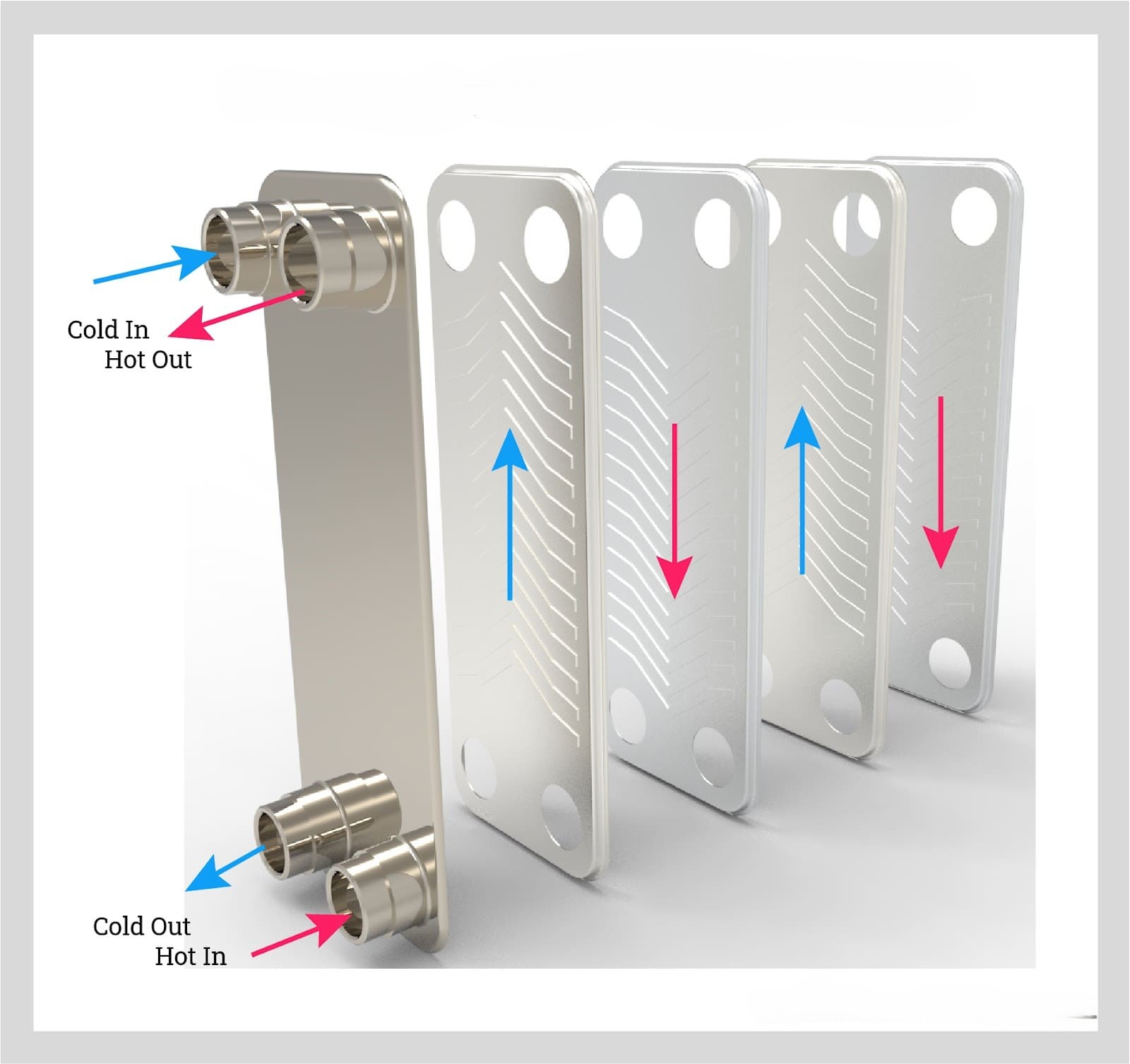
While a brazed plate heat exchanger (BPHE) is renowned for its compact design and energy efficiency, the true secret to its exceptional thermal performance lies within the intricate plate patterns. These aren’t merely decorative; the specific geometry embossed onto each corrugated plate fundamentally dictates the unit’s heat transfer efficiency, pressure drop, and suitability for various applications. From the most common chevron to more specialized designs, each pattern is a masterclass in fluid dynamics engineering, designed to maximize contact between fluids and the heat exchange surface, thereby significantly boosting overall heat exchange capabilities in a minimal footprint. The sophisticated design of Plate Patterns Brazed Heat Exchanger systems centers around advanced corrugation geometries that dramatically enhance thermal performance and heat transfer efficiency. There are two types: intermating and chevron corrugations. In general, greater heat transfer enhancement is produced from chevrons for a given increase in pressure drop and are more commonly used than intermating corrugations. The Chevron Plate Heat Exchanger Pattern utilizes strategically designed corrugation angles ranging from 20° to 75°, with each angle offering distinct thermal and hydraulic characteristics. The thermal and hydraulic performance of BPHEs is strongly affected by the plate surface corrugation patterns. Although a variety of corrugation patterns are commercially available but the chevron corrugation geometry dominates the current market. These Corrugated Plate Heat Exchanger Patterns create highly turbulent flow conditions by forcing fluids through tortuous pathways, maximizing heat transfer coefficients while optimizing pressure drop characteristics for various industrial applications.
How Plate Patterns Drive Turbulence and Heat Transfer
The primary function of these sophisticated plate patterns is to induce and maintain a high degree of turbulent flow within the narrow channels formed between adjacent plates. Unlike laminar flow, turbulence continuously disrupts the stagnant boundary layers that would otherwise impede convective heat transfer. The peaks and valleys of the chevron pattern, for instance, create countless points of fluid redirection, swirling the media and ensuring fresh fluid is constantly exposed to the heat transfer surface area. This engineered turbulence drastically improves the heat transfer coefficient, allowing for more efficient heat extraction or rejection, which translates directly into superior thermal efficiency and substantial energy savings for the operating system. The precision engineering of Herringbone Pattern Heat Exchanger designs involves critical geometric parameters that directly influence thermal performance and pressure characteristics. The geometry optimisation of the corrugated surface was limited to the chevron angle β and the corrugation depth e, with the corrugation pitch Λ being generally 3-4 times the corrugation depth. The inclination angle β has a large influence on the single-phase flow patterns, HTC and the friction factor. Advanced Brazed Plate Corrugation Design utilizes sophisticated flow pattern analysis where a pair of plates with a high β angle (> 45 °) gives a turbulence and therefore a high heat exchange with a higher pressure drop. A smaller angle (β <45 °) causes a lower turbulence flow and lower heat exchange coefficients but also lower pressure drops. The search for a compromising β angle between high exchange coefficients and acceptable load losses is therefore essential. Modern Multi Channel Plate Patterns incorporate optimized corrugation depths and pitches that create complex three-dimensional flow paths, ensuring maximum surface contact between fluid streams while maintaining manageable pressure drop characteristics.
Balancing Performance: Heat Transfer vs. Pressure Drop
The choice of plate pattern involves a critical trade-off between heat transfer capability and pressure drop. “Hard” patterns, characterized by steeper chevron angles and deeper corrugations, generate higher turbulence, leading to excellent high heat transfer rates. However, this increased turbulence also results in a higher pressure drop across the exchanger. Conversely, “soft” patterns, with shallower angles, offer a lower pressure drop, making them suitable for applications with flow-rate limitations or where pumping costs are a significant concern, though typically at the expense of slightly lower heat transfer. Manufacturers carefully select and combine these plate designs—sometimes even using asymmetric plate patterns—to optimize the BPHE performance for specific duties, whether it’s a viscous oil cooling application or a low-pressure HVAC system. The intricate Plate Heat Exchanger Flow Patterns generated by chevron corrugations create sophisticated mixing mechanisms that significantly outperform traditional smooth-tube designs. The corrugated pattern on the thermal plate induces a highly turbulent fluid flow. The high turbulence in the PHE leads to an enhanced heat transfer, to a low fouling rate, and to a reduced heat transfer area. Research demonstrates that Turbulent Flow Plate Patterns with specific chevron angles achieve remarkable performance improvements, where higher Nusselt number (Nu) and friction factor at the increasing chevron angle of 35°–65° provide optimal thermal efficiency. The Cross Flow Plate Heat Exchanger Pattern technology enables counter-current flow configurations that maximize temperature differential utilization, with modern units achieving temperature approaches as low as 1°C compared to 5°C or higher for conventional shell-and-tube exchangers.