
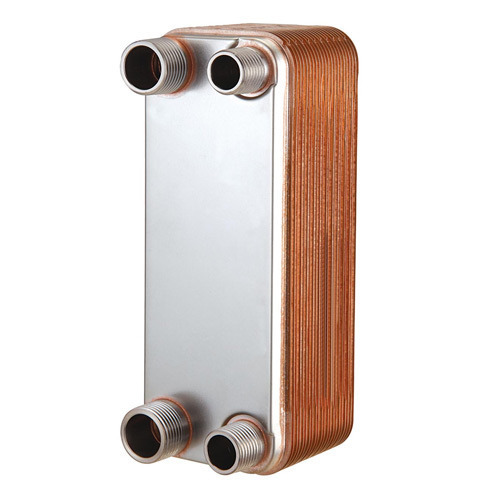
Brazed plate heat exchangers (BPHEs) are engineered to provide exceptional durability under high-pressure and high-temperature conditions, while still maintaining their compact and lightweight form. Their gasket-free, fully brazed design makes them far stronger and more resistant to leaks than traditional gasketed plate or shell-and-tube heat exchangers. By using copper or nickel as brazing materials, the plates are permanently fused into a single, solid unit, ensuring excellent structural integrity and long-term performance even in the most demanding environments.
Most standard BPHEs can withstand working pressures up to 30 bar (435 psi), making them ideal for HVAC, refrigeration, hydraulic, and oil cooling systems. However, advanced models designed for special applications — such as CO₂ transcritical refrigeration — can handle pressures exceeding 140 bar (2,030 psi). This makes BPHEs highly reliable for industries that deal with high-pressure refrigerants, compressed gases, and hydraulic circuits. Their ability to handle pressure spikes, surges, and pulsations without deformation or leakage is a critical advantage in ensuring operational safety.
Brazed plate heat exchangers can operate efficiently across a wide temperature spectrum, typically from -196°C (cryogenic applications like liquefied natural gas or liquid nitrogen) to 225°C (steam, hot water, or thermal oil applications). This flexibility makes them equally useful in extremely cold refrigeration systems as well as in high-temperature heating, condensing, or energy recovery systems. Unlike gasketed exchangers, BPHEs do not suffer from gasket hardening or degradation at high temperatures, which improves reliability and reduces maintenance needs.
Another important factor is the choice of brazing material. Copper-brazed exchangers are widely used in HVAC and general industrial applications due to their strong bonding and affordability. Nickel-brazed exchangers, on the other hand, are ideal for corrosive environments, aggressive fluids, or higher temperature operations, ensuring longer service life under tough conditions.
The combination of high pressure and high temperature resistance allows BPHEs to replace larger and more expensive traditional heat exchangers, saving both space and costs while improving energy efficiency. Industries such as renewable energy (solar and geothermal heating), oil & gas, chemical processing, food & beverage, pharmaceuticals, and automotive increasingly prefer BPHEs because they deliver durability, efficiency, and reliability even under extreme operating conditions.