
Hydraulic oil chillers are essential in maintaining the proper temperature of hydraulic systems across various industrial machines. The core element that enables these chillers to remove heat from hydraulic oil is the refrigerant.
A refrigerant is a chemical fluid used in the refrigeration cycle to absorb heat from hydraulic oil and expel it to the surrounding environment. It undergoes phase changes — from liquid to gas and back — to perform this function. Choosing the right refrigerant is critical to the chiller’s efficiency, safety, compatibility, and environmental compliance.
This guide covers everything you need to know about refrigerants in hydraulic oil chillers — types, properties, applications, performance, safety, innovations, and environmental impact.
What Role Does the Refrigerant Play in Hydraulic Oil Chillers?
In a hydraulic oil chiller, the refrigerant works as the heat transfer medium between the hot hydraulic oil and the cooling system. Here’s how it works step-by-step:
- Heat Absorption (Evaporator):
The hot hydraulic oil flows through a heat exchanger. The refrigerant absorbs this heat and evaporates from liquid to vapor. - Compression (Compressor):
The vapor is compressed to increase its temperature and pressure. - Heat Rejection (Condenser):
The high-pressure vapor releases heat to the atmosphere or water loop and condenses back into a liquid. - Expansion (Expansion Valve):
The liquid refrigerant passes through an expansion valve, reducing pressure and cooling it before it enters the evaporator again.
This continuous cycle keeps hydraulic oil at an optimal temperature, which in turn enhances machinery performance and prolongs component life.
Types of Refrigerants Used in Hydraulic Oil Chillers
Different refrigerants are chosen based on cooling capacity, oil compatibility, pressure characteristics, environmental regulations, and safety. Here are the most widely used refrigerants:
R-134a (1,1,1,2-Tetrafluoroethane)
- Type: Hydrofluorocarbon (HFC)
- Properties:
- Non-toxic, non-flammable
- Medium pressure refrigerant
- Excellent for systems requiring stability and moderate cooling load
- Ideal for:
CNC machines, injection molding, robotics - GWP (Global Warming Potential): ~1430
- Ozone Depletion Potential: 0
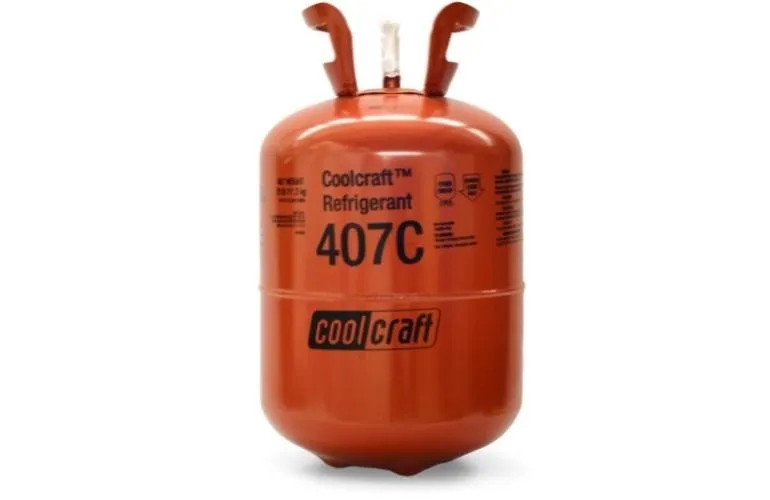
R-407C
- Type: HFC Blend (R-32, R-125, R-134a)
- Properties:
- Similar performance to R-22
- Non-ozone depleting
- Widely used as a transitional refrigerant
- Ideal for:
High-capacity oil chillers, presses, manufacturing lines - GWP: ~1770
R-410A
- Type: HFC Blend (R-32 and R-125)
- Properties:
- Higher pressure, greater cooling power
- Efficient in compact chiller units
- Ideal for:
High-pressure hydraulic systems, compact industrial chillers - GWP: ~2088
R-404A
- Type: HFC Blend
- Properties:
- Suited for low-temperature applications
- Very high cooling efficiency
- Ideal for:
Die-casting machines, continuous-duty chillers - GWP: ~3922
Environmental Considerations
Many old refrigerants like R-22 and R-12 are now banned due to:
- High Ozone Depletion Potential (ODP)
- High Global Warming Potential (GWP)
Current trends include:
- Phasing out HFCs like R-404A and R-410A
- Adopting natural refrigerants like R-290, R-600a, R-717
- Using next-gen synthetic refrigerants like R-1234yf with ultra-low GWP
Hydraulic oil chillers are now designed with low-GWP refrigerants to comply with:
- F-Gas Regulation (EU)
- Kigali Amendment (Global)
- Montreal Protocol
Technological Innovations in Refrigerants for Oil Chillers
- IoT Monitoring Systems:
Real-time refrigerant temperature/pressure monitoring with AI alerts. - Leak Detection Sensors:
Particularly for hydrocarbon or ammonia systems, enhancing safety. - Modular Refrigeration Units:
Designed for easy refrigerant switching as regulations change. - Inverter Compressors:
Match cooling output to load, improving refrigerant efficiency.
Refrigerants are the lifeline of hydraulic oil chillers. Their selection directly impacts:
- System cooling efficiency
- Oil temperature stability
- Machine uptime and safety
- Environmental responsibility
With regulatory landscapes evolving, eco-friendly refrigerants like R-290, R-717, and R-32 are gaining popularity in modern chillers. However, proper system design and safety measures are critical to their safe use.
As chillers evolve with smarter controls and energy-efficient designs, refrigerant choice must balance technical performance, legal compliance, safety, and sustainability.