
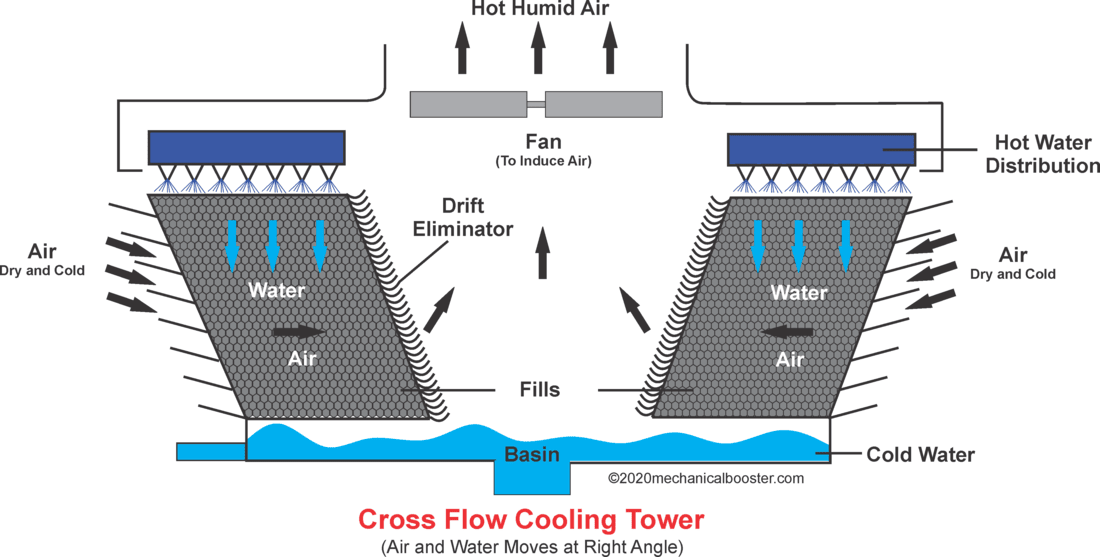
Crossflow cooling towers are among the most preferred solutions in industrial, HVAC, and commercial cooling applications due to their reliable performance, easy maintenance, and energy-efficient design. But behind every efficient crossflow tower is a carefully engineered structure that ensures it can handle both thermal loads and environmental stresses for years.
Understanding the structural components of a crossflow cooling tower gives insight into how these systems work so effectively. From the fan deck to the fill pack, every part plays a critical role in ensuring uniform water distribution, optimal airflow, and efficient heat rejection.
In this blog, we’ll explore the key components, their materials, their functions, and how they contribute to both performance and longevity.
Framework and Casing
The outer body and structural skeleton of a crossflow cooling tower form the backbone of the entire system.
Description:
- Typically made from galvanized steel, FRP (fiberglass-reinforced plastic), concrete, or wood
- Designed to support the internal components and resist environmental factors like wind, UV, and moisture
Key Functions:
- Provides mechanical strength and wind load resistance
- Encases and protects internal parts
- Offers mounting surfaces for fans, motors, drift eliminators, and piping
Keywords: cooling tower casing, FRP tower structure, galvanized cooling tower frame
Hot Water Distribution Basin
One of the defining features of crossflow towers is the gravity-fed distribution basin located at the top.
Description:
- A shallow tray or basin fitted with nozzles or orifice holes
- Made from FRP, stainless steel, or polypropylene
Key Functions:
- Evenly distributes hot water across the fill
- Operates without pressure (gravity-fed), reducing energy consumption
- Allows easy inspection and cleaning
Keywords: gravity water basin, open-type hot water distribution, low-pressure cooling tower
Fill Media
The fill is the heart of the cooling process, where most of the heat exchange occurs.
Description:
- Made of PVC or polypropylene sheets with a corrugated structure
- Installed vertically below the water basin
Key Functions:
- Maximizes surface area for water-air contact
- Slows water flow for improved evaporation
- Enhances cooling performance at minimal space
Keywords: crossflow fill pack, energy-efficient fill, thermal transfer media
Air Inlet Louvers
Located at the sides of the tower, air inlet louvers regulate ambient airflow into the fill section.
Description:
- Typically made of FRP or UV-resistant plastic
- Angled to block sunlight and debris
Key Functions:
- Ensures steady airflow into the tower
- Prevents splash-out and water drift
- Reduces sunlight, algae growth, and contamination
Keywords: air louvers, side airflow cooling tower, splash-out protection
Fan Deck and Fan Cylinder
The fan system is located at the top of the tower and is responsible for pulling or pushing air through the fill.
Description:
- Fan deck is the platform that supports the fan assembly
- Fan cylinder is the housing that ensures efficient airflow transition
Key Functions:
- Provides a sturdy base for motors and fans
- Directs airflow to reduce turbulence and pressure loss
- Often integrated with a VFD (Variable Frequency Drive) for energy control
Keywords: axial fan system, fan deck platform, VFD cooling fan assembly
Fan Motor and Drive System
Powering the fan is a motor, typically placed near or on the fan deck.
Description:
- Can be belt-driven or direct-driven
- Enclosed in weatherproof housing (IP55 or higher)
Key Functions:
- Draws air through the tower for evaporative cooling
- Speed can be adjusted based on load (via VFD)
- Consumes the majority of tower’s electrical energy, making efficiency crucial
Keywords: cooling tower fan motor, belt drive cooling tower, energy-saving fan system
Drift Eliminators
Drift eliminators are essential for minimizing water loss and environmental contamination.
Description:
- Multi-blade structure made from PVC or polypropylene
- Located above the fill and below the fan deck
Key Functions:
- Capture and return water droplets entrained in the airflow
- Prevent water drift, especially in chemically treated systems
- Maintain water efficiency and environmental compliance
Keywords: drift eliminators, water loss control, cooling tower drift management
The structural components of a crossflow cooling tower are not just about supporting the system physically — they ensure efficiency, durability, serviceability, and energy performance.
Each part — from the gravity-fed distribution basin to the drift eliminators — is meticulously engineered to allow:
- Easy access for maintenance
- Lower energy and water consumption
- Reliable thermal output under changing load conditions
- Long service life, even in demanding industrial environments