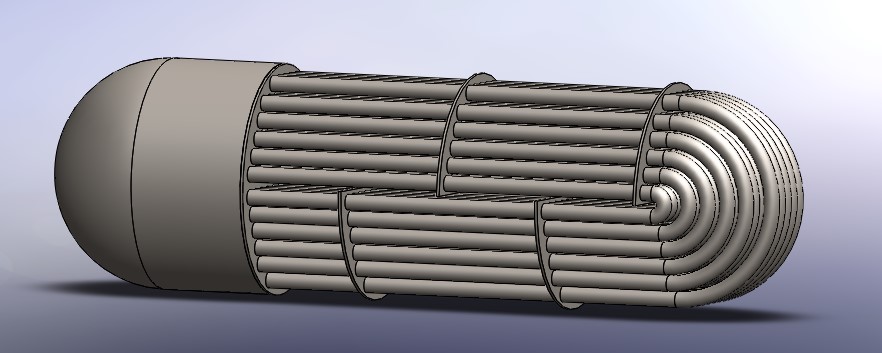
U-tube heat exchangers stand out in industrial cooling and heating applications due to their unique design and performance advantages. Unlike straight tube bundles, the U-tube configuration allows the tubes to bend and expand freely under thermal stress, minimizing the chances of cracking or damage caused by temperature fluctuations. This flexibility provides excellent thermal compensation, making U-tube exchangers a reliable choice for processes involving high temperature differences between fluids. Their design also reduces mechanical stress points, which enhances the overall durability and lifespan of the equipment.
Another key feature of U-tube heat exchangers is their compact and lightweight structure compared to other types. Since the tube bundle bends back into the same tube sheet, it eliminates the need for a second header, reducing material requirements and simplifying the construction. This makes them not only cost-effective but also easier to integrate into space-constrained facilities where equipment footprint matters. Additionally, U-tube exchangers can handle higher pressures and temperatures, making them versatile across industries such as power generation, petrochemicals, HVAC, and pharmaceuticals.
From a maintenance standpoint, U-tube heat exchangers offer a practical advantage. The tube bundle can be removed entirely for cleaning and inspection, making them suitable for applications where fouling is common. Even though individual tube cleaning can be slightly complex due to the bend, the overall ease of disassembly and the possibility of mechanical or chemical cleaning ensure long-term operational efficiency. Furthermore, the ability to replace damaged tubes individually adds another layer of cost-saving and sustainability, as it prevents complete unit replacements.
In summary, the unique features of U-tube heat exchangers—such as thermal stress resistance, compactness, high-pressure handling, and ease of maintenance—make them a preferred choice in demanding industrial operations. Their adaptability across diverse applications highlights why industries continue to rely on this design for efficient and reliable heat transfer.