
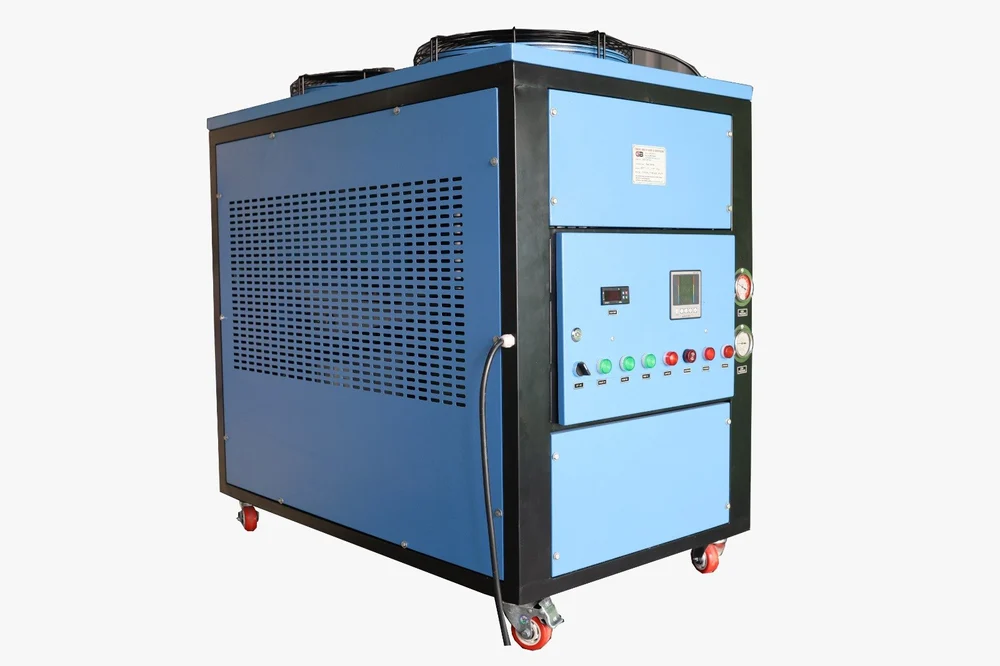
Understanding the working principle of oil chiller systems is essential for industries that rely on hydraulic power packs, CNC machinery, EDM equipment, and precision engineering tools. An oil chiller is a specialized industrial unit designed to regulate the temperature of high-viscosity oil used as a lubricant, coolant, or hydraulic medium.
During continuous machine operation, oil absorbs significant heat, which, if left uncontrolled, can lead to viscosity breakdown, mechanical wear, thermal expansion, and performance inaccuracy. Oil chillers operate using a closed-loop refrigeration cycle, effectively extracting heat from the oil and maintaining it at a set temperature. By ensuring thermal stability, oil chillers help extend equipment life, maintain machining accuracy, and reduce operational downtimes.
Oil Intake – Heat Source Identification
Hot oil from the system (spindle, hydraulic tank, press machine, etc.) is pumped into the oil chiller’s evaporator section. The heat source here is the thermal energy stored in the oil after absorbing mechanical and frictional heat.
Key Points:
- Oil can be mineral-based, synthetic, or dielectric depending on the application.
- Flow can be external (circulated via pump) or internal (immersion chillers).
Evaporator – Heat Exchange Starts
In this stage, the oil flows through a heat exchanger or evaporator, where it comes into thermal contact with a cold refrigerant. Heat is absorbed from the oil by the refrigerant, causing the refrigerant to evaporate.
Types of Heat Exchangers Used:
- Shell and tube (robust, high-capacity)
- Brazed plate (compact, efficient)
- Immersion coil (for direct oil tank applications)
Unique Insight:
- The design must accommodate oil’s high viscosity and lower thermal conductivity than water.
- Some systems have built-in oil filters to prevent fouling of internal coils.
Refrigeration Cycle – Heat Extraction Mechanism
Once the refrigerant absorbs heat from the oil and evaporates, it moves through the standard vapor compression refrigeration cycle, composed of:
Compressor
- Compresses the low-pressure vapor into high-pressure, high-temperature gas.
- This is the driving engine of the chiller system.
Compressor Types Used:
- Scroll (for precision)
- Rotary (for moderate load)
- Hermetic/semi-hermetic (for reliability)
Condenser
- This hot, high-pressure refrigerant gas now passes through the condenser.
- The condenser releases heat to the atmosphere (air-cooled) or water (water-cooled), converting the gas into a high-pressure liquid.
Expansion Valve
- This liquid refrigerant passes through the expansion valve, which reduces its pressure and temperature.
- The cold, low-pressure refrigerant re-enters the evaporator for the next cooling cycle.
Chilled Oil Circulation Back to Equipment
The cooled oil exits the evaporator at a controlled temperature and is recirculated back to the machine (hydraulic system, spindle housing, etc.).
Important Features:
- Thermostat or PID controller maintains desired oil temperature.
- Sensors monitor oil flow, pressure, and temperature for safety and performance.
- Many modern chillers integrate with SCADA or PLC systems for remote monitoring.
Advanced Note:
- Some oil chillers use variable-frequency drives (VFDs) to regulate compressor speed based on oil temperature load, improving energy efficiency.
Real-Time Monitoring and Control
Modern oil chillers include intelligent features like:
- Touchscreen HMI
- Digital thermostats with ±1°C accuracy
- Remote error alerts
- High/low oil pressure cut-offs
- Overload protection for compressor and pump
To sum up, the working principle of an oil chiller revolves around a precisely engineered process of refrigerant-based heat extraction, where thermal energy is drawn from industrial oil and dissipated via an air or water-cooled condenser. This continuous cycle ensures that the oil used in machine tools, hydraulics, and electronics operates within its optimal temperature range.
Oil chillers are not just auxiliary components but critical to maintaining productivity, equipment longevity, and safety in industrial settings. By understanding their working mechanism, manufacturers and engineers can make better decisions regarding oil cooling technology, leading to enhanced system reliability and energy efficiency.