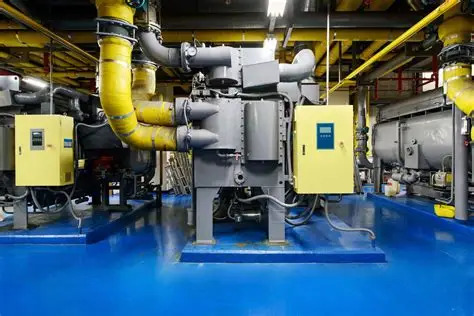
When businesses want to slash electricity costs or utilize “waste” energy, Absorption Chillers are the premier solution. Unlike standard vapor compression systems, these machines trade mechanical compressors for a thermal-chemical process.
Here is SEO-optimized content designed to capture traffic from engineers, facility managers, and sustainability consultants.
1. What is an Absorption Chiller?
An absorption chiller is a cooling system that uses a heat source (such as steam, hot water, or natural gas) to drive a refrigeration cycle. Instead of a mechanical compressor, it uses a chemical “absorbent”—typically Lithium Bromide ($LiBr$)—and a refrigerant—typically Water ($H_2O$).
This makes them ideal for facilities with access to cheap thermal energy or those looking to reduce their peak electrical demand.
2. How the Absorption Cycle Works
The magic of an absorption chiller lies in the affinity between the absorbent and the refrigerant. The efficiency of these systems is expressed as the Coefficient of Performance (COP), calculated by:
$$\text{COP}_{absorption} = \frac{Q_{cooling}}{Q_{heat\_input}}$$
The Four-Step Process:
- Evaporator: The refrigerant (water) evaporates at very low pressure, absorbing heat from the chilled water loop.
- Absorber: The refrigerant vapor is absorbed by a concentrated lithium bromide solution.
- Generator: A heat source (waste heat or steam) boils the refrigerant out of the lithium bromide solution to be reused.
- Condenser: The refrigerant vapor is cooled back into a liquid state, rejecting heat to a cooling tower.
3. Types of Absorption Chillers
Not all absorption systems are built the same. They are generally categorized by how many stages they use to recover heat:
| Type | Heat Source | Typical COP | Best Use Case |
| Single-Effect | Low-grade waste heat/Hot water | 0.6 – 0.7 | Industrial waste heat recovery. |
| Double-Effect | High-pressure steam/Natural gas | 1.0 – 1.2 | Commercial HVAC & District cooling. |
| Triple-Effect | High-temperature thermal | 1.4 – 1.6 | Cutting-edge high-efficiency plants. |
4. Why Switch to Absorption Cooling?
- Lower Electricity Bills: Since there is no massive motor-driven compressor, electrical consumption is negligible.
- Quiet & Vibration-Free: With fewer moving parts, these systems are significantly quieter than centrifugal or screw chillers.
- Sustainability (Eco-Friendly): They use water as a refrigerant, which has zero Ozone Depletion Potential (ODP) and zero Global Warming Potential (GWP).
- Waste Heat Recovery: Perfect for Combined Heat and Power (CHP) plants where “free” heat from engines or turbines can be converted into cooling.
5. SEO Quick-Tips for Absorption Chillers
- Primary Keyword: Absorption Chillers
- LSI Keywords: Thermally driven cooling, Lithium Bromide cycle, waste heat recovery, non-electric cooling.
- User Intent: Focus on “Cost Savings” and “Sustainability,” as these are the main drivers for this specific technology.
[Image suggestion: A simplified diagram showing the flow between the Generator, Condenser, Evaporator, and Absorber.]