When designing an industrial or commercial HVAC system, the debate often comes down to Cooling Towers vs. Chillers. While both are heat rejection systems, they operate on different physical principles and serve distinct…

Cooling Tower Repair Services Near Me
Expert Cooling Tower Repair Services Near You Is your cooling tower underperforming, leaking, or facing a sudden breakdown? Downtime in your cooling system can cripple operations, leading to costly production losses and potential…
Eco-Friendly Aspects of Using PVC Honeycomb Fills
Durability as a Pillar of Sustainability The primary eco-friendly advantage derived from utilizing PVC honeycomb fills lies in their exceptional material longevity. Unlike less resilient materials that degrade quickly due to exposure to…
Choosing the Right Fill Thickness for Your Cooling Tower
Understanding Fill Thickness and Its Fundamental Impact Selecting the appropriate fill thickness, more accurately described as the spacing between individual fill sheets, is a critical decision influencing a cooling tower's overall performance, efficiency,…
Why Honeycomb PVC Fills Are Ideal for High-Temperature Operations
Engineered Thermal Resilience for Elevated Operations Honeycomb PVC fills excel in high-temperature cooling tower operations up to 60°C by leveraging their unique cellular structure, which promotes even heat dissipation and prevents localized overheating.…
Difference Between PVC and PP Fills – Which Is Better for Cooling Towers?
Material Composition and Thermal Resistance Properties PVC (Polyvinyl Chloride) and PP (Polypropylene) fills represent two distinct material technologies in cooling tower applications, each offering unique advantages for specific operational environments. PVC fills are…
Maintenance of Natural Draft Cooling Towers
Natural Draft Cooling Towers (NDCTs) are monumental structures that play a vital role in large-scale industrial cooling operations. While they are praised for minimal energy consumption and low mechanical complexity, their performance heavily…
Applications of Natural Draft Cooling Towers
Natural Draft Cooling Towers (NDCTs) are a cornerstone of thermal management in large-scale industrial operations. With their iconic hyperbolic shape, towering presence, and ability to cool vast volumes of water without mechanical fans,…
Materials Used in Natural Draft Cooling Towers
Natural Draft Cooling Towers (NDCTs) are some of the largest and most enduring industrial structures in the world. Found primarily in thermal power plants, refineries, and fertilizer industries, these hyperbolic structures operate without…
Fill Media in Natural Draft Cooling Towers
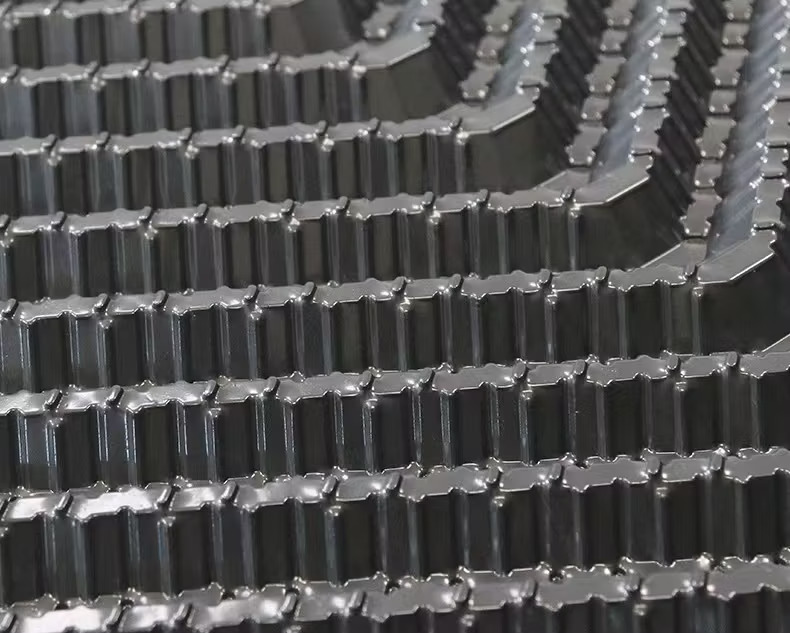
When it comes to Natural Draft Cooling Towers (NDCTs) — those iconic hyperbolic giants of the industrial landscape — the fill media quietly plays a starring role. Despite relying on passive airflow, these…

Drift Eliminators in Natural Draft Cooling Towers
Natural Draft Cooling Towers (NDCTs), with their towering hyperbolic shells and passive airflow mechanisms, are designed for large-scale heat rejection without mechanical fans. One often-overlooked yet critical component of these towers is the…
Components of Natural Draft Cooling Tower
Natural Draft Cooling Towers (NDCTs) are massive, hyperbolic structures that rely on natural convection to remove heat from industrial processes — without consuming energy for fans or mechanical parts. Behind their silent operation…
Hyperbolic Structure Design in Natural Draft Towers
One of the most iconic silhouettes in industrial engineering is the hyperbolic natural draft cooling tower. Its hourglass shape isn't just for aesthetics — it plays a critical role in airflow dynamics, structural…
Airflow Mechanism in Natural Draft Cooling Towers
Natural Draft Cooling Towers (NDCTs) operate without mechanical fans, yet they effectively cool thousands of cubic meters of water per hour. The secret lies in their airflow mechanism, which is both ingenious and…
Energy Efficiency of Natural Draft Cooling Towers
Among the various technologies available, Natural Draft Cooling Towers (NDCTs) stand out as a passive, fan-less, and highly energy-efficient solution. These massive hyperbolic structures offer long-term cost savings, environmental benefits, and unmatched scalability.…
Characteristics of Natural Draft Cooling Tower
Natural draft cooling towers are among the most iconic structures in industrial landscapes—recognized by their hyperboloid shape and colossal size. Unlike mechanical draft towers, these cooling systems rely on natural airflow to move…
Water Treatment in Evaporative Cooling Towers
Evaporative cooling towers rely on water as their primary medium for heat exchange. But untreated or poorly treated water can become a silent threat to both system performance and lifespan. Whether you're operating…
Drift Eliminators in Evaporative Cooling Towers
In the world of evaporative cooling systems, drift eliminators are one of the most underrated yet essential components. While the cooling tower’s primary job is to remove heat from water through evaporation, it's…
Fill Media in Evaporative Cooling Towers
Fill media is the heart of an evaporative cooling tower—it dramatically enhances the efficiency of the cooling process by increasing the surface area for heat and mass transfer. Without efficient fill material, a…
Components of Evaporative Cooling Tower
Evaporative cooling towers are essential heat rejection systems used in power plants, refineries, commercial HVAC, and industrial manufacturing facilities. Their design is based on maximizing efficiency, optimizing water and air flow, and ensuring…
Fan Systems in Evaporative Cooling Towers
In evaporative cooling towers, fan systems play a critical role in ensuring thermal efficiency by maintaining a consistent and controlled airflow. Whether in large-scale industrial plants, commercial HVAC systems, or power generation units,…
Materials Used in Evaporative Cooling Towers
The choice of materials in evaporative cooling towers plays a crucial role in determining their longevity, corrosion resistance, heat transfer efficiency, and maintenance cost. With rising demand for eco-efficient industrial cooling systems in…
Energy Efficiency in Evaporative Cooling Towers
In an era where energy conservation and sustainable operations are no longer optional but essential, industries across India are rapidly shifting toward energy-efficient cooling technologies. Among these, evaporative cooling towers have emerged as…
Characteristics of Evaporative Cooling Tower
In the evolving landscape of industrial cooling technologies, evaporative cooling towers have become the backbone of energy-efficient heat rejection systems. From HVAC applications in corporate hubs like Bengaluru and Mumbai to heavy-duty cooling…
Maintenance of Evaporative Cooling Towers
Evaporative cooling towers are the workhorses of industrial heat rejection systems, widely used in HVAC plants, chemical industries, power plants, refineries, steel plants, and food processing. Unlike dry cooling towers, they operate with…
Maintenance of Dry Cooling Towers
Dry cooling towers are valued for their water-saving design and low environmental impact, but maintaining their performance demands proactive care. Unlike wet cooling towers that suffer from water-related issues like scaling and microbial…