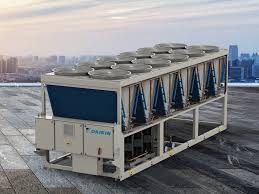
For an Air-Cooled Chillers page, your content should focus on ease of installation, low maintenance, and space-saving design. Unlike water-cooled systems, these units don’t require a cooling tower, making them the primary choice for facilities where water is scarce or maintenance budgets are lean.
Proposed Page Content
H1: High-Performance Air-Cooled Chillers: Versatile Industrial Cooling
Introduction When your facility requires reliable temperature control without the complexity of cooling towers and external piping, air-cooled chillers are the ultimate solution. Engineered for “plug-and-play” simplicity, these units reject heat directly into the ambient air, providing a self-contained cooling plant that can be installed on rooftops, parking lots, or ground-level pads.
H2: The Advantages of Air-Cooled Systems
Air-cooled industrial chillers are the preferred choice for modern manufacturing due to several key operational benefits:
- Lower Initial Cost: No need for cooling towers, condenser water pumps, or extensive chemical water treatment systems.
- Minimal Maintenance: Without a cooling tower, you eliminate the risk of Legionella, scale buildup in condenser tubes, and constant water testing.
- All-Weather Reliability: Our units are equipped with low-ambient head pressure control, allowing them to operate efficiently in temperatures ranging from -10°C to 50°C.
- Rapid Deployment: Because the refrigeration circuit is factory-sealed and tested, installation time is reduced by up to 50% compared to water-cooled plants.
H2: Technical Specifications & Component Quality
| Feature | Benefit for Industrial Processes |
| Microchannel Condenser Coils | Higher heat transfer efficiency with 30% less refrigerant charge. |
| VFD Screw or Scroll Compressors | Matches cooling output to your real-time load, saving energy. |
| Galvanized Steel Cabinetry | Powder-coated for superior corrosion resistance in outdoor environments. |
| Axial Low-Noise Fans | High-static pressure fans designed for quiet, high-volume airflow. |
H3: Understanding Heat Rejection Capacity
The performance of an air-cooled chiller is highly dependent on the Ambient Air Temperature ($T_{amb}$). The heat rejected ($Q_{rej}$) by the condenser is calculated as:
$$Q_{rej} = Q_{cooling} + W_{compressor}$$
As $T_{amb}$ rises, the Log Mean Temperature Difference ($\Delta T_{lm}$) between the refrigerant and the air decreases. To compensate, our chillers utilize oversized condenser surface areas ($A$) to ensure that even on a 45°C day, the compressor work ($W$) remains stable and prevents high-pressure trips.
H2: Ideal Applications
- Plastic Processing: Cooling injection molds and extruders in self-contained cells.
- Data Centers: Reliable supplemental cooling for server rooms and UPS systems.
- Printing & Packaging: Temperature control for high-speed rollers and UV curing lamps.
- Brewing & Distilling: Precise fermentation temperature management without water waste.
Meta Description for this Page
“Save on installation and maintenance with our high-efficiency air-cooled chillers. Compact, ‘plug-and-play’ cooling for 2-ton to 200-ton industrial loads. Get a quote.”