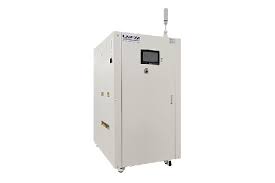
Automotive Testing Chillers: Precision Cooling for the Future of Mobility
In the automotive industry, innovation is driven by rigor. From testing the endurance of a new Electric Vehicle (EV) battery to simulating the extreme conditions of a high-performance combustion engine, temperature control is the most critical variable.
Automotive testing chillers are high-precision thermal management systems designed to provide the exact temperatures needed for R&D, quality control, and safety certification.
Why Precision Cooling is Vital in Automotive Testing
Modern vehicles are complex ecosystems of electronics, chemicals, and mechanical parts. To ensure they perform in the Sahara or the Arctic, engineers rely on chillers to simulate these environments with surgical precision.
1. EV Battery & Drivetrain Testing
Electric vehicle batteries are highly sensitive to temperature. During rapid charge/discharge cycles, they generate immense heat. An automotive chiller provides the necessary cooling to:
- Prevent thermal runaway during stress tests.
- Simulate real-world driving conditions across various climates.
- Test the efficiency of the vehicle’s internal Thermal Management System (TMS).
2. Dynamometer (DYNO) Cooling
When a vehicle is pushed to its limits on a dyno, the engine, transmission, and exhaust systems generate heat that would normally be dissipated by moving air. A dedicated chiller provides constant coolant flow to keep these components within operating parameters, ensuring test data remains accurate.
3. Component Environmental Testing
From sensors and ADAS (Advanced Driver Assistance Systems) to transmissions and fuel injectors, components must be tested for thermal shock. Chillers allow for rapid temperature ramping—moving from -40°C to +150°C in minutes.
Key Features of Automotive-Grade Chillers
Not all chillers are built for the lab. Automotive testing requires specific “heavy-duty” capabilities:
- Ultra-Wide Temperature Ranges: The ability to handle both cryogenic lows and high-temperature peaks.
- Rapid Ramping Rates: Precision control that can change temperatures quickly to simulate “cold starts” or sudden acceleration.
- High-Pressure Pumps: Designed to push coolant through the narrow, high-resistance channels found in modern battery cold plates and heat exchangers.
- Explosion-Proof Options: Essential for testing fuel-based systems or hydrogen fuel cells where volatile vapors may be present.
Comparison: Standard Industrial vs. Automotive Testing Chillers
| Feature | Standard Chiller | Automotive Testing Chiller |
| Tolerance | $\pm 1.0^{\circ}C$ | $\pm 0.1^{\circ}C$ to $\pm 0.05^{\circ}C$ |
| Temp Range | $5^{\circ}C$ to $35^{\circ}C$ | $-40^{\circ}C$ to $+180^{\circ}C$ (Typical) |
| Communication | Basic On/Off | CANbus, EtherCAT, Modbus for Lab Integration |
| Fluid Compatibility | Water/Glycol | Galden, Dielectric Fluids, Oil, Glycol |
Future-Proofing for EV and Autonomous Tech
As the industry shifts toward Level 5 Autonomy and 800V Battery Architectures, the demand for sophisticated cooling is skyrocketing.
- Direct-to-Chip Cooling: Used for testing the high-powered computers inside autonomous vehicles.
- Dielectric Cooling: Testing immersion-cooled battery packs where the coolant comes in direct contact with electrical components.
Conclusion
In the automotive world, a failed test is a costly setback. An automotive testing chiller is more than just a piece of equipment—it is an insurance policy for your R&D data. By providing stable, repeatable, and extreme thermal conditions, these chillers help bring the next generation of vehicles to market faster and safer.