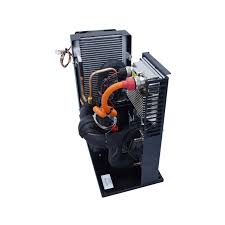
Battery Cooling Chillers (EV): Powering the Future of Electric Mobility
In the world of Electric Vehicles (EVs), the battery pack is more than just a fuel tank; it is a complex chemical reactor that is highly sensitive to temperature. Battery cooling chillers are the critical infrastructure behind EV development, ensuring that high-voltage battery systems remain safe, efficient, and long-lasting.
Whether you are testing a new lithium-ion architecture or managing a fleet of ultra-fast charging stations, precision thermal management is the key to unlocking maximum performance.
The Science of EV Battery Cooling
Lithium-ion batteries have a “sweet spot” for operation—typically between 15°C and 35°C. When batteries operate outside of this window, performance drops, and safety risks increase.
EV Battery Chillers provide three vital functions:
- Heat Dissipation During Rapid Discharge: During high-speed driving or heavy acceleration, batteries generate immense internal heat that must be removed instantly.
- Fast-Charging Thermal Control: Ultra-fast charging can skyrocket battery temperatures. A chiller manages this heat, allowing for shorter charging times without damaging the cells.
- Thermal Uniformity: Keeping every cell in a large pack at the same temperature to prevent “hot spots” that lead to premature battery degradation.
Key Features of EV Testing & Charging Chillers
Not all chillers are built for the unique demands of the automotive electrical sector. High-performance EV chillers require:
- Dielectric Fluid Compatibility: Many modern EVs use immersion cooling or specialized coolants. Chillers must be compatible with fluids like Galden, 3M Novec, or specialized glycols.
- Ultra-Precise Temperature Stability: Achieving tolerances of $\pm 0.1^{\circ}C$ to ensure that R&D data is accurate and repeatable.
- High-Pressure Pumping: EV battery cold plates often have narrow, high-resistance channels. Chillers need powerful, variable-speed pumps to maintain consistent flow.
- Dynamic Load Handling: The ability to react instantly to “thermal spikes” when a battery starts a high-current discharge test.
Applications in the EV Ecosystem
| Application | Role of the Chiller | Why It Matters |
| Battery R&D | Life-cycle and stress testing | Determines the 10-year lifespan of the battery. |
| Fast-Charging Stations | Cooling the charging cable and battery | Enables “10-to-80%” charging in under 20 minutes. |
| Drive-Cycle Simulation | Replicating various climates | Ensures the EV performs in both Alaska and Arizona. |
| Safety Testing | Managing thermal runaway tests | Vital for meeting international safety certifications. |
Advantages of Dedicated EV Cooling Solutions
1. Preventing “Thermal Runaway”
Safety is the priority. A dedicated chiller acts as a fail-safe, aggressively removing heat during stress tests to prevent the dangerous chain reaction known as thermal runaway.
2. Enhancing Battery Life (SOH)
Consistent cooling preserves the State of Health (SOH) of the battery. By eliminating thermal stress, these chillers help manufacturers guarantee longer warranties and better vehicle resale value.
3. Compact and Modular Design
Modern EV labs are often crowded. High-density chillers provide massive cooling kilowatts in a small footprint, often featuring “plug-and-play” connectivity with lab automation software.
The Road Ahead: 800V and Beyond
As the industry shifts toward 800V architectures and silicon carbide (SiC) inverters, the heat loads are becoming more concentrated. Tomorrow’s EV battery chillers must be smarter, faster, and more efficient to keep up with the next generation of hyper-efficient electric transport.