
As industries push for sustainable, cost-effective, and environmentally conscious cooling solutions, dry cooling towers have become a vital technology across multiple sectors. Unlike conventional wet cooling towers that consume vast amounts of water and require frequent maintenance, dry cooling towers operate using ambient air to reject heat, eliminating water loss and chemical usage.
These systems are gaining widespread adoption in power plants, refineries, data centers, and pharmaceutical industries, especially in areas facing water scarcity or strict environmental regulations. Dry cooling towers provide not just operational reliability but also contribute to ESG compliance, zero-liquid-discharge mandates, and energy-saving goals.
In this blog post, we’ll explore the key characteristics, applications, and benefits of dry cooling towers and why they are an ideal choice for today’s advanced cooling requirements.
Key Characteristics of Dry Cooling Towers
Water-Free Operation
One of the most valuable features of dry cooling towers is their non-reliance on water. There’s no evaporation, no drift, and no water replenishment required. This makes them ideal for:
- Water-stressed locations
- Regions with high water tariffs
- Zero-liquid-discharge (ZLD) plants
Impact: Up to 95% water savings compared to traditional wet towers.
Air-Cooled Heat Transfer Mechanism
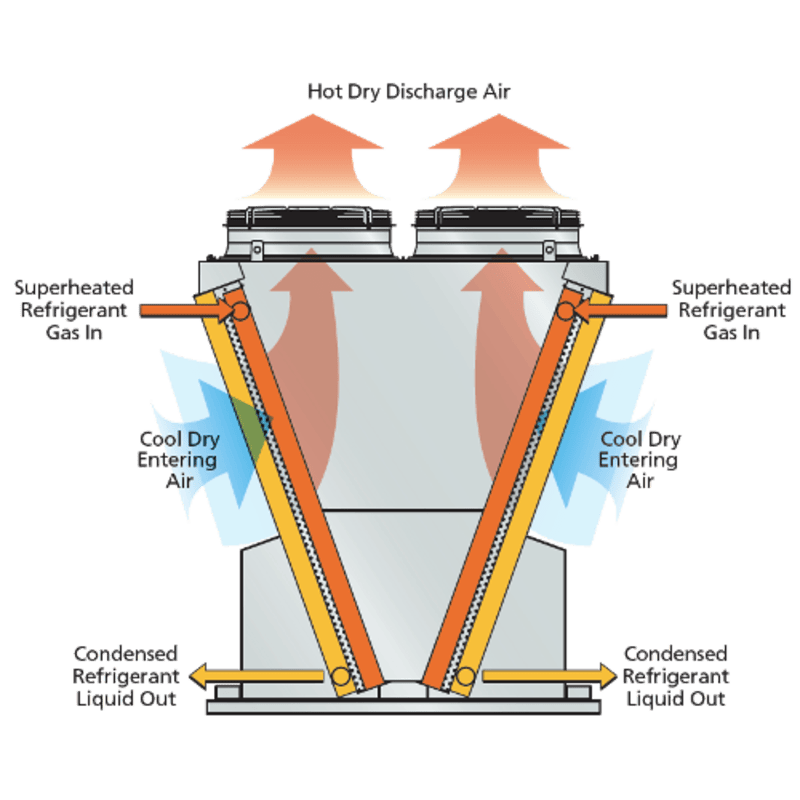
Dry cooling towers use ambient air to cool process fluids via finned-tube heat exchangers. Large axial fans draw in air, which flows over the hot coils, removing heat without physical contact with the fluid.
Advantage: Reliable even during high humidity, freezing conditions, or when water quality is poor.
Closed-Loop System
These towers operate in a closed-loop configuration, where process fluids never mix with external air or water. This helps:
- Prevent contamination and scaling
- Avoid corrosion of internal systems
- Reduce fouling, biofilm, and microbial growth
Result: Extended lifespan of connected chillers, compressors, or heat exchangers.
Minimal Maintenance Requirements
Dry cooling systems do not require water treatment chemicals, sludge cleaning, or algae control. This translates into:
- Lower maintenance costs
- Reduced labor efforts
- Fewer system shutdowns
Also: No need for blowdown systems, basin heaters, or filtration systems.
Eco-Friendly and Green Building Compliant
Due to zero drift and no water usage, these towers emit no water vapor or chemical mist, which helps comply with:
- Green building certifications (LEED, GRIHA)
- Environmental Protection Laws
- Legionella compliance (no standing water)
Perfect fit for: Urban commercial buildings, hospitals, and pharmaceutical sectors.
Modular and Scalable
Dry cooling towers are manufactured as modular systems, allowing easy expansion or relocation. You can start with a basic setup and scale based on future requirements.
Best for: Projects with tight timelines, limited space, or future expansion plans.
Popular Industrial Applications of Dry Cooling Towers
- Thermal & Nuclear Power Plants
- Oil & Gas Refineries
- Chemical and Petrochemical Plants
- HVAC Cooling for Commercial Buildings
- Data Centers & Server Rooms
- Food Processing and Cold Storage Units
Dry cooling towers are not just an alternative—they’re a smart evolution in industrial heat rejection systems. With zero water dependency, low maintenance, modular flexibility, and eco-compliant operation, they offer everything a modern facility needs for sustainable performance.
Whether you’re running a power plant, data center, manufacturing unit, or a green building, dry cooling towers deliver long-term cost savings, operational reliability, and minimal environmental footprint. As industries continue to move toward net-zero goals and water conservation, dry cooling towers are positioned to lead the future of process cooling.