
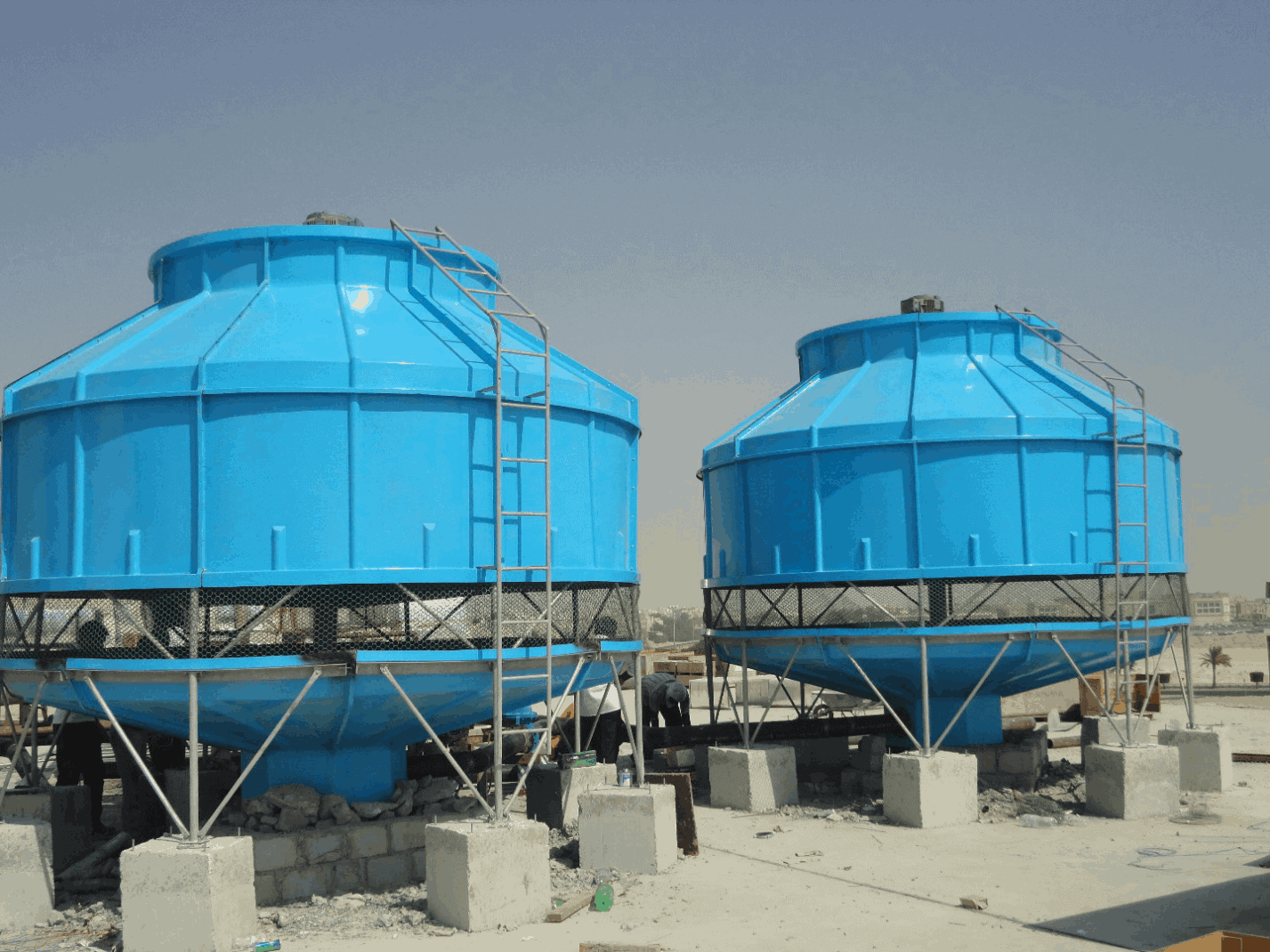
Cooling towers play a pivotal role in industrial heat rejection systems, and among the many types available, the Round Type Cooling Tower, also known as the bottle-shaped cooling tower, stands out due to its unique design and operational efficiency. These towers are engineered with a 360-degree cylindrical structure that not only enhances thermal performance but also brings significant advantages in space utilization, maintenance ease, and cost-efficiency.
Primarily used in small to medium-scale industries, such as plastics, textiles, pharmaceuticals, food processing, and HVAC applications, round type cooling towers have gained widespread popularity for their compact form factor, low drift losses, and robust adaptability to Indian weather conditions. Their fiberglass-reinforced plastic (FRP) construction offers superior resistance to corrosion, making them a reliable choice in harsh industrial environments where water quality or atmospheric conditions might compromise the longevity of traditional towers.
Aerodynamically Designed Circular Casing
The signature round (bottle-shaped) design is not just visually distinctive but also functionally superior. This shape allows air to flow smoothly from all directions without facing abrupt resistance, unlike square or rectangular towers.
- The 360° air intake ensures that the tower utilizes the ambient air uniformly from all sides, enhancing the cooling efficiency.
- Its aerodynamic profile also reduces the formation of stagnant air zones, improving the overall thermal performance even in turbulent environments or shifting wind directions.
- This shape helps in maintaining consistent airflow and heat transfer irrespective of the tower’s orientation on the site.
Minimum Drift Losses (Reduced Water Carryover)
Drift refers to the water droplets that escape from the cooling tower along with exhaust air. Round type towers naturally manage drift better due to their symmetrical internal airflow.
- Their design minimizes abrupt air turbulence and ensures smooth exit of moist air through the fan without lifting significant quantities of water droplets.
- Many modern round cooling towers are equipped with built-in drift eliminators that capture and return water droplets, conserving water and avoiding damage to nearby equipment or buildings.
- This feature is especially important in regions facing water scarcity or in industries with water conservation policies.
High Structural Stability in Windy and Cyclonic Areas
The absence of sharp corners in a circular tower allows it to withstand high wind loads better than rectangular structures.
- Wind pressure is distributed evenly around the curved body, reducing the risk of structural fatigue, especially in coastal areas, open fields, or elevated platforms.
- The stability also contributes to long service life and low repair frequency, even under challenging outdoor conditions.
Self-Cleaning Water Basin Effect
Round cooling towers often include a centrally sloped or vortex-shaped basin, which promotes a swirling water motion.
- This swirling action discourages the settling of dust, algae, and scale-forming minerals at the base of the tower.
- As a result, the basin requires less frequent cleaning, reducing maintenance downtime and extending the life of internal components.
- This makes the system more hygienic and efficient over time, especially in dusty industrial areas or hard water zones.
Low Noise Operation
Unlike other cooling towers that may produce higher noise levels due to side air intake or aggressive fan placement, round towers are designed with top-mounted axial fans.
- This vertical airflow pattern reduces horizontal air turbulence, resulting in lower noise emissions.
- Such systems are ideal for urban or sensitive environments like hospitals, data centers, schools, or office buildings where noise control is crucial.
- Additionally, many manufacturers offer low-noise motors and fan blades for sound-critical applications.
To sum up, Round Type Cooling Towers offer a strategic balance of design simplicity, functional efficiency, and operational durability. Their aerodynamic shape ensures uniform airflow and cooling distribution, while their lightweight, corrosion-resistant FRP construction reduces maintenance and extends their service life. These towers are also more space-efficient, easier to install, and better suited to deal with the operational challenges of Indian industries — from high temperatures and humidity to dusty air and inconsistent power supply.
With their modular nature, quiet operation, and lower water losses, round cooling towers are particularly suited for businesses looking to upgrade or maintain an effective cooling solution without expanding their footprint or operational costs. Whether it’s a rooftop HVAC system, a chemical process unit, a plastic molding facility, or a textile dyeing plant, these towers bring versatility and performance to the forefront.