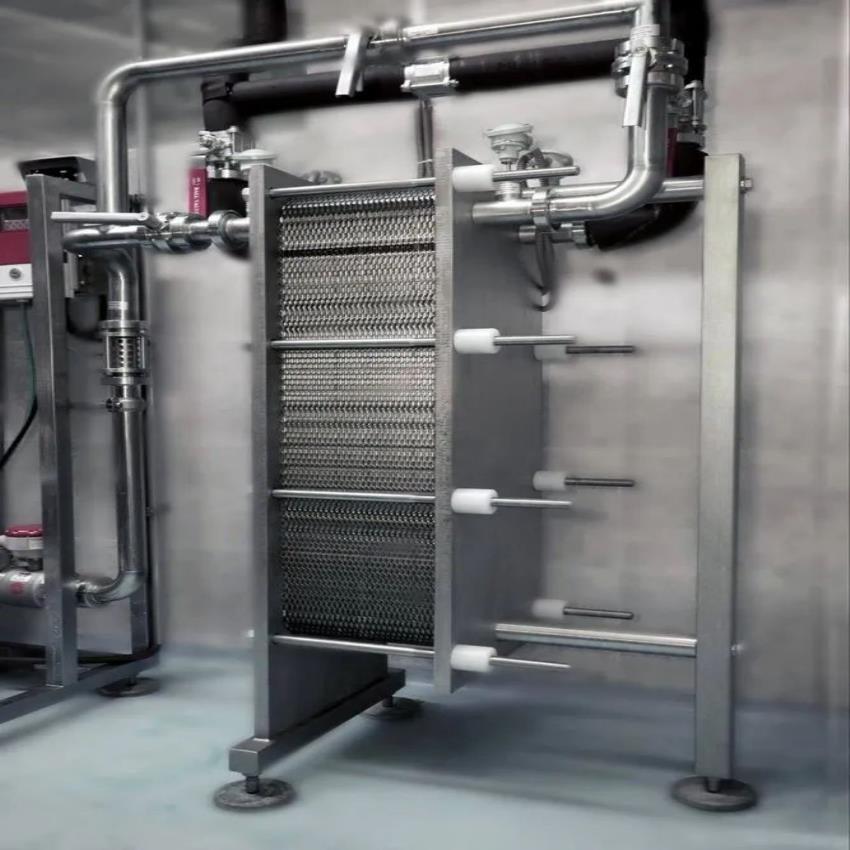
For a Chiller with Heat Exchanger page, your content should focus on system isolation, thermal efficiency, and protection. This configuration is the gold standard for “indirect cooling,” where the process fluid must be kept separate from the chiller’s internal refrigerant loop to prevent contamination, corrosion, or pressure issues.
Proposed Page Content
H1: Industrial Chillers with Integrated Heat Exchangers: Peak Thermal Efficiency
Introduction
In many high-stakes industrial processes, direct cooling isn’t an option. Whether you are dealing with corrosive chemicals, food-grade products, or high-pressure hydraulics, our chillers with integrated heat exchangers provide the perfect thermal bridge. By isolating your process fluid from the internal refrigeration loop, we ensure maximum system longevity and zero risk of cross-contamination.
H2: Why Choose an Indirect Cooling Configuration?
Integrating a high-efficiency heat exchanger—such as a plate, shell-and-tube, or coaxial model—offers several critical advantages:
- Contamination Barrier: Protects the chiller’s evaporator from scaling, debris, or chemical attack from the process side.
- Corrosion Resistance: We offer exchangers in SS316, Titanium, or Copper-Nickel to handle aggressive fluids, salt water, or deionized water.
- Pressure Isolation: Allows the chiller to operate at standard pressures while the process side handles high-pressure or high-viscosity fluids.
- Compact Footprint: Our Brazed Plate Heat Exchangers (BPHE) provide massive surface area in a small space, ensuring high BTU removal without the bulk.
H2: Technical Specifications by Exchanger Type
| Exchanger Type | Best Use Case |
| Brazed Plate (BPHE) | Maximum efficiency for clean water, glycol, and light oils. |
| Shell & Tube | Heavy-duty industrial use; ideal for high-fouling or dirty fluids. |
| Coaxial (Tube-in-Tube) | Best for high-pressure applications or fluids with small particulates. |
| Titanium Plate | Essential for saltwater, chemical plating, and corrosive acids. |
H3: Optimizing the Log Mean Temperature Difference (LMTD)
The effectiveness of your heat exchanger is driven by the LMTD. Our engineers size each system to maximize the driving force for heat transfer, defined as:
$$\Delta T_{lm} = \frac{(T_{h,in} – T_{c,out}) – (T_{h,out} – T_{c,in})}{\ln\left(\frac{T_{h,in} – T_{c,out}}{T_{h,out} – T_{c,in}}\right)}$$
By optimizing this value, we ensure your process hits the exact target temperature—whether it is 7°C for HVAC or -10°C for food processing—while consuming the least amount of energy possible.
H2: Key Industries & Applications
- Chemical Processing: Isolating exothermic reactions from the main cooling plant.
- Food & Beverage: Using food-safe exchangers for wort, milk, or juice cooling.
- Metal Finishing: Cooling anodizing and electroplating baths with acid-resistant exchangers.
- Renewable Energy: Thermal management for hydrogen refueling and battery testing.
Meta Description for this Page
“Maximize cooling efficiency with our industrial chillers featuring integrated heat exchangers. Protect your system from contamination and corrosion. Request a quote.”