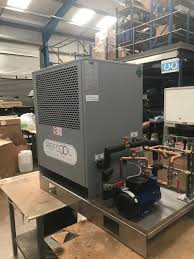
Component Manufacturing Chillers: Precision Cooling for High-Yield Production
In the world of precision engineering, heat is the enemy of accuracy. From CNC machining and laser cutting to plastic injection molding and semiconductor fabrication, component manufacturing chillers are the silent partners that ensure every part meets its exact specifications.
When a single millimeter or a micro-degree of thermal expansion can result in a rejected batch, industrial-grade cooling isn’t just a utility—it’s a competitive advantage.
The Critical Role of Chillers in Component Manufacturing
Every manufacturing process generates friction and heat. Without a dedicated chiller, this thermal energy accumulates, leading to equipment wear and inconsistent part quality.
Component manufacturing chillers provide three essential benefits:
- Dimensional Stability: By keeping tools and workpieces at a constant temperature, chillers prevent the thermal expansion that causes parts to drift out of tolerance.
- Increased Throughput: Rapid cooling allows for faster cycle times in processes like injection molding or die-casting, putting more parts in the shipping bin every hour.
- Spindle and Tool Protection: In high-speed machining, chillers protect expensive spindles from overheating, extending the lifespan of your most valuable equipment.
Applications Across the Factory Floor
| Process | Chiller Function | Impact on Quality |
| CNC Machining | Cools the spindle and cutting fluid | Maintains sub-micron accuracy and tool sharpness. |
| Injection Molding | Rapidly cools the molds | Prevents warping and ensures a smooth surface finish. |
| Laser & Plasma Cutting | Manages the resonator and optics | Ensures a clean, precise cut with minimal heat-affected zones. |
| Electronics Assembly | Controls wave soldering temperatures | Prevents component damage and ensures strong solder joints. |
Key Features of Manufacturing-Grade Chillers
Not all industrial chillers are created equal. For a high-volume component line, your cooling system needs:
- 24/7 Duty Cycles: Manufacturing doesn’t stop, and neither should your cooling. Look for units designed for continuous industrial operation.
- Precise Temperature Control: Sophisticated PID controllers that maintain setpoints within $\pm 0.5^{\circ}C$ to ensure process repeatability.
- High-Pressure Fluid Pumps: Necessary to push coolant through the narrow internal channels of high-tech machinery and molds.
- Small Footprint / Modular Design: Floor space is at a premium. Modern chillers offer high cooling density, fitting easily into existing production cells.
Choosing Between Air-Cooled and Water-Cooled Systems
- Air-Cooled Chillers: The most popular choice for individual machines. They are easy to install, require no external water source, and can be moved if the shop floor is reorganized.
- Water-Cooled Chillers: Ideal for large-scale facilities with an existing cooling tower. They offer superior energy efficiency and don’t dump heat back into the factory environment.
The ROI of Precision Cooling
Investing in a dedicated component manufacturing chiller pays for itself through:
- Reduced Scrap Rates: Fewer parts “out of spec” means higher profit margins.
- Lower Maintenance Costs: Protecting your machines from heat stress reduces unexpected downtime and expensive repairs.
- Energy Efficiency: Modern chillers use variable-speed compressors that only consume the power needed for the current load.
Summary
In an era of “just-in-time” manufacturing and zero-defect requirements, thermal management is a cornerstone of success. A high-performance component manufacturing chiller gives you the control you need to produce perfect parts every time, regardless of the production volume or ambient conditions.