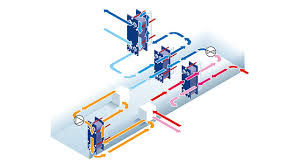

For a Desert Cooling Chiller System page, your content must focus on extreme heat tolerance and high-ambient performance. You are targeting industries in regions like the Middle East, Australia, or the Southwestern US, where temperatures regularly exceed $45^\circ\text{C}$ ($113^\circ\text{F}$), causing standard chillers to trip on high-pressure faults.
Proposed Page Content
H1: Desert Cooling Chiller Systems: Engineered for High-Ambient Extremes
Introduction
When the mercury rises above $50^\circ\text{C}$ ($122^\circ\text{F}$), standard industrial chillers often fail, leading to catastrophic production delays. Our desert cooling chiller systems are purpose-built for the world’s harshest climates. Engineered with oversized heat rejection surfaces and specialized compressors, these units provide rock-solid process cooling even in intense desert heat and abrasive sand conditions.
H2: Why Standard Chillers Fail in Desert Climates
Most chillers are rated for a maximum ambient temperature of $35^\circ\text{C}$ to $40^\circ\text{C}$. In desert environments, the Condensing Temperature ($T_c$) approaches the critical limit of the refrigerant, causing:
- High-Pressure Trips: Frequent shutdowns due to inadequate heat rejection.
- Compressor Overheating: Reduced lubricant viscosity leading to mechanical failure.
- Increased Power Consumption: Massive spikes in utility costs as the system struggles to stay cool.
H2: Advanced Features for Extreme Heat Resistance
Our desert-grade systems utilize specialized engineering to maintain a constant Energy Efficiency Ratio (EER) under thermal stress.
- Oversized Condenser Coils: Increased surface area ensures effective heat exchange even when the air-to-refrigerant temperature differential is narrow.
- High-Static “Desert Duty” Fans: Powerful fans capable of moving massive volumes of air through sand-trap louvers without stalling.
- Sand-Trap Intake Louvers: Specialized geometry that allows air in while causing heavy sand and dust particles to fall out, protecting the internal coils.
- Adiabatic Pre-Cooling Pads (Optional): Uses a small amount of water to mist the incoming air, dropping the effective ambient temperature by up to $15^\circ\text{C}$ before it hits the coils.
H2: Technical Specifications & Efficiency
| Feature | Desert Performance Benefit |
| Refrigerant Type | High-critical point refrigerants (e.g., R-134a or R-513A) |
| Cabinet Finish | UV-resistant, heat-reflective solar coatings |
| Motor Insulation | Class H insulation for high-temperature operation |
| Control System | Remote monitoring for proactive “Extreme Heat” alerts |
H3: The Physics of Heat Rejection
In desert cooling, the Log Mean Temperature Difference ($\Delta T_{lm}$) is the driving force. To keep the process fluid cool, we must maximize the heat transfer equation:
$$\dot{Q} = U \times A \times \Delta T_{lm}$$
By increasing the Area ($A$) of the condenser and maintaining a high Heat Transfer Coefficient ($U$) via anti-clogging designs, our systems reject heat efficiently even when the ambient air is scorching.
H2: Applications in Arid Regions
- Oil & Gas Refineries: Cooling for mission-critical processing equipment.
- Mining Operations: Reliable thermal management for remote excavation sites.
- Concrete Batching: Temperature control for large-scale construction pours in the heat.
- Power Plants: Auxiliary cooling for turbines and electrical switchgear.
Meta Description for this Page
“Stop high-pressure shutdowns with desert cooling chiller systems. Engineered for $50^\circ\text{C}+$ ambient heat with sand-trap louvers and oversized condensers. Request a quote.”