Round type cooling towers—also known as bottle-type FRP cooling towers—are widely used across industries for process water cooling. Their design ensures compact performance with maximum heat rejection in a small footprint. But there’s a hidden hero in this system that often goes unnoticed: the drift eliminator.
Despite its small size, a drift eliminator plays a massive role in water conservation, equipment protection, and air quality control.
Let’s explore what drift eliminators are, how they work, the different types, and why they’re non-negotiable for high-efficiency cooling tower systems—especially in areas where water loss, contamination, or regulatory compliance is a concern.
What Is a Drift Eliminator?
A drift eliminator is an internal component in a cooling tower designed to trap water droplets (drift) carried upward by air movement. These droplets are formed during the evaporative cooling process and, if not captured, escape through the fan outlet—leading to:
- Water wastage
- Environmental hazards
- Equipment corrosion
- Poor air quality in nearby areas
Drift eliminators redirect the airflow using strategically designed paths—usually a series of baffles or vanes—forcing entrained droplets to change direction and fall back into the tower basin.
Where Are Drift Eliminators Located in Round Cooling Towers?
In round cooling towers, the drift eliminator is typically installed:
- Just below the fan deck (top of the tower)
- Above the fill media and sprinkler system
- Integrated into the dome or top casing
This location allows it to capture all upward-moving air before it exits the tower.
Types of Drift Eliminators in Round Towers
PVC Blade-Type Drift Eliminators
- Most common type used in round towers.
- Made of UV-stabilized PVC blades stacked at alternating angles.
- Cost-effective and easy to replace.
FRP Molded Drift Eliminators
- Used in high-temperature or chemical environments.
- High durability and corrosion resistance.
- Often custom-designed for bottle-type towers.
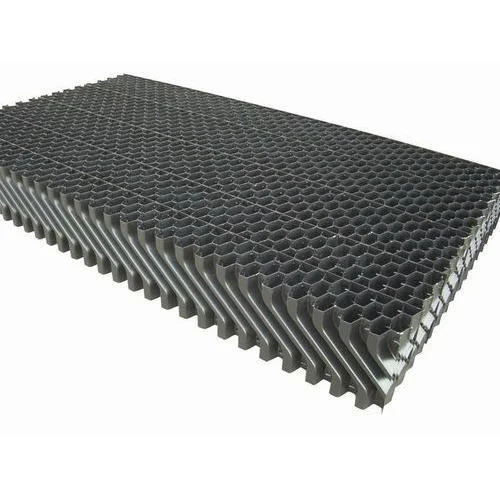
Cellular or Honeycomb Drift Eliminators
- Engineered for high-efficiency water capture.
- Offer very low pressure drop with high drift retention.
- Ideal for premium cooling systems or regulatory compliance zones.
Benefits of High-Quality Drift Eliminators
Water Conservation
- Reduces water wastage from tower drift.
- Can cut down water loss to as low as 0.001% of circulation rate.
Protects Surrounding Environment
- Prevents moisture buildup on nearby machinery, walls, or electrical systems.
- Avoids slippery floors, corrosion, and safety hazards in adjacent zones.
Air Quality Control
- Stops aerosolized minerals or chemicals from being released into the air.
- Critical in pharma, food, and urban environments.
Regulatory Compliance
- Many municipalities and green certifications (like LEED) mandate low drift loss.
- Helps in meeting environmental and occupational safety standards.
Materials Used for Drift Eliminators
| Material | Ideal For | Benefits |
|---|---|---|
| PVC | Standard HVAC, general industries | Lightweight, low cost, easy to replace |
| FRP | Chemical plants, marine, high-heat areas | Corrosion and UV resistant, durable |
| HDPE | Temporary setups or compact towers | Lightweight and weatherproof |
Maintenance Tips for Drift Eliminators
- Inspect every 6–12 months for scaling, algae, or physical damage.
- Clean with non-metallic brushes or water spray.
- Replace if baffles are broken, misaligned, or sagging.
- Ensure the airflow path is clear for efficient operation.
In round cooling towers, where airflow moves vertically through the dome, drift eliminators play a vital role in ensuring that evaporative cooling doesn’t come at the cost of water loss, equipment damage, or environmental harm.
Whether you’re operating a cooling tower in a chemical plant, food factory, hospital, or commercial complex, using high-efficiency drift eliminators will:
- Conserve water
- Improve cooling efficiency
- Extend equipment life
- Keep your operations compliant and safe