To rank well for a technical topic like Modular and Redundant Chillers, your content needs to balance high-level engineering benefits with practical “peace of mind” for facility managers.
Here is a SEO-optimized content structure designed to capture search intent for keywords like HVAC reliability, scalable cooling solutions, and N+1 redundancy.
The Ultimate Guide to Modular & Redundant Chillers: Efficiency Meets Reliability
In modern industrial and commercial cooling, “downtime” isn’t just an inconvenience—it’s a financial disaster. Whether you are managing a data center, a hospital, or a manufacturing plant, your cooling system is the heartbeat of your operation.
This is where Modular Chiller Plants and Redundancy Configurations become the gold standard for HVAC infrastructure.
What is a Modular Chiller System?
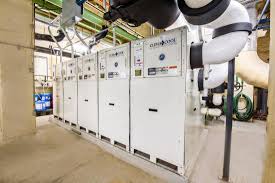
Unlike traditional monolithic chillers, a modular system consists of multiple smaller chiller units (modules) piped together to act as a single machine.
Key Benefits:
- Scalability: Start with the cooling capacity you need today and add modules as your facility grows.
- Ease of Installation: Modules are often designed to fit through standard doorways and into freight elevators, eliminating the need for expensive cranes or structural demolition.
- Energy Efficiency: Because these systems can stage individual modules on and off, they match your building’s “part-load” demand much more accurately than one large chiller.
Understanding Redundancy: The Power of N+1
Redundancy is your insurance policy against mechanical failure. In a redundant setup, you have more cooling capacity than your maximum load requires.
| Configuration | What it Means | Why it Matters |
| N | The minimum capacity needed to cool the building. | No backup; if the chiller fails, the building overheats. |
| N+1 | Your total capacity (N) plus one extra module. | If one module fails or needs service, the “plus one” keeps the system at 100% capacity. |
| 2N | Two completely independent systems. | The highest level of reliability; common in Tier IV data centers. |
Why Choose Modular Over Traditional Chillers?
- Lower Lifecycle Costs: While the upfront cost may be comparable, the ability to service one module while the others remain operational saves thousands in emergency rentals and lost productivity.
- Compact Footprint: Modular units can be arranged in “banks,” making them ideal for tight mechanical rooms where space is at a premium.
- Built-in Safety: In a modular system, the “failure point” is isolated. If one compressor goes down, you only lose 10–20% of your capacity, rather than the whole 100%.
Applications for Redundant Cooling
- Data Centers: Where even a 2°C rise can trigger server shutdowns.
- Healthcare Facilities: Critical for MRI cooling and operating room climate control.
- Pharmaceutical Lab: Protecting temperature-sensitive chemicals and research.
Conclusion: Future-Proof Your Facility
Investing in a modular, redundant chiller system isn’t just about buying hardware; it’s about buying uptime. By utilizing an N+1 strategy, you ensure that maintenance is a scheduled task rather than an emergency.
Are you planning a retrofit or a new build? Don’t get locked into a single-point-of-failure system.