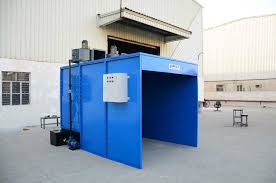
Paint Booth Chillers: The Key to Flawless Industrial Finishing
In high-end automotive, aerospace, and industrial coating sectors, the difference between a mirror-like finish and a costly rework often comes down to one variable: temperature control. A paint booth chiller is an essential tool for maintaining the precise thermal environment required for modern paints and coatings to bond and cure perfectly.
From controlling the temperature of the spray media to managing the humidity of the booth air, a dedicated chiller ensures that your finishing line remains consistent, regardless of the weather outside.
Why Temperature Matters in the Paint Booth
Modern coatings—especially waterborne and high-solids paints—are chemically sensitive. Even a slight deviation in temperature can lead to significant defects:
- Viscosity Control: If the paint is too warm, it runs; too cold, and it becomes too thick to atomize, leading to “orange peel” textures.
- Flash-Off Times: Precise cooling ensures that solvents evaporate at the correct rate, preventing solvent trap and “pinholing.”
- Condensation Prevention: By managing the dew point within the booth, chillers prevent moisture from settling on the substrate, which is the leading cause of adhesion failure.
Applications of Chillers in Finishing Lines
Paint booth chillers aren’t just for cooling the air; they serve several critical roles in a professional finishing setup:
1. Air Makeup Unit (AMU) Cooling
In humid or tropical climates, chillers are used to dehumidify the intake air. By cooling the air below its dew point, moisture is stripped out, providing “dry” air that is essential for waterborne paint systems.
2. Heat Exchanger Cooling
Many automated spray systems use heat exchangers to keep the paint at a constant temperature right up to the spray tip. A chiller provides the steady loop of cold fluid needed to maintain this thermal stability.
3. Curing Oven Support
While ovens provide the heat for curing, chillers are often used in the “cool-down” zones of a conveyor line, allowing parts to be handled or packaged sooner without risking damage to the fresh coat.
Key Features of a Paint Booth Chiller
To survive the demanding environment of a paint shop, a chiller must be more than just powerful:
- Explosion-Proof (XP) Options: Essential for booths involving solvent-based paints where flammable vapors are present (Class 1, Div 1/2 environments).
- High Filtration: Built-in protection to prevent overspray or dust from clogging the condenser coils.
- Corrosion Resistance: High-quality coatings on the coils (such as epoxy or e-coating) to protect against the chemicals and solvents used in the shop.
- Tight Tolerance Control: Maintaining a setpoint within $\pm 0.5^{\circ}C$ to ensure that the “Recipe” for your paint remains unchanged throughout the day.
Comparison: Standard HVAC vs. Industrial Paint Chillers
| Feature | Standard HVAC | Paint Booth Chiller |
| Stability | $\pm 2.0^{\circ}C$ | $\pm 0.5^{\circ}C$ |
| Duty Cycle | Intermittent | 24/7 Continuous |
| Environment | Clean Air | Chemical/Overspray Resistant |
| Safety | General Purpose | Available in Explosion-Proof |
Benefits of Investing in Precision Cooling
- Eliminate Seasonal Variability: Your paint will behave exactly the same in mid-July as it does in January.
- Reduce Material Waste: Proper viscosity means less overspray and better transfer efficiency, saving thousands in paint costs.
- Higher Throughput: Faster flash-off and controlled cooling cycles mean more parts through the booth every shift.
- Superior Aesthetics: Achieve the high-gloss, defect-free finishes that premium clients demand.
Summary
A paint booth chiller is an investment in quality assurance. By removing the “weather variable” from your finishing process, you reduce reworks, save on materials, and deliver a consistently superior product.