
Refrigerant used in oil chillers forms the heart of the thermal transfer process, enabling the system to extract heat from high-viscosity industrial oils and reject it through a condenser. Unlike residential or air conditioning systems, oil chillers operate under higher stress, fluctuating loads, and often dirty environments, which demand more robust and specialized refrigerant choices.
Choosing the right refrigerant impacts not just cooling efficiency but also system longevity, compressor health, energy consumption, and compliance with environmental standards.
Common Refrigerants Used in Oil Chillers – With Deep Dive
R-134a (Tetrafluoroethane)
One of the most widely used refrigerants for medium temperature oil chillers. Works well in ambient industrial environments, especially for machines like CNCs, EDMs, hydraulic systems, etc.
- Operating pressure: Medium
- Oil compatibility: Works well with POE oils
- Thermal stability: High; ideal for long operational hours
Why it’s used:
- Non-flammable and safe for technicians
- Good energy efficiency for general applications
- Excellent for oil chilling from 35°C to 20°C range
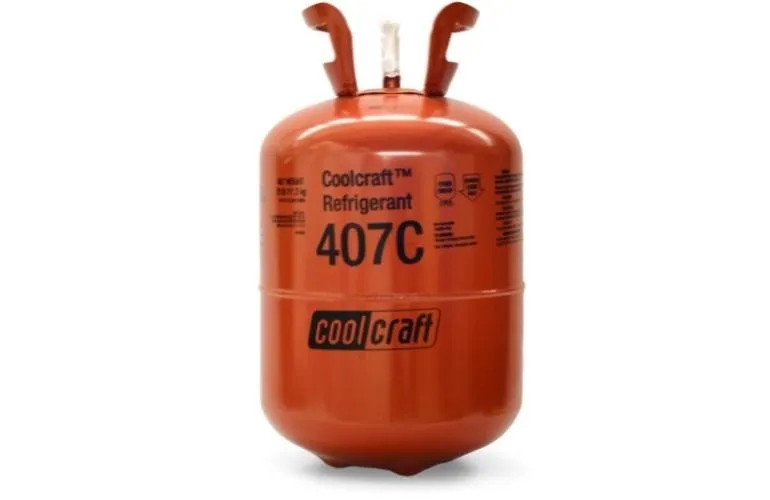
R-407C
This is a zeotropic blend of R-32, R-125, and R-134a. It was developed as a replacement for R-22 and performs well in chillers designed for high ambient or higher capacity needs.
- Operating pressure: Slightly higher than R-134a
- Oil compatibility: POE oil required
- Applications: Gear oil chillers, large hydraulic reservoirs
Why it’s used:
- Similar performance to R-22 with zero ODP
- Stable under frequent load variations
- Slightly better heat exchange characteristics
R-410A
A high-pressure refrigerant used in compact chillers or newer high-performance models. Not suitable for retrofits of older R-22/R-134a systems due to its higher working pressure.
- Operating pressure: High
- Oil compatibility: POE oils
- Applications: Compact chiller modules, lab or precision chillers
Why it’s used:
- Small coil size with high heat exchange rate
- Ideal for space-saving installations
- Excellent for precise oil temperature control (±1°C)
R-404A
A blend mainly used for low-temperature cooling applications. Used in oil chillers where chilled oil must be supplied below 10°C — e.g., spindle cooling, deep hole drilling, or machining of thermally sensitive metals.
- Operating pressure: Moderate
- Oil compatibility: POE oils
- Applications: Low-temp oil cooling, cutting oil chillers
Why it’s used:
- Superior performance at sub-zero temperatures
- Maintains low discharge temperatures in compressors
- Stable under extended load cycles
Note: R-404A has very high GWP (Global Warming Potential) and is being phased out in many countries.
R-290 (Propane – Hydrocarbon Refrigerant)
A natural hydrocarbon refrigerant, used mainly in hazardous or flammable environments, such as oil chillers installed in chemical plants, paint booths, or mining applications.
- Operating pressure: Similar to R-22
- Oil compatibility: Compatible with mineral and POE oils
- Applications: Explosion-proof oil chillers, ATEX-rated environments
Why it’s used:
- Zero ozone depletion potential (ODP)
- Extremely low GWP (~3)
- Efficient heat exchange capability
Caution: Highly flammable, so requires special safety systems, flameproof enclosures, and sensor-based leak detection.
Emerging Refrigerants in Oil Chillers
Due to environmental compliance needs, newer refrigerants are emerging:
R-513A:
- Low-GWP alternative to R-134a
- Similar performance, better climate profile
R-1234yf / R-1234ze:
- Ultra-low GWP (close to 1)
- Being used in next-gen chillers especially in Europe and Japan
CO₂ (R-744):
- For high-pressure eco chillers
- Still rare in oil chillers due to complexity
The refrigerant used in an oil chiller is not just a medium—it’s the lifeline that determines the cooling efficiency, compressor health, energy usage, and regulatory compliance of the entire system. Each refrigerant — from the widely used R-134a to eco-forward R-290 — offers different performance curves and design requirements.
With industries moving toward low-GWP, high-efficiency, and safety-compliant refrigerants, it’s vital to choose a refrigerant based on application type, oil viscosity, required cooling range, and local regulations. A correct selection ensures optimized cooling, long service life, and environmental responsibility.