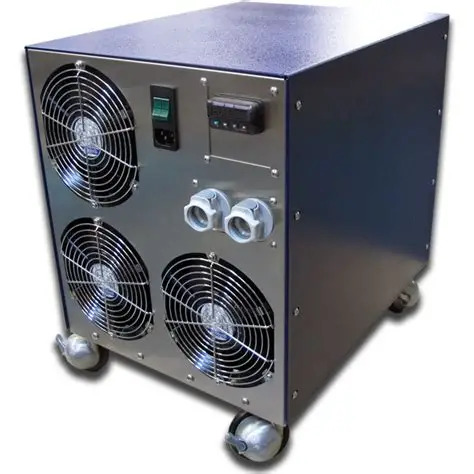
To rank for Thermoelectric Chillers, your content needs to highlight their unique “solid-state” nature. These systems are a stark contrast to traditional chillers because they have no moving parts and use no refrigerants, making them a favorite for laboratory, medical, and precision-tech applications.
Here is a structured, SEO-friendly layout for your page.
1. What is a Thermoelectric Chiller?
A thermoelectric chiller is a solid-state cooling system that uses the Peltier Effect to transfer heat. Unlike traditional chillers that rely on compressors and chemical refrigerants, these units use electricity and semi-conductors to create a temperature differential.
Because they lack compressors, they offer unparalleled precision and a compact footprint for specialized cooling needs.
2. The Science: How the Peltier Effect Works
The core of a thermoelectric chiller is the Thermoelectric Cooler (TEC) module. When a DC current flows through the device, it brings heat from one side to the other.
The efficiency and cooling capacity can be modeled by looking at the heat pumped at the cold junction ($Q_c$):
$$Q_c = \alpha IT_c – \frac{1}{2}I^2R – K(T_h – T_c)$$
Where:
- $\alpha$: Seebeck coefficient
- $I$: Electrical current
- $T_c / T_h$: Temperatures of the cold and hot sides
- $R$: Electrical resistance
- $K$: Thermal conductance
3. Key Advantages of Thermoelectric Technology
Why choose thermoelectric over vapor compression? It comes down to reliability and stability:
- Ultra-Precise Temperature Control: Can maintain temperatures within $\pm 0.01$°C, which is essential for laser cooling and DNA sequencing.
- No Moving Parts: Aside from small fans or pumps, there are no compressors. This means near-silent operation and incredibly high Mean Time Between Failures (MTBF).
- Eco-Friendly: These systems are 100% refrigerant-free. No CFCs, HCFCs, or high-GWP gases are used.
- Compact & Orientation Insensitive: They can be mounted in any direction and fit into tight rack-mount spaces where traditional chillers can’t go.
4. Common Applications
Thermoelectric chillers aren’t designed to cool skyscrapers; they are designed for “point-of-use” precision:
| Industry | Application |
| Medical | Reagent cooling, blood analyzers, and imaging equipment. |
| Laboratory | Electron microscopes, laser diodes, and CCD cameras. |
| Aerospace | Cooling sensitive electronics in high-vibration environments. |
| Manufacturing | Small-scale semiconductor wafer processing. |
5. SEO Strategy & Keywords
To capture the right traffic, ensure your metadata and headers include these terms:
- Primary Keyword: Thermoelectric Chillers
- Secondary Keywords: Peltier cooling system, solid-state chiller, refrigerant-free cooling, precision thermal management.
- Internal Linking: Link to your “Precision Cooling” or “Laboratory Equipment” categories.
- Alt-Text: Use “Thermoelectric Chiller Module Diagram” for your images to capture Google Image search traffic.