
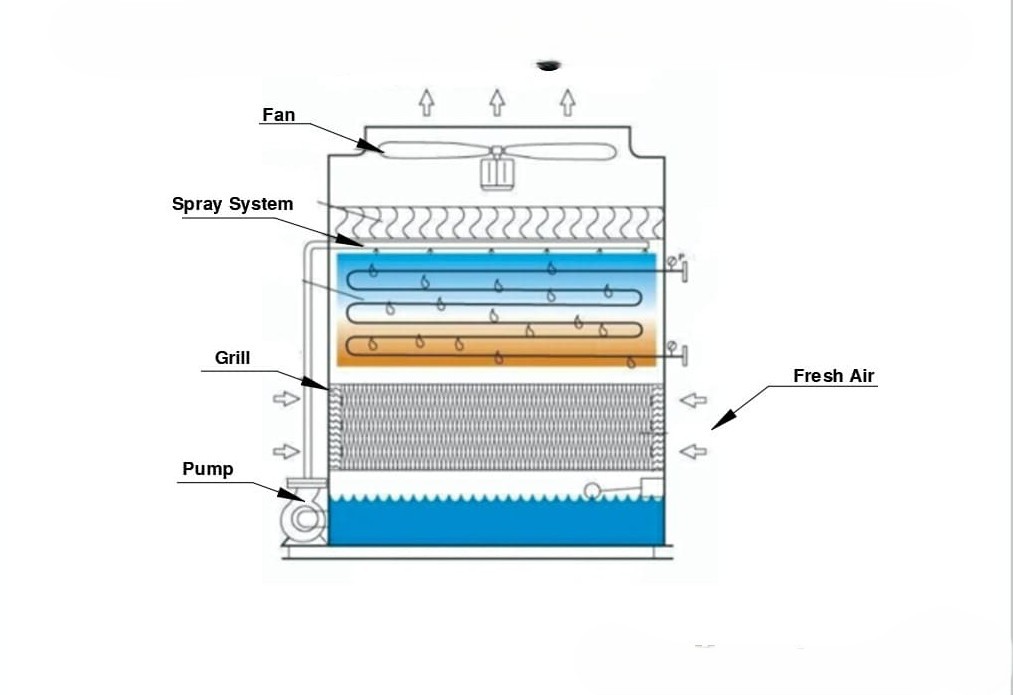
Closed loop cooling towers have become increasingly popular across industries that demand high thermal efficiency, contamination-free operation, and minimal maintenance. Unlike open systems that expose the process fluid to air, a closed loop cooling tower uses a sealed system where the fluid being cooled circulates within a closed coil, preventing it from coming into direct contact with external contaminants or ambient air.
This unique design makes closed circuit cooling towers ideal for HVAC systems, data centers, pharmaceutical plants, power stations, injection molding, machine tool cooling, and critical heat transfer applications where water quality, cleanliness, and temperature consistency are crucial.
In this blog, we’ll take a deep dive into the essential characteristics, performance advantages, and unique construction features of closed loop cooling towers—and why they’re becoming the preferred choice in modern industries.
What Is a Closed Loop Cooling Tower?
A closed loop cooling tower (also known as a closed circuit cooling tower) circulates the process fluid inside a sealed heat exchanger coil (usually copper, stainless steel, or galvanized). Ambient air and spray water are applied over the coil from the outside, cooling the fluid indirectly through heat exchange without exposing it to the environment.
Two Primary Loops:
- Internal Loop – Circulates process fluid inside the coil (remains clean and isolated)
- External Loop – Spray water + airflow over coil surface (responsible for heat rejection)
Key Characteristics of Closed Loop Cooling Towers
Sealed Heat Exchange System
- The process fluid (e.g., water, glycol mix, or oil) never contacts air or external contaminants.
- Ideal for systems where fluid cleanliness is critical—such as laser cooling, food processing, or medical chillers.
- Prevents dirt, debris, algae, and bacteria from entering the process fluid circuit.
Reduced Maintenance Requirements
- Unlike open towers, there’s no need for frequent cleaning of scale or biological growth inside coils.
- Longer intervals between blowdowns and chemical treatments.
- Minimal need for water treatment inside the closed system.
Efficient Heat Transfer
- Uses indirect evaporative cooling—air and water cool the external surface of the coils.
- Can handle high temperatures and varying load conditions with consistent cooling capacity.
- Equipped with high-performance fans, drift eliminators, and spray pumps to improve effectiveness.
Energy Saving Capabilities
- Lower water loss due to minimal evaporation inside the closed fluid circuit.
- Reduced pump energy due to lower required pressure in the process fluid circuit.
- Dry mode operation possible in cold weather (no spray water used), reducing energy and water consumption.
Comparison: Closed Loop vs Open Cooling Towers
| Feature | Closed Loop | Open Loop |
|---|---|---|
| Process fluid exposure | Fully sealed | Direct contact with air |
| Water contamination risk | Very low | High |
| Water treatment | Minimal | Frequent |
| Maintenance | Lower | Higher |
| Energy use | Lower (especially with VFDs) | Medium to High |
| Equipment life | Longer | Shorter (due to fouling) |
| Water loss | Low | High |
| Applications | Clean-sensitive | General industrial |
Common Industries That Use Closed Loop Cooling Towers
- Pharmaceutical plants
- Chemical process industries
- IT cooling / data centers
- Plastic molding factories
- Textile mills
- Food and beverage processing
- HVAC systems in hospitals, airports, malls
- Machine tools, CNC, and laser applications
Closed loop cooling towers combine the efficiency of evaporative cooling with the cleanliness of sealed systems, offering unmatched fluid protection, consistent performance, and lower lifecycle costs. Whether you’re dealing with sensitive machinery, high heat loads, or aggressive environments, closed circuit towers provide a reliable, modern solution that prioritizes cleanliness, sustainability, and performance.