
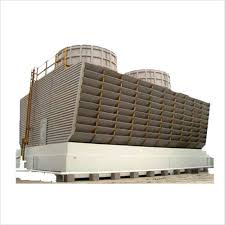
Traditional Strength. Natural Efficiency. Proven Performance.
Wooden cooling towers were among the earliest engineered cooling solutions and remain a preferred choice in various industries even today. Despite the rise of FRP and metal alternatives, wooden cooling towers have proven to offer high thermal performance, structural flexibility, and cost-efficiency for large-scale industrial cooling needs.
In this blog, we’ll explore the core characteristics, benefits, materials, and applications of wooden cooling towers—and why they still remain relevant, durable, and dependable in a modern cooling environment.
What Is a Wooden Cooling Tower?
A wooden cooling tower is a large, field-erected structure constructed using treated timber as the primary support and framework material. It typically includes:
- A wooden casing
- Splash fill media
- Drift eliminators
- Fans and motors
- A cold water basin
Used primarily for heavy-duty industrial cooling, these towers are favored for their robustness and custom-build capability.
Key Characteristics of Wooden Cooling Towers
High Structural Flexibility
Wooden towers are modular in construction, making them ideal for custom dimensions and site-specific layouts. This makes them a go-to solution for power plants, refineries, steel factories, and chemical units where large flow rates are involved.
Superior Thermal Efficiency
The wide spacing of splash bars and the open design allow:
- Better air-to-water contact
- Enhanced evaporative cooling
- High heat rejection even at peak loads
Wooden towers often use cross-flow or counter-flow designs to further boost heat exchange.
Use of Chemically Treated Timber
Modern wooden towers use CCA-treated timber (Copper Chromium Arsenic) or ACQ-treated wood, which makes them:
- Resistant to decay
- Insect- and fungus-proof
- Long-lasting even in wet conditions
Ease of Repair and Upgradation
One of the biggest advantages of wooden towers is their repairability. If a section is damaged, it can be replaced locally without dismantling the entire unit.
This lowers:
- Downtime
- Repair costs
- The need for skilled labor or expensive tools
Cost-Effective for Large Installations
When cooling requirements are high (10,000 TR or above), wooden towers become more economical than FRP due to:
- Lower raw material cost
- On-site fabrication flexibility
- Simple structural design
Noise Dampening Ability
Wood naturally absorbs vibration and sound, so wooden cooling towers operate with lower acoustic emissions compared to metal alternatives—especially in large industrial zones.
Materials Used in Wooden Cooling Towers
| Component | Common Material | Purpose |
|---|---|---|
| Structural Frame | Treated Sal Wood / Pine Wood | Support tower load and resist moisture |
| Fill Media | PVC bars / Timber splash bars | Maximize contact between air and water |
| Drift Eliminator | PVC / Wood slats | Prevent water droplets from escaping |
| Fan Deck | Timber with anti-skid coating | Walkway for maintenance staff |
| Hardware | Stainless steel / Galvanized bolts | Corrosion-resistant fastening |
Maintenance Requirements
Wooden towers do require regular upkeep to retain performance:
- Annual inspection of timber joints, splash bars, and support beams
- Periodic water treatment to avoid microbial decay
- Cleaning of fill media to avoid fouling
- Replacement of worn-out sections using local carpentry resources
Where Are Wooden Cooling Towers Still Used?
Wooden towers are commonly found in:
- Thermal power plants
- Cement factories
- Steel manufacturing units
- Chemical and petrochemical industries
- Distilleries and sugar mills
They’re especially effective in open-field, heavy-load environments where space and noise are not constraints.
Wooden vs FRP Cooling Towers
| Feature | Wooden Cooling Tower | FRP Cooling Tower |
|---|---|---|
| Cost (large size) | More economical | Expensive |
| Customization | High | Limited |
| Lifespan | 15–20 years (with care) | 15+ years |
| Repairability | Easy and local | Difficult and module-based |
| Installation | On-site construction | Factory fabricated |
While FRP and hybrid towers dominate the compact and modular space, wooden cooling towers still hold their ground in high-capacity, industrial-scale applications. They are:
- Durable
- Customizable
- Easy to repair
- Cost-effective for large installations
If your application demands bulk water cooling with long operational hours, investing in a CCA-treated wooden cooling tower offers a long-term, reliable cooling solution with proven field performance.