
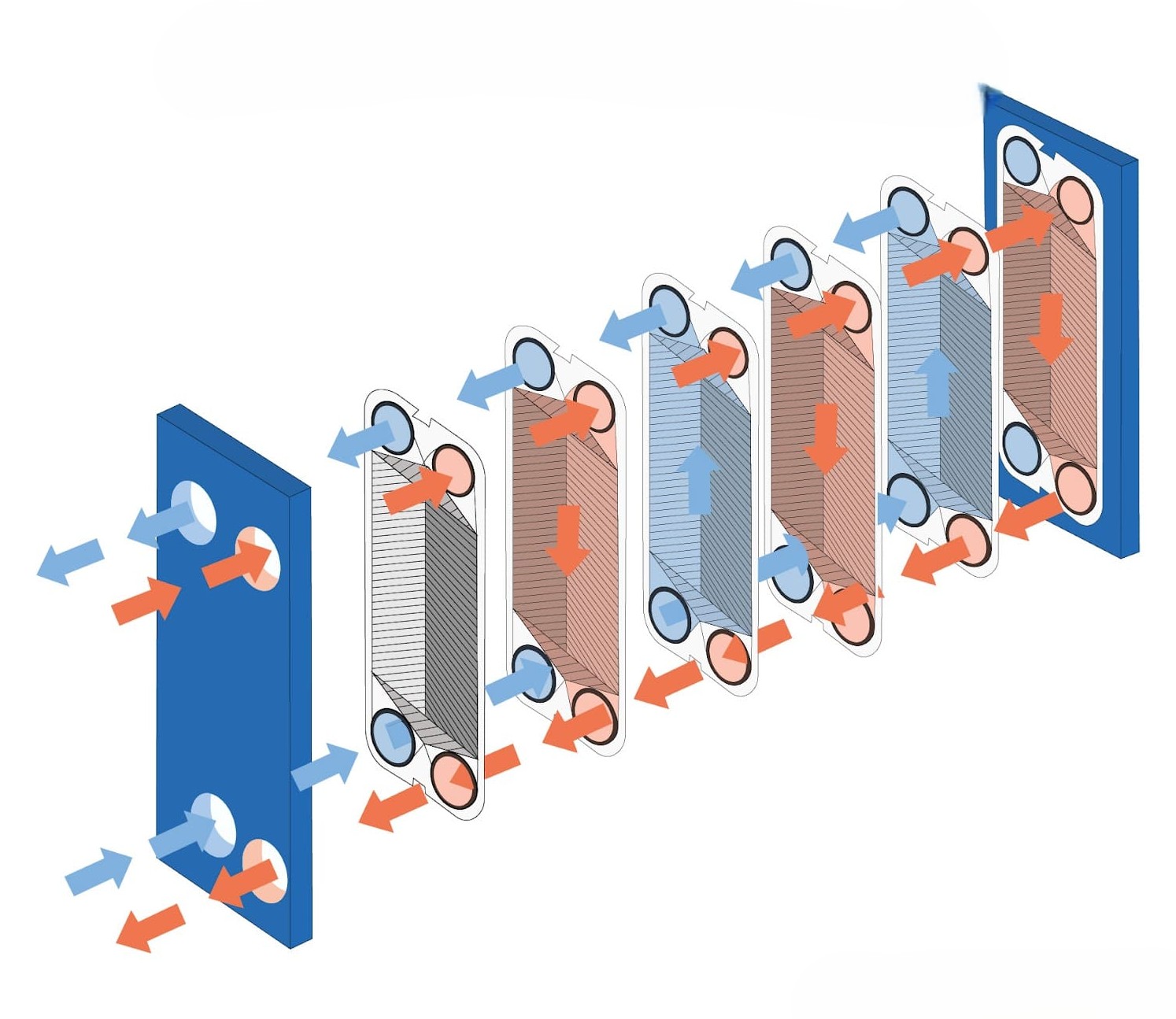
The Dual Dance of Convection and Conduction in a Compact Space
The core heat transfer mechanism within a Gasketed Plate Heat Exchanger (GPHE) is a highly efficient interplay of both convection and conduction, engineered into a remarkably compact footprint. Unlike traditional shell-and-tube designs, GPHEs maximize the heat exchange surface area through a series of thinly pressed metal plates, typically ranging from 0.4 mm to 0.6 mm in thickness. Hot and cold fluids flow in alternate channels, separated only by these thin plates. Heat energy from the hot fluid is first transferred to the plate material primarily via convective heat transfer at the fluid-to-plate interface. This energy then travels through the plate via conductive heat transfer, and finally, from the plate to the colder fluid, again through convection. This multi-layered, thin-plate architecture dramatically reduces the thermal resistance, allowing for exceptional thermal efficiency and a significantly higher overall heat transfer coefficient (U-value) compared to other heat exchanger types. Gasketed plate heat exchangers (GPHEs) achieve very high heat transfer coefficients because corrugated, herringbone‑style plates create narrow channels that force the fluids into helix‑like, highly turbulent flow—this turbulence raises the convective heat transfer coefficient (h) dramatically compared with laminar shell‑and‑tube passages while keeping the unit compact. The plate pattern, corrugation depth and chevron angle are tuning knobs: steeper angles boost turbulence (and h) but increase pressure drop, while shallower patterns lower Δp at the cost of some thermal efficiency. This balance between heat transfer and pressure drop is why designers commonly use Colburn (j‑) factor correlations and friction‑factor data when sizing and comparing plate designs.
Turbocharging Heat Exchange with Engineered Turbulence
The secret to a GPHE’s superior performance lies in the ingenious plate geometry and its ability to induce intense turbulent flow even at relatively low fluid velocities. Each plate is meticulously corrugated, often in a herringbone or chevron pattern, which forces the fluids to constantly change direction. This continuous mixing action prevents the formation of thick, stagnant laminar boundary layers – the primary resistors to convective heat transfer. By disrupting these layers, the corrugated channels ensure that fresh fluid particles are continuously brought into contact with the heat transfer surface. This high degree of turbulence significantly enhances the convective heat transfer coefficient on both sides of the plate, translating into rapid and efficient energy exchange across the minimal plate thickness. This engineered turbulence is a key differentiator, allowing GPHEs to achieve high Reynolds numbers and optimal mixing with lower pumping power than would be required in simpler, smooth-channeled designs. GPHEs normally operate in counter‑current or multipass arrangements so the hot and cold streams flow in alternating channels; that geometry produces very small LMTD requirements and enables close temperature approaches or even temperature cross in some duties. Practically, designers use Q = U·A·ΔTlm as the starting point and then iterate plate area (A), overall heat transfer coefficient (U), and plate pattern to hit the required duty while respecting allowable pressure drop and fouling margins. Plate packs give high UA per unit volume, which is why GPHEs are favored for heat recovery, district heating, refrigeration and process duties where footprint and thermal responsiveness matter.
Maximizing Thermal Drive Through True Counter-Current Flow
One of the most powerful aspects of GPHE design is its inherent ability to achieve true counter-current flow. Within the stacked plate pack, the hot and cold fluids flow in opposite directions, separated by a single heat transfer plate. This arrangement ensures that the maximum temperature difference is maintained across the plates along the entire length of the heat exchanger. This maximizes the Log Mean Temperature Difference (LMTD), which is the driving force for heat transfer, leading to a much more effective heat exchange process. This counter-current capability allows GPHEs to achieve exceptionally close temperature approaches, often within 1-2 °C, a feat difficult and costly to achieve with other heat exchanger technologies. This precise control over temperature differences is crucial for applications requiring high energy recovery efficiency, such as economizers, or for processes where a specific temperature profile is critical. The same turbulence that raises h also helps scour the plate surface, improving “self‑cleaning” and reducing fouling on many fluids—yet the narrow channels make GPHEs sensitive to particulate, viscous, or precipitating media. Wide‑gap plates or semi‑welded constructions are used for dirtier fluids or where gasket compatibility with aggressive chemistries is a concern. In-service considerations—CIP capability, gasket material selection, and achievable distribution at the ports—are as important as clean‑sheet thermal numbers because maldistribution or under‑plate dead zones quickly erode performance.