
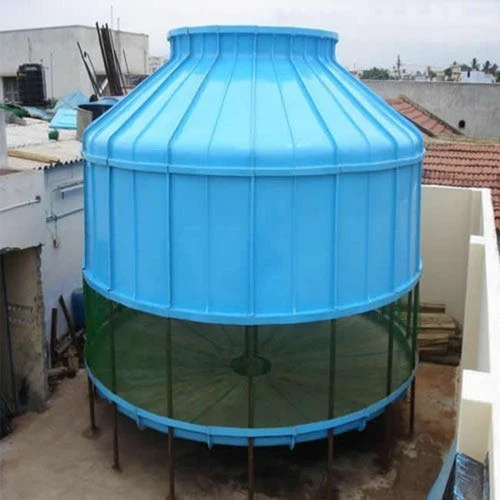
Round Cooling Towers, also referred to as bottle-type cooling towers, are compact, energy-efficient systems used to reject heat from various industrial processes and HVAC systems. Their effectiveness lies not just in their aerodynamic design or rotary sprinkler mechanism, but in the materials used in their construction. Each component is made from a material selected for its durability, corrosion resistance, thermal behavior, and maintenance profile, all of which are critical for long-term performance in harsh operating conditions. Whether the cooling tower is placed on a rooftop in a dusty city or in a coastal, high-humidity zone, the choice of materials plays a vital role in determining operational efficiency and total cost of ownership.
FRP (Fiberglass Reinforced Plastic) – Tower Casing / Structure
Function: Forms the external shell and main body of the tower.
Why FRP is Ideal:
- FRP is a composite material made of glass fiber and thermoset resin.
- It is non-corrosive, highly UV-resistant, and lightweight yet strong.
- The casing can withstand high temperatures and aggressive environments, making it suitable for both indoor and outdoor installations.
- Unlike metal, FRP does not rust or flake, which drastically reduces maintenance.
Unique Characteristics:
- Can be molded into aerodynamic bottle shapes with ease.
- Offers electrical insulation, making it safer in high-voltage industrial environments.
- Modern FRP casings are coated with UV-stabilized gel coats that maintain color and structural integrity for 10+ years, even under continuous sun exposure.
PVC or PP (Polypropylene) – Fill Media
Function: Acts as the heat exchange surface between water and air.
Why PVC or PP?
- These polymers offer high thermal resistance, are chemically inert, and do not corrode or scale easily.
- PVC is more common due to its cost-effectiveness, while PP is chosen for high-temperature applications (above 60°C).
- Both materials can be formed into honeycomb or corrugated structures that maximize surface area for evaporative cooling.
Unique Engineering Details:
- Modern fills come with anti-scaling, anti-fouling, or algae-resistant coatings.
- High-performance fills are also designed for low pressure drop, reducing fan load and saving energy.
Galvanized Steel / Stainless Steel – Fasteners, Frames, Supports
Function: Structural support, flanges, hardware joints, pipe fittings.
Material Usage:
- Hot-dip galvanized steel is used for its affordability and corrosion protection through zinc coating.
- Stainless Steel (304/316) is chosen for high-end applications where acidic fumes, salty air, or chemical leaks are common.
Advanced Insights:
- In environments with electrochemical activity, fasteners are coated with nylon or PTFE sleeves to prevent galvanic corrosion.
UV-Stabilized ABS or FRP – Fan Blades
Function: Pulls air upward through the fill for heat rejection.
Why These Materials?
- ABS (Acrylonitrile Butadiene Styrene) is light, impact-resistant, and cost-efficient for fan blade construction.
- FRP fan blades are becoming more popular due to their strength-to-weight ratio, quiet operation, and long life.
Unique Design Features:
- Fan blades are designed with aerodynamic curvature to reduce energy consumption.
- Balancing is critical; some are factory-balanced to minimize vibration, increasing motor lifespan.
Specialty Materials for Niche Applications
For industries with critical operational needs, round cooling towers may include specialized materials:
- Titanium / Cupronickel inserts for seawater applications
- Antibacterial-treated PVC fills for pharma or food industries
- Fire-retardant FRP compounds for towers installed in hazardous environments
- Electrostatic discharge-safe coatings for electronics or cleanroom setups
- Double-wall FRP casing for thermal insulation in extreme climates
The efficiency and reliability of a round cooling tower don’t come from design alone—it’s the intelligent selection of materials that make it robust, safe, and low-maintenance over years of operation. Whether facing harsh sun, aggressive chemicals, or fluctuating temperatures, each material serves a purpose—balancing cost, weight, strength, resistance, and thermal behavior.
For industries looking for long-term performance with minimal downtime, choosing the right material configuration is as important as selecting the right capacity or model. In short, the round cooling tower is a masterclass in materials engineering, fine-tuned for rugged industrial use.