
The heart of cooling performance in any wooden cooling tower lies in how efficiently the hot process water is distributed across the fill media. If the water doesn’t cover the fill area uniformly, the cooling effect suffers—no matter how powerful the fan or how effective the fill material is.
In wooden cooling towers, which are widely used in industries like thermal power generation, sugar processing, paper mills, chemical plants, and steel manufacturing, the water distribution system must be engineered to balance flow rate, spray coverage, nozzle spacing, and droplet size. These factors ensure that every inch of the fill receives sufficient water for effective evaporative heat transfer.
This blog provides an in-depth look into the design principles, components, materials, and best practices associated with water distribution in wooden cooling towers, aiming to help engineers and operators optimize performance and reliability.
Importance of Water Distribution in Wooden Cooling Towers
A cooling tower functions by allowing hot water from industrial processes to flow over fill media, where it is cooled by ambient air. This heat rejection process is only efficient when the hot water is:
- Evenly sprayed across the fill
- Delivered in consistent droplet size
- Distributed at the correct pressure and height
Poor water distribution leads to:
- Reduced thermal performance
- Uneven temperature at the outlet
- Overburdened fans due to irregular air resistance
- Dry fill sections that remain underutilized
- Higher energy and water consumption
Water Distribution System Design in Wooden Towers
Gravity-Pressure Hybrid Systems
Most wooden cooling towers use a gravity-assisted pressure system, where water from the hot water basin is:
- Pumped into a central header pipe
- Divided into branch lines with multiple nozzles
- Sprayed evenly over the fill area
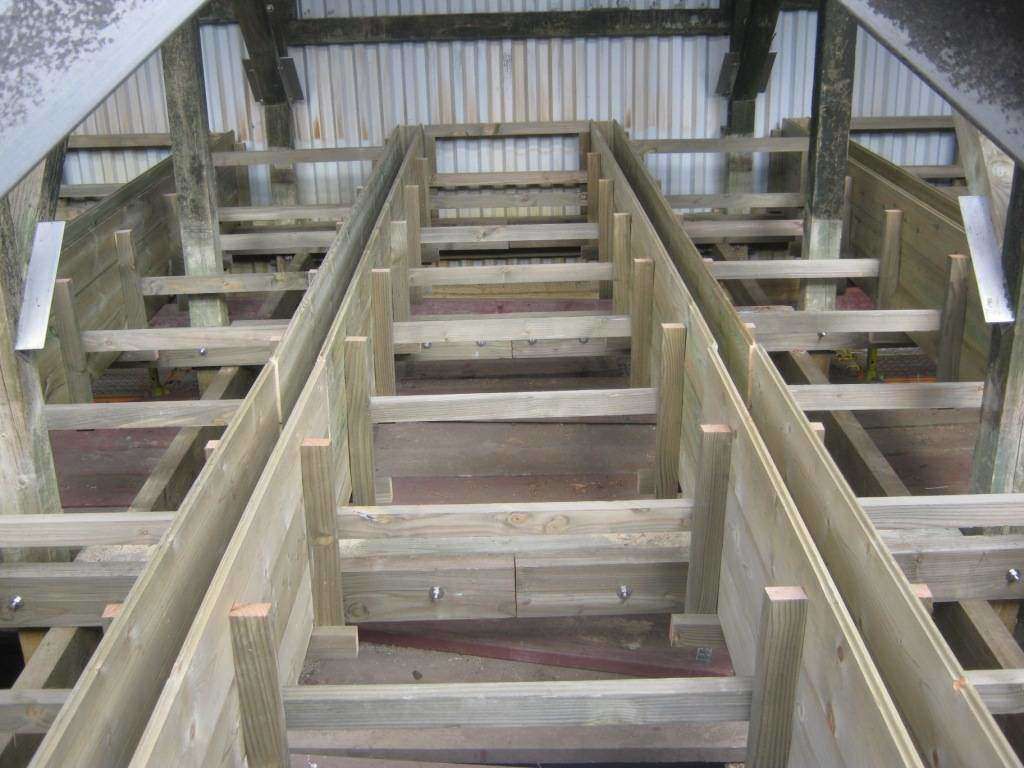
The piping is installed above the fill and supported on wooden or FRP frames, keeping the system structurally aligned with the tower body.
Key Components of the Water Distribution System
Main Header (Central Pipe)
- Carries hot water from the external pump
- Typically runs across the center or side of the tower
- Constructed from GI, SS, or PVC
Lateral Branch Pipes
- Extend perpendicularly from the main pipe
- Carry multiple nozzles
- Proper spacing ensures full coverage
Nozzles or Sprinklers
- Convert high-pressure water into droplets or fine sprays
- Installed at intervals to ensure overlap and uniformity
- Can be fixed or adjustable
Types of Spray Nozzles Used in Wooden Cooling Towers
| Nozzle Type | Spray Pattern | Benefits | Ideal Conditions |
|---|---|---|---|
| Spiral Nozzle | Hollow cone | Self-cleaning, good for moderate-fouling water | Thermal & sugar plants |
| Target Nozzle | Circular or umbrella | Low pressure drop, easy to replace | General industrial use |
| Fan Nozzle | Flat, wide spray | Even coverage, minimal drift | Chemical & process industries |
| PVC Snap-On | Adjustable cone | Easy maintenance, corrosion-free | Coastal & humid climates |
Material Choices for Distribution System
The materials used must resist corrosion, chemical attack, and biological fouling. Common materials include:
- GI (Galvanized Iron): Traditional, low cost, good for dry environments
- SS (Stainless Steel): High strength, corrosion-proof, long-lasting
- PVC / uPVC: Lightweight, easy to install, resistant to scaling and algae
- FRP (for support frames): Non-metallic, strong, non-conductive
Wooden cooling towers naturally allow flexibility for these materials due to custom-fit timber framing.
Key Engineering Parameters
| Parameter | Recommended Range |
|---|---|
| Nozzle Pressure | 0.7 to 1.5 kg/cm² |
| Spray Coverage per Nozzle | 0.25 m² to 1 m² |
| Nozzle Height from Fill | 200 to 500 mm |
| Flow per Nozzle | 5 to 15 L/min |
| Total Spray Flow Rate | Matches hot water inflow (Q = m × Cp × ΔT) |
Performance Benefits of Effective Water Distribution
- Enhanced Cooling Efficiency Ensures full use of fill area, improving heat rejection.
- Water Conservation Reduces need for make-up water by minimizing splash-out and drift.
- Lower Fan Power Consumption Even distribution results in uniform air resistance, reducing fan load.
- Prolonged Fill and Eliminator Life Avoids dry spots and thermal shocks that degrade materials.
- Better Outlet Temperature Control Ensures consistent process water for downstream systems.
Maintenance Best Practices
- Flush all nozzles quarterly to prevent clogging
- Check for scale buildup, algae, or nozzle wear
- Ensure all nozzles are pointed correctly and secured firmly
- Use pre-filters at pump inlet to trap debris
- Perform a spray test annually to verify coverage uniformity
- Re-align pipes if structural shifts occur in wooden frame
When Should the Distribution System Be Upgraded?
- Visible dry fill areas or water bypass
- High makeup water usage due to inefficiency
- Temperature spikes at the tower outlet
- Rust or corrosion on pipe branches
- Frequent pump cavitation due to uneven flow
- High drift despite eliminators (indicates poor droplet size control)
In wooden cooling towers, the water distribution system is the gateway to performance. Even with premium fans, drift eliminators, and fill, a weak water distribution setup will undermine all other components.
By designing for optimal flow, correct pressure, and full spray coverage, and using durable materials and efficient nozzles, you ensure that every droplet counts toward cooling efficiency, resource savings, and long-term reliability.