
To create high-ranking SEO content for a central AC chiller page, you need to target a mix of high-intent transactional keywords (for B2B buyers, facility managers, or engineers) and clear, problem-solving informational headers.
Here is a ready-to-use, optimized content blueprint that balances readability, technical authority, and search engine optimization.
Maximize Efficiency: The Ultimate Guide to Central AC Chillers
When it comes to cooling large-scale commercial spaces, industrial plants, or massive residential complexes, standard air conditioning units simply won’t cut it. You need a system built for high-capacity demands. That is where a central AC chiller comes in.
As the backbone of large-scale HVAC systems, central chillers offer unmatched cooling power, energy efficiency, and long-term cost savings. Let’s dive into how they work, the different types available, and how to choose the right one for your facility.
What is a Central AC Chiller?
A central AC chiller is a cooling system that removes heat from a liquid (usually water or a water-glycol mixture) via a vapor-compression or absorption refrigeration cycle.
Unlike traditional split ACs that cool air directly using refrigerant, a chiller cools water first. This chilled water is then pumped through pipes to Air Handling Units (AHUs) or Fan Coil Units (FCUs) distributed throughout the building to cool the indoor air.
How Does a Central Chiller System Work?
Central chillers operate on a continuous loop consisting of four primary components: the evaporator, compressor, condenser, and expansion valve.
- Heat Absorption: Warm water returning from the building enters the evaporator, where its heat is transferred to a cold liquid refrigerant, causing the refrigerant to evaporate into a gas.
- Compression: The low-pressure refrigerant gas travels to the compressor, which raises its pressure and temperature.
- Heat Rejection: The hot gas moves to the condenser, where it releases its heat to either the outdoor air or a separate cooling tower water loop, turning back into a liquid.
- Expansion: The high-pressure liquid passes through the expansion valve, dropping its pressure and temperature before restarting the cycle.
Air-Cooled vs. Water-Cooled Chillers: Which is Best?
Choosing the right central AC chiller depends heavily on your architectural constraints, water availability, and efficiency goals.
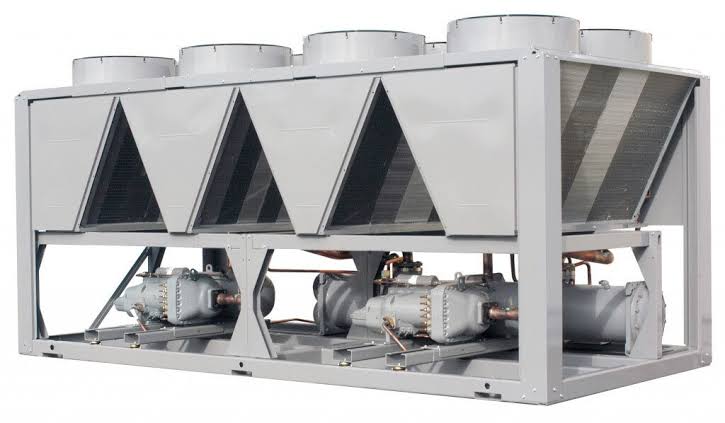
1. Air-Cooled Chillers
Air-cooled chillers use ambient air to reject heat from the condenser using mechanical fans.
- Best For: Small to medium commercial buildings, areas with water scarcity, or facilities wanting low maintenance.
- Pros: Lower initial cost, no need for cooling towers or water pumps, easier installation, saves physical space.
- Cons: Less energy-efficient than water-cooled models, shorter lifespan due to outdoor exposure.
2. Water-Cooled Chillers
Water-cooled chillers use water from an external cooling tower to absorb heat from the condenser.
- Best For: Large commercial high-rises, industrial manufacturing plants, data centers, and facilities requiring massive cooling loads.
- Pros: Exceptionally high energy efficiency, longer operational lifespan, quieter indoor operation.
- Cons: Higher upfront cost, requires continuous water supply and chemical water treatment, requires more maintenance.
Key Benefits of Upgrading to an Efficient Central Chiller
Investing in a modern, high-efficiency central AC chiller offers significant advantages for facility managers:
- Drastic Energy Savings: Modern chillers utilize Variable Speed Drives (VSDs) and advanced magnetic-bearing compressors to dynamically match part-load demands, cutting energy consumption by up to 30-40%.
- Zoned Temperature Control: Because chillers route water rather than air over long distances, they allow precise, independent temperature control across different zones or floors of a building.
- Environmental Compliance: Newer systems utilize eco-friendly, low-GWP (Global Warming Potential) refrigerants that comply with modern environmental regulations.
- Scalability and Reliability: Industrial-grade central chillers are built for redundancy and long-term durability, ensuring your operations never suffer from unexpected downtime.
Frequently Asked Questions (FAQs)
What is the lifespan of a commercial central chiller?
With routine preventative maintenance, a water-cooled chiller can last 20 to 25 years, while an air-cooled chiller typically lasts 15 to 20 years.
How do I calculate the chiller capacity needed for my building?
Chiller capacity is measured in Tons of Refrigeration (TR). A rough estimate requires calculating the building’s total square footage, insulation quality, occupancy, and heat-generating equipment. Consult an HVAC engineer to perform a precise Manual N load calculation before purchasing.
What maintenance does a central AC chiller require?
To maintain peak efficiency, systems require regular tube cleaning (to prevent scaling), refrigerant leak checks, compressor oil analysis, and water treatment testing for cooling towers.