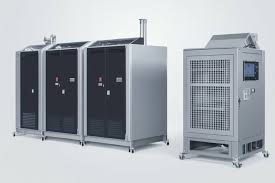

Flexo Printing Chillers: Precision Cooling for High-Speed Packaging
In the fast-paced world of flexographic printing, heat is a constant challenge. High-speed central impression (CI) drums, friction from rollers, and high-intensity UV curing systems all generate significant thermal energy. A flexo printing chiller is an essential piece of equipment that stabilizes these temperatures, ensuring that your colors stay sharp, your substrates stay flat, and your production lines stay profitable.
Whether you are printing on flexible films, corrugated board, or labels, a dedicated chiller is the key to maintaining the high-quality standards that modern packaging clients demand.
Why Temperature Control is Vital for Flexography
Flexographic printing relies on a delicate balance of pressure and chemistry. Heat disrupts this balance in several ways:
- Substrate Protection: Flexible films (like PE or BOPP) are heat-sensitive. Excessive heat from the central drum or UV lamps can cause the material to stretch or warp, leading to poor registration and wasted material.
- Ink Viscosity Management: Heat thins out flexo inks, causing “dot gain” and color inconsistency. A chiller maintains the ink at its optimal temperature for perfect transfer and vibrant results.
- Central Impression (CI) Drum Stability: Large CI drums must remain at a constant temperature to prevent thermal expansion. If the drum expands even slightly, it can throw off the registration of a 10-color job.
- UV/LED Curing Longevity: Chillers dissipate the intense heat from curing lamps, protecting the lamp heads from burnout and preventing the heat from transferring to the substrate.
Key Applications in the Flexo Process
| Feature | Function of the Chiller | The Benefit |
| CI Drum Cooling | Maintains a stable drum surface temperature | Ensures perfect registration on multi-color runs. |
| Anilox Roller Cooling | Regulates the temperature of the ink delivery | Provides consistent ink volume and density. |
| UV/LED Curing | Cools the lamp housing and power supplies | Extends lamp life and prevents film deformation. |
| After-Coolers | Chills the web before it reaches the rewinder | Prevents “blocking” (ink sticking) in the finished roll. |
Must-Have Features for Flexo Chillers
To keep up with a 24/7 packaging facility, a chiller needs to be more than just a standard air conditioner. High-performance flexo chillers offer:
- Ultra-Precise PID Controls: Maintaining temperatures within $\pm 0.1^{\circ}C$ to $\pm 0.5^{\circ}C$ to guarantee process repeatability.
- Dual-Circuit Systems: Many units can provide two different temperatures—one for the CI drum and another for the UV curing system—from a single compact footprint.
- Corrosion-Resistant Circuits: Designed to handle the water-glycol mixtures and additives often used in industrial printing environments.
- Smart Integration: Compatibility with Modbus or Profibus allows the chiller to communicate directly with the printing press for automated temperature adjustments.
The Business Case for Precision Cooling
- Reduce Scrap & Waste: By eliminating registration errors and substrate warping, you save thousands in raw material costs every month.
- Maximize Press Speeds: When you control the heat, you can run your press at its maximum rated speed without risking quality issues.
- Consistent Brand Colors: Ensure that the brand colors you print in the morning match exactly with what you print at midnight.
- Lower Maintenance Downtime: Keeping critical components cool reduces the wear and tear on motors, bearings, and expensive UV lamps.
Summary
A flexo printing chiller is an investment in consistency. In a market where packaging quality is a major brand differentiator, having total control over your thermal environment gives you a significant competitive edge.