
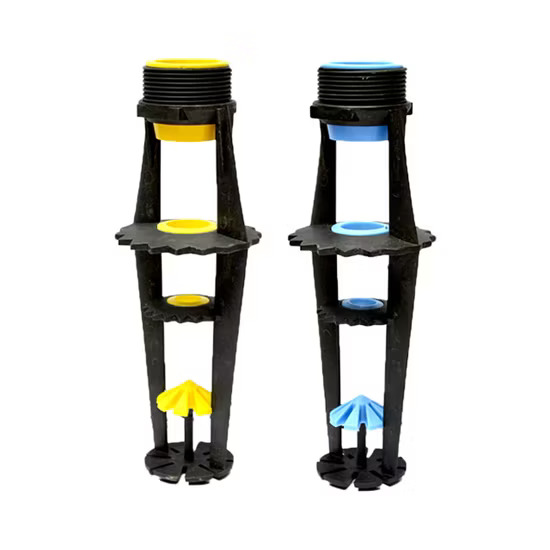
Precision Water Distribution for Maximum Thermal Efficiency
In the performance of round type cooling towers—also known as bottle-type FRP cooling towers—one small component has a big impact: the nozzle system. Though often overlooked, nozzles are the entry point of hot water into the cooling process and are central to ensuring even water distribution, preventing hotspots, and optimizing evaporative heat transfer.
This post explores the design, material, working principles, and impact of cooling tower nozzles, with a specific focus on round cooling tower applications.
What Are Cooling Tower Nozzles?
A cooling tower nozzle is a precision-designed component that sprays or distributes hot process water evenly over the fill media. In round type towers, these nozzles are typically connected to a rotary sprinkler system that spins from the water pressure itself, spreading water uniformly in a 360° arc.
Why Nozzle Design Matters in Round Cooling Towers
- Ensures even wetting of fill media
- Prevents dry patches and localized inefficiency
- Maximizes surface contact area between air and water
- Reduces scaling, clogging, and fouling risks
- Improves overall cooling efficiency and tower lifespan
Types of Nozzles Used in Round Cooling Towers
Single Inlet Rotary Spray Nozzles
- Found in almost all round cooling towers.
- These nozzles are fixed to the rotary sprinkler arm and spray water in a wide cone as the arm rotates.
Benefits:
- Uniform coverage
- Low maintenance
- Self-cleaning via water pressure
Fixed Cone Nozzles
- These nozzles are stationary and often used in custom-designed round towers.
Benefits:
- Precise spray pattern
- Ideal for controlled flow rate systems
- Can be made from materials resistant to chemical fouling
Full Cone & Hollow Cone Nozzles
- These generate circular spray patterns.
- Available in 90°, 120°, and 180° spray angles depending on system design.
Key Design Considerations
Spray Angle
- Impacts coverage area of water spray
- For round towers, wide angles (90–120°) are preferred for full basin coverage
Orifice Size
- Affects flow rate and droplet size
- Adjustable orifices allow control for fine or coarse sprays
Flow Rate
- Nozzles must match the water flow rate of the process system
- Proper sizing ensures balanced water pressure and consistent coverage
Materials Used in Cooling Tower Nozzles
| Material | Suitable For | Benefits |
|---|---|---|
| Nylon | Standard towers with clean water | Lightweight, cost-effective |
| ABS | Industrial use in medium-temperature zones | Durable, UV-resistant |
| FRP | Corrosive or coastal environments | Non-corrosive, long-lasting |
| Brass | High-pressure or chemical industries | Precision casting, long life |
| PP (Polypropylene) | Harsh water conditions | Resistant to scaling, chemical attacks |
Working Principle of Rotary Nozzle System in Round Cooling Towers
- Hot water enters the rotary sprinkler through the central inlet.
- Water pressure spins the arms of the sprinkler.
- Nozzles attached to the arms spray water downward in a circular pattern.
- Water lands uniformly on the fill media for maximum evaporative cooling.
Maintenance Tips for Cooling Tower Nozzles
- Check for clogging or debris monthly
- Clean orifice openings with a soft brush or compressed air
- Ensure nozzle spray pattern is not distorted or restricted
- Replace cracked or deformed nozzles immediately
- Avoid using metal rods or wires to clean—this can damage nozzle shape
Though small in size, nozzle systems in round cooling towers play a critical role in determining how efficiently your tower cools process water. A well-designed and properly maintained nozzle ensures:
- Uniform water spread
- Efficient evaporative heat rejection
- Lower operational costs
- Longer fill and tower life
When upgrading or servicing a cooling tower, don’t overlook the nozzles—they’re essential to both performance and water conservation.