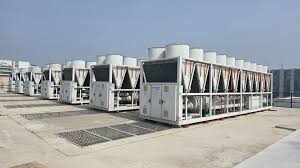
Data Center Chillers: The Heart of Mission-Critical Cooling
In the world of high-density computing, heat is the ultimate enemy. As servers become more powerful, the thermal load within a facility can skyrocket in minutes. A Data Center Chiller is the primary line of defense, providing the massive cooling capacity required to keep “the cloud” from overheating.
Without a robust chilled water system, even the most advanced data center risks hardware failure, data loss, and catastrophic downtime.
The Critical Role of Chillers in Data Centers
Unlike standard office air conditioning, data center chillers are engineered for 24/7/365 operation. They are designed to manage the constant, high-intensity heat generated by thousands of CPUs and GPUs.
- Maintaining Uptime: Data centers operate on strict Service Level Agreements (SLAs). Chillers ensure the environment stays within ASHRAE-recommended thermal envelopes.
- Improving PUE: Power Usage Effectiveness (PUE) is the gold standard for data center efficiency. Modern chillers use variable speed drives (VSDs) and “free cooling” to lower energy consumption.
- Scaling with Density: As rack densities move from 10kW to 50kW and beyond, liquid-to-liquid cooling—driven by industrial chillers—is becoming the only viable solution.
Modern Cooling Technologies for Data Centers
To balance the need for extreme cooling with the push for sustainability, data centers utilize several specialized chiller configurations:
1. Air-Cooled Chillers with Free Cooling
These units use ambient outdoor air to cool the water loop. When temperatures drop in winter or at night, the compressor turns off, and the system uses “integrated free cooling” to save up to 80% on energy costs.
2. Water-Cooled Central Plants
Typically found in massive hyperscale facilities, these systems connect chillers to external cooling towers. They offer the highest possible efficiency (kW/ton) but require significant water infrastructure.
3. Oil-Free Centrifugal Chillers
Utilizing magnetic levitation (MagLev) bearings, these chillers eliminate friction and the need for oil lubrication. This results in ultra-quiet operation and significantly lower maintenance costs over the system’s life.
Key Requirements for Data Center Cooling
| Feature | Importance |
|---|---|
| Rapid Restart | Essential for regaining cooling quickly after a power flicker or generator transition. |
| Redundancy (N+1 or 2N) | Ensures that if one chiller fails, the backup units can carry the full thermal load. |
| High Leaving Water Temps | Modern servers can tolerate warmer water, allowing chillers to operate more efficiently. |
| Harmonic Filtration | Protects the chiller’s electronics from the electrical “noise” common in data centers. |
Export to Sheets
Sustainable Cooling: The Future of the Data Center
As environmental regulations tighten, the industry is moving toward Low-GWP (Global Warming Potential) Refrigerants like R-1234ze. Additionally, many modern designs utilize “Waste Heat Recovery,” taking the heat rejected by the chiller and repurposing it to warm nearby office buildings or greenhouses.
Summary: Reliability by Design
Choosing a Data Center Chiller is a high-stakes decision. The right system doesn’t just keep servers cool; it optimizes your entire facility’s energy profile and ensures your digital services remain online, no matter how high the heat index climbs.
Are you designing a new facility or retrofitting an existing Tier III data center? Finding the right balance between peak capacity and annual efficiency is the key to a successful cooling strategy.