
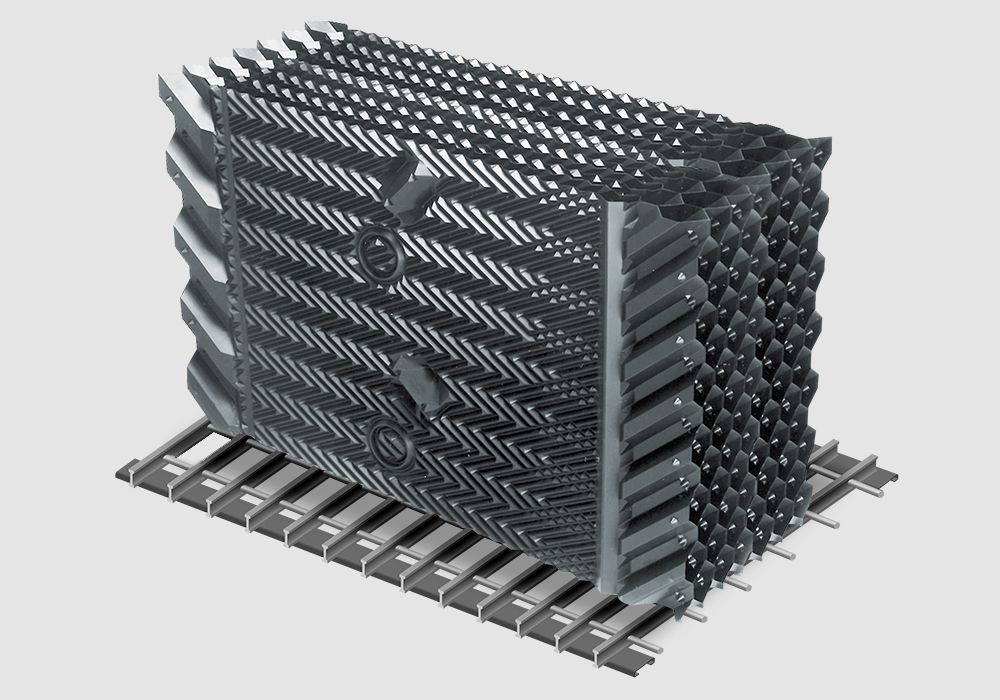
In crossflow cooling towers, the fill media is not just an internal accessory — it is the core thermal component that enables the tower to perform effective evaporative cooling. While the fan system pulls air through the tower, it is the fill that maximizes contact between water and air, enabling efficient heat transfer and cooling.
Whether you’re operating an industrial facility, commercial HVAC system, or a power plant, understanding how fill media works—and how to choose and maintain it—can lead to enhanced cooling performance, lower energy use, and extended equipment life.
In this blog post, we’ll cover:
- The types of fill media used in crossflow cooling towers
- Their working mechanism and material choices
- Key performance benefits
- Maintenance tips
- Why proper fill selection is vital to your tower’s efficiency and sustainability
What Is Fill Media in a Crossflow Cooling Tower?
Fill media is a structured surface installed inside the tower, just below the hot water distribution basin and across the path of incoming air. It breaks down the water flow into thin films or droplets, increasing its surface area and air contact time. This promotes evaporation, which is the primary method of cooling in a tower.
In crossflow towers, water flows vertically through the fill due to gravity, while air flows horizontally across it. This cross-pattern ensures effective cooling with low air resistance and uniform water distribution.
Types of Fill Media in Crossflow Towers
Film Fill
Description:
Thin sheets of material arranged in closely spaced, corrugated layers. Water forms a thin film as it travels down the sheet surface.
Materials:
- PVC (Polyvinyl Chloride)
- Polypropylene (PP)
- ABS (Acrylonitrile Butadiene Styrene)
Applications:
- Ideal for clean water systems (HVAC, power plants)
- High thermal performance with minimal space
Benefits:
- High surface contact area
- Greater thermal efficiency
- Lower space requirements
Splash Fill
Description:
Series of grids, slats, or bars over which water “splashes” as it falls, breaking into droplets and increasing air exposure.
Materials:
- Wood
- PVC
- Polypropylene
- Stainless steel (in corrosive environments)
Applications:
- Excellent for dirty or scaling water
- Used in steel plants, chemical processing, and dusty industrial environments
Benefits:
- Less prone to clogging
- Long life in challenging water conditions
- Easy to clean and replace
How Fill Media Works: The Science of Evaporative Cooling
- Hot process water enters the tower through the distribution basin and flows downward.
- The fill media breaks the water into thin films or droplets, depending on type.
- Ambient air enters horizontally through louvers and passes across the water-covered fill.
- The interaction causes a small portion of the water to evaporate, absorbing heat from the rest of the water.
- This latent heat loss cools the water, which is then collected in the cold water basin and returned to the system.
This evaporative process is extremely efficient — even 1–2% of water loss by evaporation can reduce water temperature by up to 10–15°C, depending on the wet bulb temperature.
Key Benefits of Efficient Fill Media
Improved Thermal Performance
- Provides large surface area for heat exchange
- Maximizes evaporation rate
- Delivers lower approach temperature (closer to ambient wet bulb)
Energy Efficiency
- Higher evaporation = less pumping and fan power
- Works well with low fan speeds in crossflow systems
- Enables towers to operate under variable loads without performance drop
Ease of Installation & Maintenance
- Modular design enables quick assembly
- Easy to clean or replace in case of scaling or fouling
- Splash fill is less prone to biological growth in dirty water
The fill media is the thermal engine of a crossflow cooling tower. It’s the component where real cooling happens—converting hot process water into usable, lower-temperature water through evaporative action.
When engineered and maintained properly, quality fill media delivers:
- Higher heat rejection per cubic meter
- Lower energy use per ton of cooling
- Extended cooling tower life
- Better water conservation
- Increased equipment uptime and efficiency
Choosing the right type of fill, made from the right material, tailored to your water quality and cooling demand, can reduce operational costs by up to 20–30% annually.
Fill media may be out of sight, but it should never be out of mind. It’s the hidden hero that determines whether your tower performs like a champion — or struggles under load.